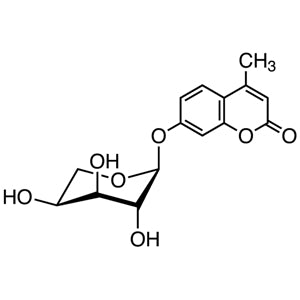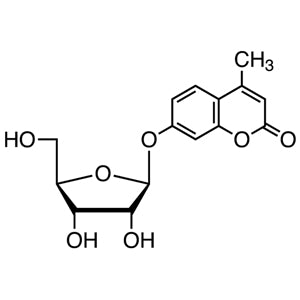
TCI M3027, CAS 195385-93-4, is 4-Methylumbelliferyl beta-D-Ribofuranoside, a fluorogenic substrate that links a ribose unit in its furanose ring form to 4-methylumbelliferone through a beta-glycosidic bond. The compound is prepared for detecting and measuring the activity of enzymes capable of hydrolysing ribofuranoside linkages, including ribosidases and nucleoside hydrolases. When that bond is cleaved, the fluorescent coumarin is released and generates a fluorescence signal that can be read quantitatively, giving researchers a direct way to follow enzyme action without requiring chromatographic separation.
The property that makes this material valuable is its availability as a ribofuranoside substrate, which is uncommon compared with the widely supplied pyranose glycosides. The five-membered furanose ring has a geometry and reactivity distinct from the pyranose ring, so this substrate opens up the study of enzymes that no other substrate can represent. Its fluorometric sensitivity allows very low enzyme activities to be measured, a situation that is common when researchers work with newly isolated enzymes or with recombinant proteins produced at limited expression yields. The solid form supplied allows the user to prepare working solutions at the concentration each assay requires.
In Indonesian laboratories, this substrate is used in academic and institutional research settings where enzyme characterisation work is carried out, including university biochemistry groups, glycoscience research units and laboratories studying carbohydrate-active enzymes. It suits workflows built around fluorescence microplate readers and fluorometers, which are standard instruments in such facilities. Because the assay avoids chromatographic separation, it fits research programmes that need reliable enzyme activity data without committing dedicated separation instrumentation to every measurement.
TCI brochures (PDF)
- Reagents for Biological Research 2025-03-11 · p. 22
Related TCI products
- TCI M3030 37067-30-4 4-Methylumbelliferyl 2-Acetamido-2-deoxy-beta-D-glucopyranoside
- TCI M3029 36476-29-6 4-Methylumbelliferyl 2-Acetamido-2-deoxy-beta-D-galactopyranoside
- TCI M3026 881005-91-0 4-Methylumbelliferyl beta-D-Glucuronide Hydrate
- TCI M3025 69414-26-2 4-Methylumbelliferyl alpha-L-Arabinopyranoside
- TCI M3023 28541-83-5 4-Methylumbelliferyl alpha-D-Mannopyranoside
- TCI M3022 18997-57-4 4-Methylumbelliferyl beta-D-Glucopyranoside
- Ribosidase activity assay — the beta-ribofuranoside bond is cleaved by these enzymes, releasing fluorescent 4-methylumbelliferone that reports activity directly and quantitatively in a single reaction mixture.
- Nucleoside hydrolase characterisation — this substrate presents the furanose ring configuration these enzymes act upon, making it suitable for kinetic study where pyranose glycosides would give no meaningful signal.
- Screening newly isolated enzymes — the fluorometric readout detects very low activity levels, so candidate enzymes from environmental isolates or culture collections can be evaluated before scale-up.
- Recombinant protein activity confirmation — limited expression yields still give measurable fluorescence, letting researchers verify that an expressed construct is catalytically functional rather than merely present.
- Glycoscience research on furanose-specific enzymes — the five-membered ring geometry differs from pyranose substrates, allowing study of enzyme specificity that no pyranose glycoside substrate can address.
| Brand | TCI |
|---|---|
| CAS number | 195385-93-4 |
| Molecular formula | — |
| Purity | — |
| Category | Chemistry > Chemical Biology > Glycoscience |
| Pack sizes | available in the catalogue pack sizes offered for this item |
| Physical form | solid |
| Storage | keep in the closed original container under the conditions stated on the manufacturer label |
- Chemical name: 4-Methylumbelliferyl beta-D-Ribofuranoside
Store the material in its original closed container in a cool, dry place away from direct light, following the storage conditions printed on the manufacturer label and safety data sheet. Fluorogenic coumarin substrates are generally protected from prolonged light exposure to preserve assay performance. Use clean, dry spatulas and amber glass or suitable plastic vials when transferring or preparing stock solutions, and allow the closed container to reach room temperature before opening to limit moisture condensation. Handle in a well-ventilated area or fume hood, wearing gloves, safety glasses and a laboratory coat. Label all prepared solutions clearly with the compound name, concentration and preparation date, and dispose of residues and contaminated consumables in accordance with the institution's chemical waste procedures.
—
Product Categories
Produk Terkait
-
4-Methylumbelliferyl2-Acetamido-2-deoxy-beta-D-glucopyranoside TCI M3030
Regular price From Rp 2.439.150,00Regular price -
4-Methylumbelliferyl2-Acetamido-2-deoxy-beta-D-galactopyranoside TCI M3029
Regular price From Rp 3.180.450,00Regular price -
4-Methylumbelliferylbeta-D-GlucuronideHydrate TCI M3026
Regular price From Rp 1.565.550,00Regular price -
4-Methylumbelliferylalpha-L-Arabinopyranoside TCI M3025
Regular price From Rp 1.353.450,00Regular price -
4-Methylumbelliferylalpha-D-Mannopyranoside TCI M3023
Regular price From Rp 1.829.100,00Regular price -
4-Methylumbelliferylbeta-D-Glucopyranoside TCI M3022
Regular price From Rp 1.008.000,00Regular price -
Methyl2,3-O-Isopropylidene-beta-D-ribofuranoside TCI M3528
Regular price From Rp 769.650,00Regular price -
Methylbeta-D-Ribofuranoside TCI M1965
Regular price From Rp 2.227.050,00Regular price