

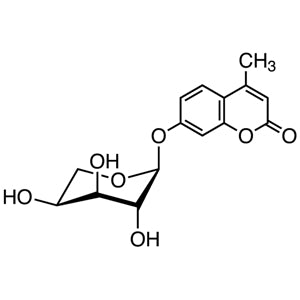
TCI M3025, CAS 69414-26-2, is 4-Methylumbelliferyl alpha-L-Arabinopyranoside, a fluorogenic substrate used to measure the activity of alpha-L-arabinosidase enzymes. The compound links an arabinose sugar unit in the alpha-L configuration to 4-methylumbelliferone. When an enzyme cleaves the glycosidic bond, a fluorescent coumarin is released, allowing enzyme activity to be followed fluorometrically. Substrates of this kind are essential tools for researchers studying hemicellulose breakdown, particularly the arabinose side chains attached to the arabinoxylan and arabinan backbones of plant cell walls.
The characteristics that make this substrate a preferred choice are its high detection sensitivity and the clarity of the results it produces. Arabinosidase enzymes are often present in only small amounts within lignocellulolytic enzyme mixtures, and ordinary chromogenic substrates are frequently not sensitive enough to detect them. The fluorogenic format overcomes that limitation by delivering a strong signal even at low activity levels. The specificity of the alpha-L configuration ensures that only the corresponding enzyme reacts, so results are not confounded by other glycosidase activities present in the sample.
In Indonesian laboratories, this substrate fits naturally into work on plant biomass and enzyme characterization, where arabinose-releasing activities are routinely assayed. Its stable powder form makes it straightforward to handle in academic research groups, biotechnology institutes, and industrial enzyme laboratories, where stock solutions are prepared as needed and the remaining material is returned to storage between experiments.
TCI brochures (PDF)
- Reagents for Biological Research 2025-03-11 · p. 22
Related TCI products
- TCI M3023 28541-83-5 4-Methylumbelliferyl alpha-D-Mannopyranoside
- TCI M3030 37067-30-4 4-Methylumbelliferyl 2-Acetamido-2-deoxy-beta-D-glucopyranoside
- TCI M3029 36476-29-6 4-Methylumbelliferyl 2-Acetamido-2-deoxy-beta-D-galactopyranoside
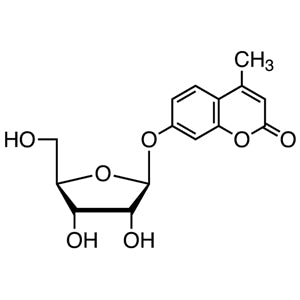
- TCI M3027 195385-93-4 4-Methylumbelliferyl beta-D-Ribofuranoside
- TCI M3026 881005-91-0 4-Methylumbelliferyl beta-D-Glucuronide Hydrate
- TCI M3022 18997-57-4 4-Methylumbelliferyl beta-D-Glucopyranoside
- Alpha-L-arabinosidase activity assays — the fluorogenic release of 4-methylumbelliferone gives a direct, quantitative readout of enzyme activity that is far easier to measure than colorimetric alternatives at low concentrations.
- Hemicellulose degradation research — supports studies of how arabinose side chains are removed from arabinoxylan and arabinan backbones during the enzymatic breakdown of plant cell wall material.
- Screening of lignocellulolytic enzyme mixtures — the high sensitivity allows detection of arabinosidase components that are present only as minor constituents within complex multi-enzyme preparations.
- Enzyme specificity studies — the defined alpha-L configuration means only the matching enzyme cleaves the substrate, letting researchers distinguish arabinosidase activity from other glycosidase activities in the same sample.
- Microbial and plant enzyme characterization — suitable for profiling arabinose-releasing enzymes from culture supernatants, cell extracts, and purified fractions using standard fluorometric instrumentation.
| Brand | TCI |
|---|---|
| CAS number | 69414-26-2 |
| Molecular formula | — |
| Purity | — |
| Category | Chemistry > Chemical Biology > Glycoscience |
| Pack sizes | available in the pack sizes offered by the manufacturer; please refer to the product listing |
| Physical form | stable powder |
| Storage | — |
- Chemical name: 4-Methylumbelliferyl alpha-L-Arabinopyranoside
Store the material in its original tightly closed container under the storage conditions specified by the manufacturer on the product label, keeping it protected from moisture and from prolonged exposure to light. Amber glass or opaque containers are appropriate for prepared stock solutions, which should be clearly labelled with contents and preparation date. Handle the powder in a well-ventilated area using gloves, safety glasses, and a laboratory coat, and avoid generating dust when weighing. Use clean, dry spatulas to prevent contamination of the stock, and consult the manufacturer's safety data sheet before first use.
—
Product Categories
Produk Terkait
-
4-Methylumbelliferylalpha-D-Mannopyranoside TCI M3023
Regular price From Rp 1.829.100,00Regular price -
4-Methylumbelliferyl2-Acetamido-2-deoxy-beta-D-glucopyranoside TCI M3030
Regular price From Rp 2.439.150,00Regular price -
4-Methylumbelliferyl2-Acetamido-2-deoxy-beta-D-galactopyranoside TCI M3029
Regular price From Rp 3.180.450,00Regular price -
4-Methylumbelliferylbeta-D-Ribofuranoside TCI M3027
Regular price From Rp 4.108.650,00Regular price -
4-Methylumbelliferylbeta-D-GlucuronideHydrate TCI M3026
Regular price From Rp 1.565.550,00Regular price -
4-Methylumbelliferylbeta-D-Glucopyranoside TCI M3022
Regular price From Rp 1.008.000,00Regular price -
4-Nitrophenylalpha-D-Mannopyranoside[Substrateforalpha-Mannosidase] TCI N0619
Regular price Rp 4.902.450,00Regular price -
4-Nitrophenylalpha-D-Glucopyranoside[Substrateforalpha-D-Glucosidase] TCI N0493
Regular price From Rp 2.147.250,00Regular price




![10357-27-4 4-Nitrophenyl alpha-D-Mannopyranoside [Substrate for alpha-Mannosidase] - AMI Scientific](http://amiscientific.com/cdn/shop/files/TCI2510N0619.jpg?v=1767130142&width=533)
![3767-28-0 4-Nitrophenyl alpha-D-Glucopyranoside [Substrate for alpha-D-Glucosidase] - AMI Scientific](http://amiscientific.com/cdn/shop/files/TCI2510N0493.jpg?v=1767129938&width=533)