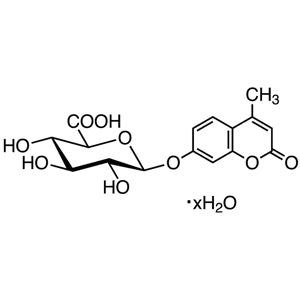
TCI M3026, with CAS number 881005-91-0, is 4-Methylumbelliferyl beta-D-Glucuronide Hydrate, a compound better known among researchers by the abbreviation MUG. It is a classic fluorogenic substrate for the enzyme beta-glucuronidase. When the enzyme hydrolyses the glucuronide bond, free 4-methylumbelliferone is released and emits a blue fluorescence that is readily visible under an ultraviolet lamp and equally measurable with a fluorometer. Because beta-glucuronidase is an important marker in *Escherichia coli* and at the same time a highly popular reporter gene in plant biotechnology, this substrate has become one of the most widely used glycoscience reagents in the laboratory.
The property that makes this material a preferred choice is that detection can be carried out both qualitatively and quantitatively using simple equipment. The fluorescence produced is strong enough to be observed directly with a handheld ultraviolet lamp, so a test for the presence of the enzyme can be run even without a plate reader. When quantification is required, fluorometric reading provides a wide linear range and a low detection limit. The hydrate form is stable under cold storage and dissolves readily in aqueous buffers, which makes preparation of working solutions straightforward for routine analytical work.
In Indonesian laboratories, this substrate is used across water microbiology units, food and beverage quality control laboratories, university research groups, and plant biotechnology facilities. Its appeal lies in the fact that a meaningful result can be obtained with modest instrumentation, which suits laboratories that do not always have access to advanced fluorescence readers. The same vial therefore serves both routine screening work and more detailed quantitative research programmes.
TCI brochures (PDF)
- Reagents for Glyco Chemistry & Biology 5th Edition · p. 51
- Reagents for Biological Research 2025-03-11 · p. 22
Related TCI products
- TCI N0618 10344-94-2 4-Nitrophenyl beta-D-Glucuronide [Substrate for beta-Glucuronidase]
- TCI M3030 37067-30-4 4-Methylumbelliferyl 2-Acetamido-2-deoxy-beta-D-glucopyranoside
- TCI M3029 36476-29-6 4-Methylumbelliferyl 2-Acetamido-2-deoxy-beta-D-galactopyranoside
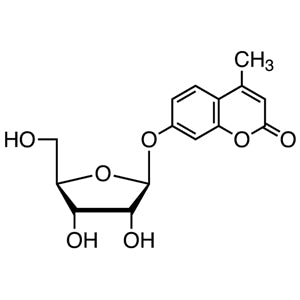
- TCI M3027 195385-93-4 4-Methylumbelliferyl beta-D-Ribofuranoside
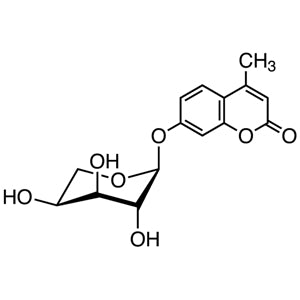
- TCI M3025 69414-26-2 4-Methylumbelliferyl alpha-L-Arabinopyranoside
- TCI M3023 28541-83-5 4-Methylumbelliferyl alpha-D-Mannopyranoside
- Detection of *Escherichia coli* in water samples, because beta-glucuronidase activity in this organism releases a blue fluorescence that confirms its presence without additional confirmatory media.
- GUS reporter gene assays in plant biotechnology, since beta-glucuronidase is a very popular reporter and this substrate gives a direct fluorescent readout of gene expression.
- Quantitative enzyme activity measurement by fluorometry, where the wide linear range and low detection limit allow small differences in beta-glucuronidase activity to be resolved reliably.
- Rapid qualitative screening under a handheld ultraviolet lamp, useful when a laboratory needs a presence or absence answer and has no fluorescence plate reader available.
- Food and beverage quality control testing, where the same fluorogenic principle supports routine microbiological screening of production samples with simple and inexpensive laboratory equipment.
| Brand | TCI |
|---|---|
| CAS number | 881005-91-0 |
| Molecular formula | — |
| Purity | — |
| Category | Chemistry > Chemical Biology > Glycoscience |
| Pack sizes | — |
| Physical form | hydrate; soluble in aqueous buffers |
| Storage | cold storage, in which the hydrate form remains stable |
- Chemical name: 4-Methylumbelliferyl beta-D-Glucuronide Hydrate
Data from the TCI brochure
| Purity | >98.0%(HPLC) |
|---|
Source: TCI brochure reagent_for_glyco_chemistry_&_biology_5th_ed ()
Store this substrate under cold conditions, as the hydrate form is stable when kept refrigerated. Keep the material in its original tightly closed container, or in a clean amber glass vial, and protect it from light and moisture, since fluorogenic substrates are sensitive to both. Allow the container to reach room temperature before opening to avoid moisture condensing on the contents. Handle the compound in a well ventilated area using standard laboratory personal protective equipment, including gloves, safety glasses, and a laboratory coat. Prepare working solutions in aqueous buffer shortly before use, label them clearly with the preparation date, and dispose of residues according to the laboratory chemical waste procedure.
—
Product Categories
Produk Terkait
-
4-Nitrophenylbeta-D-Glucuronide[Substrateforbeta-Glucuronidase] TCI N0618
Regular price Rp 1.776.600,00Regular price -
4-Methylumbelliferyl2-Acetamido-2-deoxy-beta-D-glucopyranoside TCI M3030
Regular price From Rp 2.439.150,00Regular price -
4-Methylumbelliferyl2-Acetamido-2-deoxy-beta-D-galactopyranoside TCI M3029
Regular price From Rp 3.180.450,00Regular price -
4-Methylumbelliferylbeta-D-Ribofuranoside TCI M3027
Regular price From Rp 4.108.650,00Regular price -
4-Methylumbelliferylalpha-L-Arabinopyranoside TCI M3025
Regular price From Rp 1.353.450,00Regular price -
4-Methylumbelliferylalpha-D-Mannopyranoside TCI M3023
Regular price From Rp 1.829.100,00Regular price -
4-Methylumbelliferylbeta-D-Glucopyranoside TCI M3022
Regular price From Rp 1.008.000,00Regular price -
4-Methylumbelliferylbeta-D-Cellobioside TCI M3028
Regular price From Rp 3.525.900,00Regular price
![10344-94-2 4-Nitrophenyl beta-D-Glucuronide [Substrate for beta-Glucuronidase] - AMI Scientific](http://amiscientific.com/cdn/shop/files/TCI2510N0618.jpg?v=1767130139&width=533)