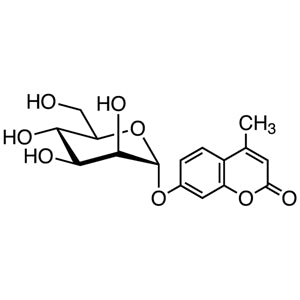
TCI M3023, CAS 28541-83-5, is 4-Methylumbelliferyl alpha-D-Mannopyranoside, a fluorogenic substrate used to measure alpha-mannosidase enzyme activity. Its molecular structure links a mannose unit through an alpha-glycosidic bond to 4-methylumbelliferone. When the enzyme cleaves that bond, the fluorescent coumarin is released and produces a fluorescence signal that can be quantified. Its principal role in the laboratory is to provide a sensitive, rapid, and easily automated means of measuring enzyme activity, whether for enzymes of microbial or plant origin or for lysosomal enzymes of interest in biomedical research.
The property that makes this substrate a preferred choice is the stereochemical specificity of the alpha-mannosidic linkage, so that it is recognised only by alpha-mannosidase and not by other glycosidases that accompany it in crude extracts. This matters when researchers must distinguish the activity of several enzymes within a single complex biological sample. Fluorometric sensitivity allows reaction volumes to be reduced to the microlitre scale, conserving precious samples, while the low background fluorescence of the intact substrate keeps the signal-to-noise ratio favourable throughout the assay.
In Indonesian laboratories, this substrate fits the work of university research groups, biochemistry and enzymology teaching laboratories, and institutional research units studying glycosidases from microbial, plant, and animal sources. It is used wherever a fluorescence plate reader or fluorometer is available and enzyme activity must be determined reliably on limited sample material, including screening work where many reactions are run in parallel on a microplate.
TCI brochures (PDF)
- Reagents for Glyco Chemistry & Biology 5th Edition · p. 59
- Reagents for Biological Research 2025-03-11 · p. 22
Related TCI products
- TCI N0619 10357-27-4 4-Nitrophenyl alpha-D-Mannopyranoside [Substrate for alpha-Mannosidase]
- TCI M3025 69414-26-2 4-Methylumbelliferyl alpha-L-Arabinopyranoside
- TCI M3030 37067-30-4 4-Methylumbelliferyl 2-Acetamido-2-deoxy-beta-D-glucopyranoside
- TCI M3029 36476-29-6 4-Methylumbelliferyl 2-Acetamido-2-deoxy-beta-D-galactopyranoside
- TCI M3027 195385-93-4 4-Methylumbelliferyl beta-D-Ribofuranoside
- TCI M3026 881005-91-0 4-Methylumbelliferyl beta-D-Glucuronide Hydrate
- Alpha-mannosidase activity assays: the alpha-glycosidic linkage is cleaved only by alpha-mannosidase, giving a direct and specific readout of that enzyme's activity in a sample.
- Microbial and plant glycosidase characterisation: the substrate lets researchers profile alpha-mannosidase from culture supernatants or plant extracts without first purifying the enzyme away from other glycosidases.
- Lysosomal enzyme research: because alpha-mannosidase is a lysosomal enzyme of biomedical interest, this fluorogenic substrate supports studies where sensitive detection of low activity levels is required.
- Microplate screening of enzyme preparations: the fluorometric signal and microlitre reaction scale make the assay easy to automate across many wells while conserving limited or valuable sample material.
- Enzymology teaching and method development: the clean fluorescence response on bond cleavage makes the substrate suitable for demonstrating glycosidase kinetics and for validating new assay protocols.
| Brand | TCI |
|---|---|
| CAS number | 28541-83-5 |
| Molecular formula | — |
| Purity | — |
| Category | Chemistry > Chemical Biology > Glycoscience |
| Pack sizes | available in standard TCI catalogue pack sizes; please confirm the size required when ordering |
| Physical form | — |
| Storage | store according to the manufacturer's stated conditions on the product label and certificate of analysis |
- Chemical name: 4-Methylumbelliferyl alpha-D-Mannopyranoside
Data from the TCI brochure
| Purity | >97.0%(HPLC) |
|---|---|
| mp | 217℃ |
Source: TCI brochure reagent_for_glyco_chemistry_&_biology_5th_ed ()
Store the container tightly closed in a cool, dry place, following the storage conditions stated by the manufacturer on the product label. Keep the substrate protected from light and moisture, as fluorogenic reagents are best handled under conditions that limit exposure to humidity and prolonged illumination. Use clean, dry glass or chemically compatible plastic containers for prepared solutions, and label them clearly with the contents and preparation date. Handle the material in a well-ventilated area or fume hood using standard laboratory personal protective equipment, including a laboratory coat, safety glasses, and suitable gloves. Avoid raising dust when weighing out the solid, and consult the manufacturer's safety data sheet before first use.
—
Product Categories
Produk Terkait
-
4-Nitrophenylalpha-D-Mannopyranoside[Substrateforalpha-Mannosidase] TCI N0619
Regular price Rp 4.902.450,00Regular price -
4-Methylumbelliferylalpha-L-Arabinopyranoside TCI M3025
Regular price From Rp 1.353.450,00Regular price -
4-Methylumbelliferyl2-Acetamido-2-deoxy-beta-D-glucopyranoside TCI M3030
Regular price From Rp 2.439.150,00Regular price -
4-Methylumbelliferyl2-Acetamido-2-deoxy-beta-D-galactopyranoside TCI M3029
Regular price From Rp 3.180.450,00Regular price -
4-Methylumbelliferylbeta-D-Ribofuranoside TCI M3027
Regular price From Rp 4.108.650,00Regular price -
4-Methylumbelliferylbeta-D-GlucuronideHydrate TCI M3026
Regular price From Rp 1.565.550,00Regular price -
4-Methylumbelliferylbeta-D-Glucopyranoside TCI M3022
Regular price From Rp 1.008.000,00Regular price -
Phenyl2,3,4,6-Tetra-O-acetyl-1-thio-alpha-D-mannopyranoside TCI P2521
Regular price Rp 5.803.350,00Regular price
![10357-27-4 4-Nitrophenyl alpha-D-Mannopyranoside [Substrate for alpha-Mannosidase] - AMI Scientific](http://amiscientific.com/cdn/shop/files/TCI2510N0619.jpg?v=1767130142&width=533)