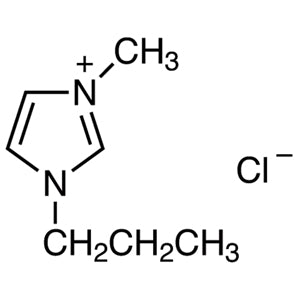
TCI M3035 1-Methyl-3-propylimidazolium Chloride is an imidazolium-based ionic liquid that pairs the 1-methyl-3-propylimidazolium cation with a chloride anion. Like other members of the ionic liquid family, this compound is composed entirely of ions, which gives it solvation and thermal behaviour markedly different from that of conventional molecular solvents. In the laboratory it serves as a high-temperature reaction medium, as an electrolyte, and — most frequently of all — as a starting material for preparing derivative ionic liquids by exchanging the chloride anion for whichever other anion the researcher requires.
The principal characteristic behind its selection is the nature of the chloride anion itself: small, coordinating, and very readily exchanged. Chloride makes this compound the most economical and most common point of departure in anion metathesis routes. Beyond that, imidazolium chlorides are well known for their ability to disrupt the hydrogen-bonding network of natural polymers, a property that has made this class of compounds attractive for cellulose dissolution and biomass processing research. Adequate thermal stability, negligible vapour pressure, and the capacity to dissolve metal salts further reinforce its usefulness as a working medium.
In Indonesian laboratories, this material is typically encountered in university and institutional research groups working on green solvents, electrochemistry, and biomass valorisation — fields in which locally abundant lignocellulosic feedstocks make ionic liquid processing a subject of active interest. It is commonly ordered by chemistry and chemical engineering departments for method development work, and by synthesis laboratories that prepare their own task-specific ionic liquids in house rather than purchasing each variant separately.
TCI brochures (PDF)
- Ionic Liquids 2026-06-08 · p. 9
Related TCI products
- TCI M3059 216299-72-8 1-Methyl-3-propylimidazolium Bis(trifluoromethanesulfonyl)imide
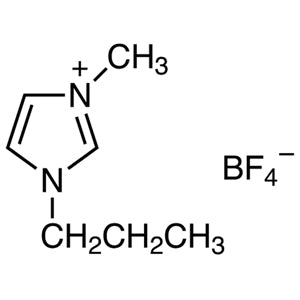
- TCI M3036 244193-48-4 1-Methyl-3-propylimidazolium Tetrafluoroborate
- TCI M3034 85100-76-1 1-Methyl-3-propylimidazolium Bromide
- TCI M1440 119171-18-5 1-Methyl-3-propylimidazolium Iodide
- TCI D4289 169051-76-7 2,3-Dimethyl-1-propylimidazolium Bis(trifluoromethanesulfonyl)imide
- TCI D3903 218151-78-1 1,2-Dimethyl-3-propylimidazolium Iodide
- Anion metathesis and ionic liquid synthesis: the chloride anion is easily displaced, making this the standard and most economical precursor for generating a wide family of task-specific ionic liquids.
- Cellulose dissolution studies: imidazolium chlorides disrupt the hydrogen-bonding network of natural polymers, allowing researchers to bring otherwise intractable cellulose into solution for further processing.
- Biomass processing and pretreatment research: the same hydrogen-bond-breaking behaviour supports investigations into the fractionation and valorisation of lignocellulosic feedstocks under laboratory conditions.
- High-temperature reaction medium: negligible vapour pressure and adequate thermal stability let this ionic liquid replace volatile molecular solvents in reactions that must be run hot.
- Electrolyte formulation and electrochemical work: being composed entirely of ions, and able to dissolve metal salts, it functions directly as an electrolyte medium in electrochemical experiments.
| Brand | TCI |
|---|---|
| CAS number | 79917-89-8 |
| Molecular formula | — |
| Purity | — |
| Category | Chemistry > Specialty Synthesis > Ionic Liquids [Specialty Synthesis] |
| Pack sizes | available in the standard TCI catalogue pack sizes; please confirm the size required when ordering. |
| Physical form | — |
| Storage | keep in a tightly closed container in a cool, dry place, protected from moisture. |
- Product code: M3035
Store the container tightly closed in a cool, dry, well-ventilated area, away from moisture. Imidazolium chlorides are generally hygroscopic, so containers should be opened only briefly and resealed promptly; transferring under dry conditions or in a glovebox is advisable where water content matters to the experiment. Use chemically compatible glass or suitable sealed containers and avoid prolonged exposure to open air. Handle in a fume hood with gloves, safety goggles, and a laboratory coat, following the manufacturer's safety data sheet and your institution's standard chemical handling procedures. Keep away from incompatible materials and label all secondary containers clearly.
—
Produk Terkait
-
1-Methyl-3-propylimidazoliumBis(trifluoromethanesulfonyl)imide TCI M3059
Regular price From Rp 1.538.250,00Regular priceRp 1.090.950,00Sale price From Rp 1.538.250,00 -
1-Methyl-3-propylimidazoliumTetrafluoroborate TCI M3036
Regular price From Rp 1.167.600,00Regular priceRp 831.600,00Sale price From Rp 1.167.600,00 -
1-Methyl-3-propylimidazoliumBromide TCI M3034
Regular price From Rp 1.431.150,00Regular priceRp 1.016.400,00Sale price From Rp 1.431.150,00 -
1-Methyl-3-propylimidazoliumIodide TCI M1440
Regular price From Rp 1.298.850,00Regular priceRp 924.000,00Sale price From Rp 1.298.850,00 -
2,3-Dimethyl-1-propylimidazoliumBis(trifluoromethanesulfonyl)imide TCI D4289
Regular price From Rp 2.013.900,00Regular priceRp 1.423.800,00Sale price From Rp 2.013.900,00 -
1,2-Dimethyl-3-propylimidazoliumIodide TCI D3903
Regular price From Rp 1.618.050,00Regular priceRp 1.146.600,00Sale price From Rp 1.618.050,00 -
1-Butyl-2,3-dimethylimidazoliumChloride TCI B2473
Regular price From Rp 980.700,00Regular priceRp 701.400,00Sale price From Rp 980.700,00 -
1-Butyl-3-methylimidazoliumChloride TCI B2194
Regular price From Rp 928.200,00Regular priceRp 664.650,00Sale price From Rp 928.200,00