


TCI M3204 4-(4-Methylphenylazo)phenol, CAS 2497-33-8, is an aromatic azo compound built from two benzene rings joined by a nitrogen-nitrogen double bond, carrying a hydroxyl group on one ring and a methyl group on the other. Compounds of the azobenzene class such as this one are classic materials in dye chemistry and in the chemistry of functional materials. In the laboratory it serves as a model dye, as a starting material for the synthesis of light-responsive materials, and as a reference compound in the development of analytical methods for azo dyes.
The characteristic that makes this compound a preferred choice is its long conjugated system, which extends across both aromatic rings and the azo bridge that links them. Because of this extended conjugation the compound absorbs strongly in the visible region and appears coloured. The phenolic hydroxyl group is weakly acidic and can be deprotonated, and this change shifts the absorption of the compound so that it displays pH-dependent behaviour. The azo bridge can also undergo isomerisation between the trans and cis forms on irradiation, a property that underpins the development of molecular switches and photoresponsive materials. The hydroxyl group additionally provides an attachment point for further etherification or esterification.
In Indonesian laboratories, materials of this type are typically used in academic and institutional research settings where dye chemistry, functional materials, and analytical method development are studied. The compound is handled at bench scale for synthesis work, for spectroscopic study of colour and absorption behaviour, and as a reference substance when analytical procedures for azo dyes are being established or verified. It is supplied under the TCI brand for laboratory research use.
Related TCI products
- TCI B4053 3035-94-7 4-(4-Bromophenylazo)phenol
- TCI B2357 2496-21-1 4-(4-Butylphenylazo)phenol
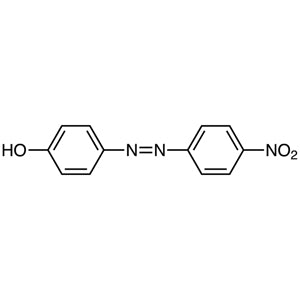
- TCI N0653 1435-60-5 4-(4-Nitrophenylazo)phenol
- TCI N0324 607-96-5 4-(4-Nitrophenylazo)orcinol
- TCI M1463 942230-11-7 11-[4-(4-Butylphenylazo)phenoxy]undecyl Methacrylate
- TCI H1452 1093077-77-0 1,2,3,4,5,6-Hexa-O-[11-[4-(4-hexylphenylazo)phenoxy]undecanoyl]-D-mannitol
- Model dye studies: the extended conjugation across both rings and the azo bridge gives strong visible absorption, making it a convenient representative azo dye for teaching and research work.
- Synthesis of photoresponsive materials: the azo bridge isomerises between trans and cis forms under irradiation, so the compound serves as a building block for light-switchable molecular systems and materials.
- Analytical method development for azo dyes: as a defined reference compound of the azobenzene class, it supports the establishment and verification of procedures intended for the analysis of azo colourants.
- pH-dependent spectroscopic work: the weakly acidic phenolic hydroxyl can be deprotonated, and the accompanying shift in absorption allows the compound to be studied as a pH-responsive chromophore.
- Derivatisation and functionalisation chemistry: the free hydroxyl group provides a reactive handle for etherification or esterification, allowing the azo chromophore to be attached to larger molecular frameworks.
| Brand | TCI |
|---|---|
| CAS number | 2497-33-8 |
| Molecular formula | — |
| Purity | — |
| Category | TCI |
| Pack sizes | available in the pack sizes listed for this catalogue item; please refer to the product listing for currently offered options |
| Physical form | — |
| Storage | store according to the conditions stated on the manufacturer label and safety data sheet |
- Chemical name: 4-(4-Methylphenylazo)phenol
- Product code: M3204
Store the container tightly closed in a cool, dry, well-ventilated area, away from direct sunlight and sources of heat or ignition, and follow the specific storage conditions indicated on the manufacturer label and safety data sheet. Keep the material in its original supplier container, or in a clean, chemically compatible and clearly labelled container, protected from light where prolonged exposure is a concern. Handle in a fume hood using appropriate personal protective equipment, including safety glasses, gloves and a laboratory coat. Avoid the generation and inhalation of dust, avoid contact with skin and eyes, and wash hands thoroughly after handling. Dispose of residues and contaminated materials in accordance with applicable laboratory waste procedures.
—
Produk Terkait
-
4-(4-Bromophenylazo)phenol TCI B4053
Regular price From Rp 3.392.550,00Regular price -
4-(4-Butylphenylazo)phenol TCI B2357
Regular price From Rp 2.677.500,00Regular price -
4-(4-Nitrophenylazo)phenol TCI N0653
Regular price From Rp 6.308.400,00Regular price -
4-(4-Nitrophenylazo)orcinol TCI N0324
Regular price Rp 2.995.650,00Regular price -
11-[4-(4-Butylphenylazo)phenoxy]undecylMethacrylate TCI M1463
Regular price From Rp 6.308.400,00Regular price -
1,2,3,4,5,6-Hexa-O-[11-[4-(4-hexylphenylazo)phenoxy]undecanoyl]-D-mannitol TCI H1452
Regular price Rp 8.162.700,00Regular price -
2,5-DimethylphenylaceticAcid TCI D3779
Regular price Rp 1.776.600,00Regular price -
4-(1,2,2-Triphenylvinyl)phenol TCI T3895
Regular price Rp 6.333.600,00Regular price



![942230-11-7 11-[4-(4-Butylphenylazo)phenoxy]undecyl Methacrylate - AMI Scientific](http://amiscientific.com/cdn/shop/files/TCI2510M1463.jpg?v=1768361498&width=533)
![1093077-77-0 1,2,3,4,5,6-Hexa-O-[11-[4-(4-hexylphenylazo)phenoxy]undecanoyl]-D-mannitol - AMI Scientific](http://amiscientific.com/cdn/shop/files/TCI2510H1452.jpg?v=1767118033&width=533)

