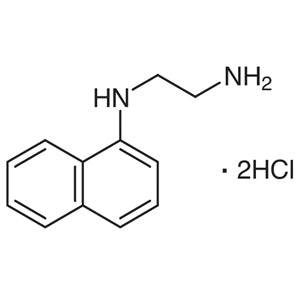
TCI N0063 N-(1-Naphthyl)ethylenediamine Dihydrochloride (CAS 1465-25-4), commonly abbreviated as NED, is a classic analytical reagent supplied as a dihydrochloride salt consisting of an ethylenediamine chain bonded to a naphthalene nucleus. The compound is best known as the coupling component of the Griess reagent for nitrite determination, one of the most firmly established colorimetric methods in the analytical world. In that reaction, nitrite diazotises sulfanilamide or sulfanilic acid, and the diazonium salt formed is then coupled with NED to produce a purplish-red azo dye whose intensity is proportional to the nitrite content of the sample.
The qualities that have kept this reagent in continuous use for decades are its sensitivity and the stability of the colour it produces. The dihydrochloride salt form dissolves very readily in water, so reagent solutions are easy to prepare and become homogeneous quickly. The aliphatic amine group on the side chain improves solubility while keeping the naphthalene ring electron-rich and ready to accept electrophilic attack from the diazonium salt. The coupling product absorbs strongly in the visible region, so spectrophotometric measurement can be carried out with a low detection limit.
In Indonesian laboratories, NED is a routine item wherever nitrite is measured by the Griess method. It appears in water and wastewater testing laboratories, environmental monitoring work, food and beverage quality control, agricultural and soil analysis, and in university teaching and research laboratories where classical colorimetric methods are taught and applied. Its role as a standard reagent in widely referenced analytical procedures makes it a recurring entry on laboratory consumable lists.
Related TCI products
- TCI B2318 1820706-16-8 (+/-)-1,2-Bis(2,4,6-trimethylphenyl)ethylenediamine Dihydrochloride
- TCI N0869 1465-25-4 N-(1-Naphthyl)ethylenediamine Dihydrochloride [for Biochemical Research]
- TCI N0577 N-(1-Naphthyl)ethylenediamine Dihydrochloride Monomethanolate
- TCI E0078 333-18-6 Ethylenediamine Dihydrochloride
- TCI B1952 10563-26-5 N,N'-Bis(3-aminopropyl)ethylenediamine
- TCI A1492 37818-93-2 N-(1-Adamantyl)ethylenediamine
- Nitrite determination in drinking water and wastewater — as the Griess coupling agent it forms a strongly absorbing azo dye that allows low nitrite levels to be quantified spectrophotometrically with good sensitivity.
- Environmental monitoring of surface water and effluent — the reagent's high water solubility and rapid colour development suit high sample throughput and routine field-support laboratory schedules.
- Food and beverage quality control for nitrite content — the proportional relationship between colour intensity and nitrite concentration provides a straightforward quantitative basis for curing salt and preservative checks.
- Agricultural and soil extract analysis — nitrite in soil and fertiliser extracts can be measured with the same established colorimetric chemistry, making method transfer between sample types simple.
- Academic teaching and research in analytical chemistry — the Griess reaction is a well-documented classical procedure, so NED serves as a reliable reagent for demonstrating diazotisation and azo coupling principles.
| Brand | TCI |
|---|---|
| CAS number | 1465-25-4 |
| Molecular formula | — |
| Purity | — |
| Category | Chemistry > Building Blocks > Non-Heterocyclic Building Blocks |
| Pack sizes | Available in standard TCI catalogue pack sizes; please confirm the size required when ordering |
| Physical form | — |
| Storage | Store in a tightly closed container, protected from light and moisture |
- Chemical Form: Dihydrochloride salt, readily soluble in water
Store the reagent in a tightly closed original container in a cool, dry place and keep it protected from light, since the material and its solutions are sensitive to light and moisture. Amber glass or other opaque containers are appropriate for prepared reagent solutions, and solutions should be freshly made where the analytical method calls for it. Handle the solid in a well-ventilated area or fume hood to avoid inhaling dust, and wear gloves, safety glasses, and a laboratory coat. Avoid contact with skin and eyes, wash hands after handling, and consult the manufacturer's safety data sheet before use and disposal.
—
Produk Terkait
-
(+/-)-1,2-Bis(2,4,6-trimethylphenyl)ethylenediamineDihydrochloride TCI B2318
Regular price From Rp 5.352.900,00Regular price -
N-(1-Naphthyl)ethylenediamineDihydrochloride[forBiochemicalResearch] TCI N0869
Regular price Rp 1.538.250,00Regular price -
N-(1-Naphthyl)ethylenediamineDihydrochlorideMonomethanolate TCI N0577
Regular price From Rp 664.650,00Regular price -
EthylenediamineDihydrochloride TCI E0078
Regular price From Rp 505.050,00Regular price -
N,N'-Bis(3-aminopropyl)ethylenediamine TCI B1952
Regular price From Rp 610.050,00Regular price -
N-(1-Adamantyl)ethylenediamine TCI A1492
Regular price Rp 5.062.050,00Regular price -
N,N'-Bis(salicylidene)ethylenediamine TCI H0199
Regular price From Rp 1.298.850,00Regular price -
EthylenediamineSulfate TCI E0082
Regular price From Rp 557.550,00Regular price

![1465-25-4 N-(1-Naphthyl)ethylenediamine Dihydrochloride [for Biochemical Research] - AMI Scientific](http://amiscientific.com/cdn/shop/files/TCI2510N0869.jpg?v=1767130464&width=533)