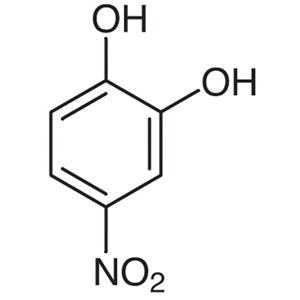
4-Nitrocatechol is a chemical compound widely used in laboratory settings for the synthesis of complex molecules. As a building block in organic chemistry, it serves as a key intermediate in various reactions, particularly in substitution and oxidation processes. Its unique structure, featuring a phenolic ring with a nitro group at the 4-position, makes it highly reactive and versatile. This compound is commonly utilized in the development of aromatic and heterocyclic compounds, playing a crucial role in both academic and industrial research.
The polar nature of 4-Nitrocatechol, combined with the electron-withdrawing effect of the nitro group, enhances its reactivity with a wide range of reagents. These properties make it a preferred choice for chemists seeking to create compounds with specific functional groups or desired chemical properties. Its ability to participate in multiple reaction pathways also allows for greater flexibility in synthetic strategies. This versatility is especially valuable in the context of medicinal chemistry and material science.
In Indonesian laboratories, 4-Nitrocatechol is a staple in organic chemistry research. It is frequently used in the synthesis of pharmaceuticals, industrial chemicals, and analytical compounds. Its availability through reliable suppliers like AMI Scientific ensures that researchers have access to this essential building block for their experimental needs. This compound supports a wide array of applications, from drug development to the creation of specialty materials.
- Synthesis of complex aromatic compounds for pharmaceutical research due to its reactivity and structural versatility.
- Facilitation of substitution reactions on phenolic rings for the production of heterocyclic compounds.
- Development of industrial chemicals such as dyes and plastics through its ability to participate in oxidation processes.
- Use in qualitative and quantitative analysis for its detectability and reactivity in analytical procedures.
- Support for medicinal chemistry studies by enabling the creation of compounds with specific functional groups.
| Brand | TCI |
|---|---|
| CAS number | 3316-09-4 |
| Molecular formula | — |
| Purity | — |
| Category | Chemistry > Building Blocks > Non-Heterocyclic Building Blocks |
| Pack sizes | Available in various quantities as per supplier specifications |
| Physical form | Solid |
| Storage | Store in a cool, dry place away from light and incompatible materials |
4-Nitrocatechol should be stored in a cool, dry environment, away from direct sunlight and sources of heat. It is recommended to keep the compound in a sealed container to prevent moisture absorption and contamination. Due to its polar nature, it is advisable to use glass or plastic containers that are resistant to chemical reactions. General laboratory precautions include handling with care to avoid skin contact and inhalation of vapors. Always ensure proper ventilation in the workspace and follow standard safety protocols when working with reactive chemicals. This compound is not classified as hazardous under normal conditions but should still be treated with the same level of caution as other organic reagents.
—
Produk Terkait
-
3,4,5,6-Tetrachlorocatechol TCI T3627
Regular price From Rp 1.829.100,00Regular price -
3-Chlorocatechol TCI C1246
Regular price Rp 5.539.800,00Regular price -
4-Chlorocatechol TCI C0568
Regular price From Rp 4.213.650,00Regular price -
3-Bromocatechol TCI B3710
Regular price From Rp 1.776.600,00Regular price -
4-Bromocatechol TCI B2173
Regular price Rp 1.458.450,00Regular price -
3-Methoxycatechol TCI M0524
Regular price From Rp 2.837.100,00Regular price -
PyrocatecholViolet TCI P0568
Regular price From Rp 664.650,00Regular price -
4-Fluorocatechol TCI F0483
Regular price From Rp 4.452.000,00Regular price