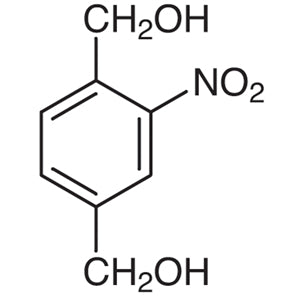
2-Nitro-p-xylylene Glycol is a chemical compound widely used in laboratory settings for the synthesis of complex molecules. It serves as a key building block in both heterocyclic and non-heterocyclic chemical structures, playing a vital role in various synthetic pathways. This compound is commonly utilized in substitution and oxidation reactions, making it an essential reagent for researchers aiming to develop new compounds with diverse applications. Its versatility and reactivity make it a preferred choice in modern chemical research.
The compound’s molecular structure and high reactivity are the main factors contributing to its popularity in chemical synthesis. The presence of the nitro group imparts electron-withdrawing properties, which enhance its ability to participate in a wide range of chemical reactions. This characteristic allows it to act as a versatile intermediate in the modification of molecular structures. Its stability and predictable behavior under controlled laboratory conditions further support its use in both academic and industrial research environments.
In Indonesian laboratories, 2-Nitro-p-xylylene Glycol is frequently employed in scientific research and product development. Due to its availability and reliability, it is a common choice for chemists conducting experiments that require high-quality building blocks. Its role in the synthesis of pharmaceuticals, materials, and industrial compounds underscores its importance in the chemical research landscape of Indonesia.
TCI brochures (PDF)
- Biomaterials Research Reagents 2025-02-19 · p. 20
- Monomers 2025-05-28 · p. 25
Related TCI products
- TCI B3807 4439-20-7 N,N'-Bis(2-hydroxyethyl)ethylenediamine
- TCI B3384 821-11-4 trans-2-Butene-1,4-diol
- TCI B1643 10038-40-1 2,2'-Bis(hydroxymethyl)diphenyl Ether
- TCI B1621 20601-38-1 4,4'-Bicyclohexanol (mixture of isomers)
- TCI B1158 1455-42-1 3,9-Bis(1,1-dimethyl-2-hydroxyethyl)-2,4,8,10-tetraoxaspiro[5.5]undecane
- TCI B0922 115-84-4 2-Butyl-2-ethyl-1,3-propanediol
- Synthesis of Complex Organic Compounds: This compound is ideal for creating intricate molecular structures due to its reactivity and versatility in chemical reactions.
- Pharmaceutical Research: Its ability to participate in substitution and oxidation reactions makes it valuable in the development of new drug molecules.
- Material Science Applications: It is used in the synthesis of polymers and other advanced materials, contributing to the creation of functional materials.
- Industrial Chemistry Processes: Its role in oxidation and substitution reactions supports the production of various industrial chemicals and intermediates.
- Academic Research Projects: It is a preferred reagent in educational and research settings where reliable and high-quality building blocks are required.
| Brand | TCI |
|---|---|
| CAS number | 23222-97-1 |
| Molecular formula | — |
| Purity | — |
| Category | Chemistry > Building Blocks > Non-Heterocyclic Building Blocks |
| Pack sizes | Available in standard laboratory quantities |
| Physical form | Solid or liquid, depending on the specific product variant |
| Storage | Store in a cool, dry place away from direct sunlight and incompatible materials |
This compound should be stored in a cool, dry environment to maintain its stability and prevent degradation. It is recommended to use tightly sealed containers to minimize exposure to moisture and air. Due to its reactivity, it should be kept away from strong oxidizing agents and incompatible substances. Proper labeling and storage in a designated chemical storage area are essential for safety. Laboratory personnel should handle it with appropriate personal protective equipment, including gloves and safety goggles, to ensure safe handling and prevent accidental exposure. Regular monitoring of storage conditions is advised to maintain the integrity of the compound.
—
Product Categories
Produk Terkait
-
N,N'-Bis(2-hydroxyethyl)ethylenediamine TCI B3807
Regular price Rp 3.498.600,00Regular priceRp 2.446.500,00Sale price Rp 3.498.600,00 -
trans-2-Butene-1,4-diol TCI B3384
Regular price From Rp 2.809.800,00Regular priceRp 1.980.300,00Sale price From Rp 2.809.800,00 -
2,2'-Bis(hydroxymethyl)diphenylEther TCI B1643
Regular price From Rp 3.815.700,00Regular priceRp 2.683.800,00Sale price From Rp 3.815.700,00 -
4,4'-Bicyclohexanol(mixtureofisomers) TCI B1621
Regular price From Rp 1.618.050,00Regular priceRp 1.146.600,00Sale price From Rp 1.618.050,00 -
3,9-Bis(1,1-dimethyl-2-hydroxyethyl)-2,4,8,10-tetraoxaspiro[5.5]undecane TCI B1158
Regular price From Rp 1.060.500,00Regular priceRp 757.050,00Sale price From Rp 1.060.500,00 -
2-Butyl-2-ethyl-1,3-propanediol TCI B0922
Regular price From Rp 530.250,00Regular priceRp 386.400,00Sale price From Rp 530.250,00 -
cis-2-Butene-1,4-diol TCI B0693
Regular price From Rp 769.650,00Regular priceRp 553.350,00Sale price From Rp 769.650,00 -
2,3-Butanediol(mixtureofstereoisomers) TCI B0681
Regular price From Rp 769.650,00Regular priceRp 553.350,00Sale price From Rp 769.650,00



![TCI B1158 1455-42-1 3,9-Bis(1,1-dimethyl-2-hydroxyethyl)-2,4,8,10-tetraoxaspiro[5.5]undecane](http://amiscientific.com/cdn/shop/files/TCI2510B1158.jpg?v=1792659572&width=533)
![1455-42-1 3,9-Bis(1,1-dimethyl-2-hydroxyethyl)-2,4,8,10-tetraoxaspiro[5.5]undecane - AMI Scientific](http://amiscientific.com/cdn/shop/files/TCI2510B1158_609993f6-3ef5-43f1-b023-4ccd96c49dd8.jpg?v=1767231560&width=533)