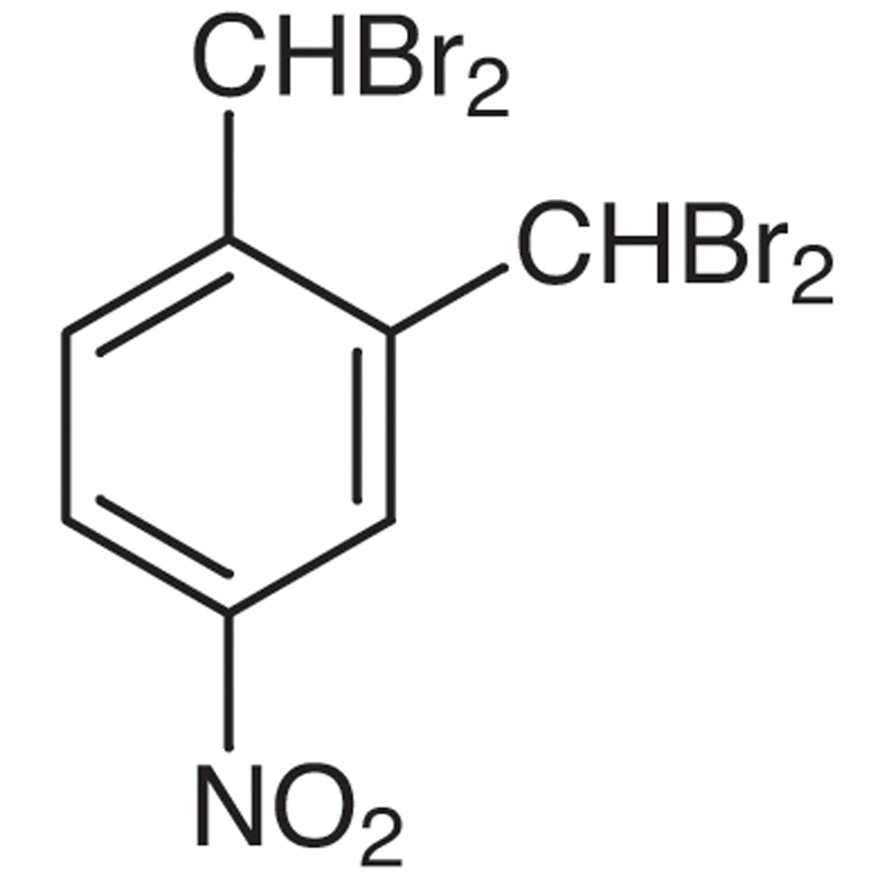
4-Nitro-alpha,alpha,alpha',alpha'-tetrabromo-o-xylene is a complex organic compound widely used in chemical reactions for the synthesis of various organic substances. It plays a crucial role in laboratory settings where the development of compounds with specific properties is required. Its molecular structure is characterized by the presence of multiple bromo and nitro groups, making it a versatile building block for chemical synthesis. This compound is commonly utilized in research involving functional group modifications and the creation of new chemical entities. Its unique structure allows it to participate in a variety of chemical transformations, contributing to the advancement of organic chemistry.
The compound's high reactivity is attributed to the presence of both nitro and bromo groups, which make it an ideal candidate for substitution and electrophilic reactions. These functional groups enhance its utility in synthetic pathways, enabling the formation of more complex molecules. Despite its reactivity, the compound exhibits stability under certain conditions, although it is sensitive to heat and UV light. This sensitivity necessitates careful handling and storage, but its chemical properties make it a preferred choice for researchers aiming to explore new synthetic routes and chemical modifications.
In Indonesian laboratories, 4-Nitro-alpha,alpha,alpha',alpha'-tetrabromo-o-xylene is frequently used in organic chemistry research, particularly in the synthesis of complex compounds and the development of new chemical materials. Its availability and consistent quality make it a reliable option for researchers working on advanced chemical projects. The compound is essential in both academic and industrial settings, supporting the creation of novel compounds with tailored properties.
Related TCI products
- Organic synthesis is a key application where this compound serves as a versatile building block for the creation of complex molecules and functionalized derivatives.
- Heterocyclic compound development benefits from its reactivity, allowing for the introduction of bromo and nitro groups into ring structures.
- Dye and pigment formulation utilizes its molecular structure to create compounds with specific color properties and chemical stability.
- Industrial chemical precursor applications rely on its ability to undergo substitution reactions, making it a valuable intermediate in chemical manufacturing.
- Research in chemical modification projects uses its functional groups to explore new synthetic pathways and molecular transformations.
| Brand | TCI |
|---|---|
| CAS number | 13209-16-0 |
| Molecular formula | — |
| Purity | — |
| Category | Chemistry > Building Blocks > Non-Heterocyclic Building Blocks |
| Pack sizes | Available in standard laboratory quantities as per supplier specifications |
| Physical form | Solid, typically in crystalline or powder form |
| Storage | Store in a cool, dark place away from heat and UV light |
This compound should be stored in a cool, dark environment to prevent degradation due to heat and UV exposure. It is recommended to use airtight containers made of inert materials such as glass or polyethylene to minimize chemical interactions. Due to its sensitivity, it should be handled with care using appropriate personal protective equipment. Laboratory personnel should avoid direct contact and ensure proper ventilation when working with this compound. Storage conditions should be controlled to maintain its stability and ensure safe usage in chemical experiments.
—
Produk Terkait
-
alpha,alpha'-Dianilino-p-xylene TCI D2143
Regular price From Rp 1.140.300,00Regular price -
alpha,alpha'-Bis(4-methylbenzyloxy)-p-xylene TCI B1482
Regular price From Rp 2.254.350,00Regular price -
5-Nitro-o-anisaldehyde TCI N1034
Regular price From Rp 980.700,00Regular price -
4-Nitro-1-naphthol TCI N0672
Regular price From Rp 3.870.300,00Regular price -
6-Nitro-2,3-xylidine TCI N0500
Regular price From Rp 1.936.200,00Regular price -
2-Nitro-p-tolunitrile TCI N0494
Regular price From Rp 1.881.600,00Regular price -
1-Nitro-2-naphthol TCI N0370
Regular price Rp 4.479.300,00Regular price -
4-Nitro-1-naphthylamine TCI N0213
Regular price From Rp 3.605.700,00Regular price