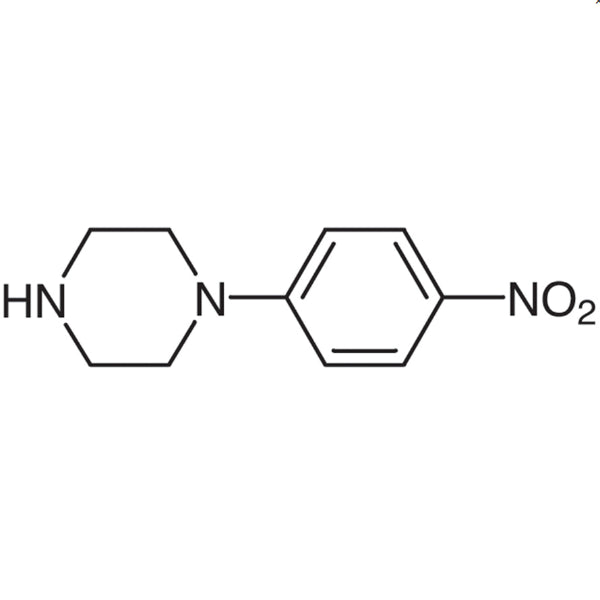
1-(4-Nitrophenyl)piperazine from TCI (product code N0694) is a piperazine derivative. One of its nitrogen atoms is bonded to a 4-nitrophenyl ring, and the other stays a free secondary amine. Arylpiperazines are a very common structural motif in medicinal chemistry and appear in many bioactive molecules. In the laboratory, this compound is used as a heterocyclic building block to attach an arylpiperazine fragment to a target molecule. It is also a precursor to aminophenylpiperazine derivatives, which widens its value in multistep synthetic routes.
Chemists choose this compound because it has two reactive sites that complement each other. The secondary nitrogen of the piperazine ring is nucleophilic, so it can be acylated, alkylated, or sulfonylated, or used in reductive amination. The nitro group on the aromatic ring can be reduced to a primary amine, which opens a second round of functionalization, such as forming amides, ureas, or carbamates. This lets researchers build symmetrical or unsymmetrical molecules step by step with good control. The nitroaromatic group also absorbs UV light, which makes reactions easier to monitor.
In Indonesia, this material suits medicinal chemistry and pharmaceutical laboratories at universities, research institutes, and industrial research and development units. Research groups working on new bioactive compounds, compound library synthesis, or structure-activity relationship studies can use it as a dependable starting point for arylpiperazine scaffolds. It also works well in advanced organic synthesis teaching, where it shows students how to use two different functional groups in sequence. AMI Scientific supplies this TCI reagent to support these research and teaching needs across the country.
Related TCI products
- TCI N0935 59084-06-9 1-(2-Nitrophenyl)piperazine
- TCI B1047 69231-13-6 2,3-Bis(4-nitrophenyl)-5-phenyltetrazolium Chloride
- TCI B0311 3-(4-Nitrophenyl)-5-methyl-2-phenyltetrazolium Chloride
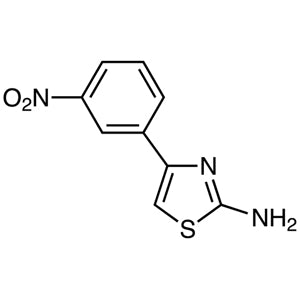
- TCI A3086 57493-24-0 2-Amino-4-(3-nitrophenyl)thiazole
- TCI N1333 729-13-5 2-(4-Nitrophenyl)-1H-benzo[d]imidazole
- TCI N1283 2301-25-9 1-(4-Nitrophenyl)-1H-imidazole
- Arylpiperazine scaffold construction: the pre-formed 4-nitrophenylpiperazine unit lets chemists add this common medicinal chemistry motif to target molecules without building the ring system from scratch.
- N-acylation and N-sulfonylation reactions: the free secondary amine on the piperazine ring is nucleophilic, so it reacts readily with acyl chlorides, anhydrides, and sulfonyl chlorides to give amide or sulfonamide products.
- Reductive amination and N-alkylation: the secondary nitrogen can be coupled with aldehydes, ketones, or alkyl halides, giving researchers a flexible way to add different substituents to the piperazine core.
- Preparation of aminophenylpiperazine derivatives: reducing the aromatic nitro group gives a primary amine, making this compound a direct precursor to aminophenylpiperazines for later amide, urea, or carbamate formation.
- Stepwise synthesis of symmetrical and unsymmetrical molecules: the two complementary reactive sites can be used one after the other, so chemists can build complex molecules in a controlled order, while UV absorption from the nitroaromatic group helps with reaction monitoring.
| Brand | TCI (product code N0694) |
|---|---|
| CAS number | 6269-89-2 |
| Molecular formula | — |
| Purity | — |
| Category | Chemistry > Building Blocks > Heterocyclic Building Blocks |
| Pack sizes | see the available pack options on the product page |
| Physical form | see the TCI product documentation and certificate of analysis |
| Storage | follow the storage conditions on the TCI label and safety data sheet (SDS) |
Keep 1-(4-Nitrophenyl)piperazine in its original tightly closed container, in a cool, dry, well-ventilated area away from direct sunlight, heat sources, and incompatible materials such as strong oxidizing agents. Glass or chemically resistant containers with secure caps are suitable if the material must be transferred. Label all containers clearly and reseal them promptly after use to limit exposure to moisture and air. When handling, wear standard laboratory protective equipment, including safety glasses, chemical-resistant gloves, and a lab coat. Work in a fume hood or well-ventilated area, and avoid breathing in dust or getting the material on skin or in eyes. Always check the TCI safety data sheet for specific hazard information, first-aid measures, and disposal guidance, and follow your institution's chemical safety procedures.
—
Produk Terkait
-
1-(2-Nitrophenyl)piperazine TCI N0935
Regular price From Rp 1.378.650,00Regular price -
2,3-Bis(4-nitrophenyl)-5-phenyltetrazoliumChloride TCI B1047
Regular price Rp 3.446.100,00Regular price -
Chloride TCI B0311
Regular price Rp 1.326.150,00Regular price -
2-Amino-4-(3-nitrophenyl)thiazole TCI A3086
Regular price From Rp 664.650,00Regular price -
2-(4-Nitrophenyl)-1H-benzo[d]imidazole TCI N1333
Regular price From Rp 1.829.100,00Regular price -
1-(4-Nitrophenyl)-1H-imidazole TCI N1283
Regular price From Rp 2.174.550,00Regular price -
2-(4-Nitrophenyl)oxirane TCI N1216
Regular price Rp 7.792.050,00Regular price -
4-(4-Nitrophenyl)morpholine TCI N1124
Regular price From Rp 557.550,00Regular price


![729-13-5 2-(4-Nitrophenyl)-1H-benzo[d]imidazole - AMI Scientific](http://amiscientific.com/cdn/shop/files/TCI2510N1333.jpg?v=1768362195&width=533)
![729-13-5 2-(4-Nitrophenyl)-1H-benzo[d]imidazole - AMI Scientific](http://amiscientific.com/cdn/shop/files/TCI2510N1333_8c2a3954-89dc-41eb-b10a-a7cee06f68b0.jpg?v=1769057185&width=533)