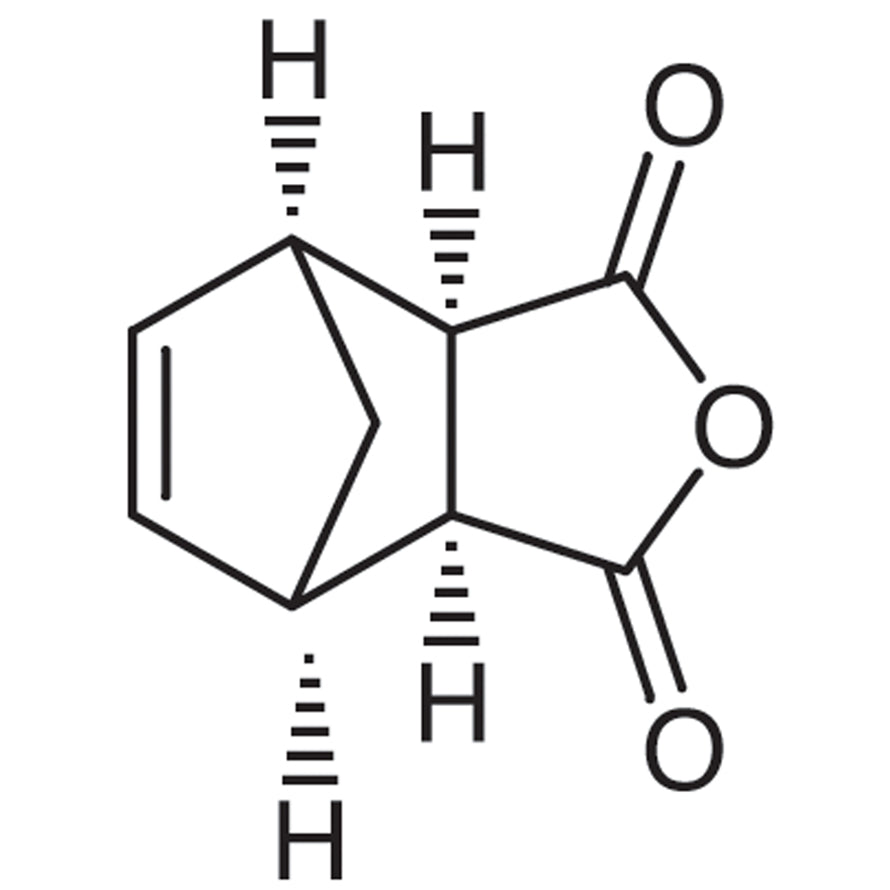
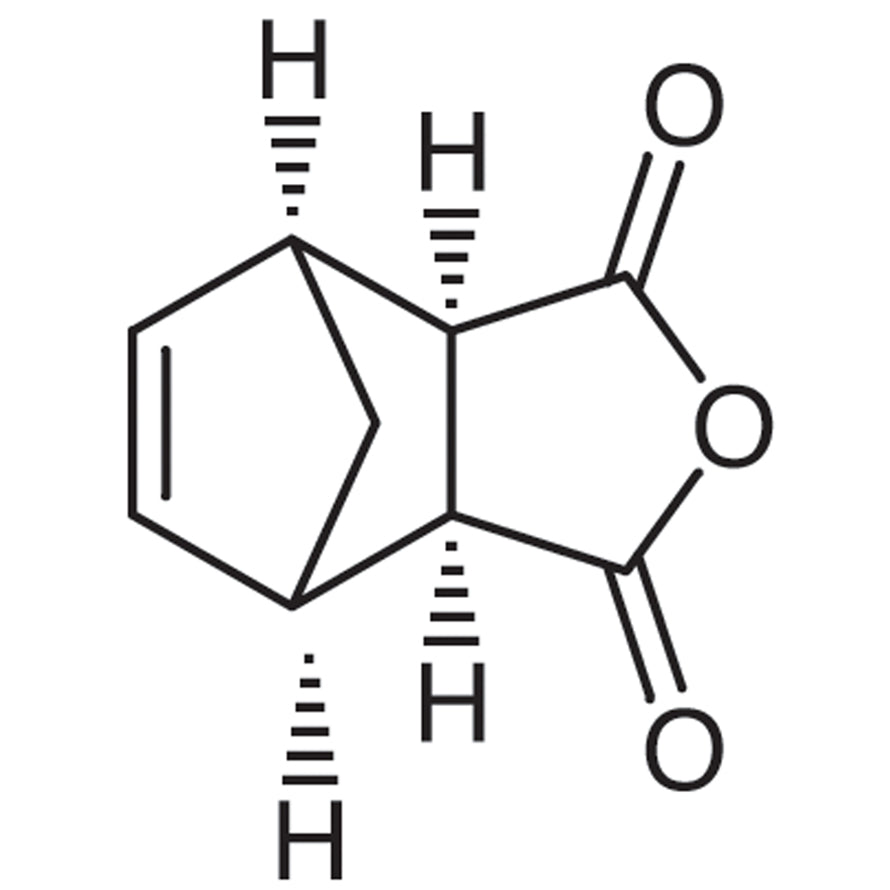
cis-5-Norbornene-exo-2,3-dicarboxylic Anhydride from TCI is a bicyclic cyclic anhydride built on a norbornene framework. Its anhydride group sits in the exo configuration on the bicyclic skeleton. In the laboratory it is mainly used as a monomer in polymer chemistry, especially for ring-opening metathesis polymerization (ROMP). It is also a very popular starting material for functional norbornene-imide monomers, made by reacting it with primary amines. It can also serve as a curing agent or modifier in resin systems.
The main reason to choose the exo isomer is its reactivity. In ROMP, exo norbornene monomers generally polymerize faster and with better control than their endo counterparts, because endo substituents tend to interfere with the catalyst's metal centre. With a pure exo isomer, researchers get more consistent kinetics and polymers whose molecular weight distribution is easier to control. The anhydride group also reacts with amines and alcohols. This lets one material be turned into many monomers, each with a side chain designed for the task, so a single reagent supports a wide range of polymer designs.
In Indonesian laboratories, this material fits well in university polymer chemistry groups, materials science research centres and industrial R&D units working on functional polymers, coatings or resins. Researchers can use it to make custom norbornene-imide monomers in-house, study how metathesis catalysts perform, or build well-defined polymer structures for thesis and publication work. A dependable reagent from a recognised brand like TCI helps keep results consistent from one batch and project to the next.
- Ring-opening metathesis polymerization (ROMP): the exo configuration generally gives faster, better-controlled polymerization than the endo isomer, so kinetics are more consistent.
- Synthesis of functional norbornene-imide monomers: the anhydride group reacts readily with primary amines, making it a convenient starting point for imide monomers with custom side chains.
- Controlled polymer architecture research: a pure exo isomer makes the molecular weight distribution easier to control, which suits studies that need well-defined polymers.
- Resin curing and modification: as a cyclic anhydride, it can act as a curing agent or modifier in resin systems, where its reactive anhydride group takes part in crosslinking chemistry.
- Derivatization with alcohols for monomer design: the anhydride also reacts with alcohols, so researchers can make ester-functional norbornene monomers with side chains tailored to the properties they want.
| Brand | TCI (product code N0767) |
|---|---|
| CAS number | 2746-19-2 |
| Molecular formula | — |
| Purity | — |
| Category | Materials Science > Polymer/Macromolecule Reagents > Monomers |
| Pack sizes | see the available options on the product page |
| Physical form | see the TCI specification sheet |
| Storage | keep tightly closed, protected from moisture, as for other cyclic anhydrides |
Store the reagent in its original, tightly sealed container in a cool, dry, well-ventilated area, away from direct sunlight and heat. Cyclic anhydrides can hydrolyse when exposed to moisture, so reseal the container promptly after use. Where possible, keep it in a desiccator or under dry conditions. Keep it away from amines, alcohols, strong bases and oxidising agents during storage. When handling, wear suitable personal protective equipment, including gloves, safety glasses and a lab coat, and work in a fume hood to avoid breathing in dust or vapour. Always check the TCI Safety Data Sheet for detailed hazard, first-aid and disposal information before use.
—
Produk Terkait
-
TCI B5774 5,10-Bis(4,4,5,5-tetramethyl-1,3,2-dioxaborolan-2-yl)naphtho[1,2-c:5,6-c']bis([1,2,5]oxadiazole)
Regular price Rp 10.255.350,00Regular price -
Dihydroiodide TCI B6569
Regular price From Rp 1.936.200,00Regular price -
Trifluoromethanesulfonate TCI B7003
Regular price From Rp 1.936.200,00Regular price
![5,10-Bis(4,4,5,5-tetramethyl-1,3,2-dioxaborolan-2-yl)naphtho[1,2-c:5,6-c']bis([1,2,5]oxadiazole) - TCI B5774 - AMI Scientific](http://amiscientific.com/cdn/shop/files/TCI2510B5774.jpg?v=1769180228&width=533)