

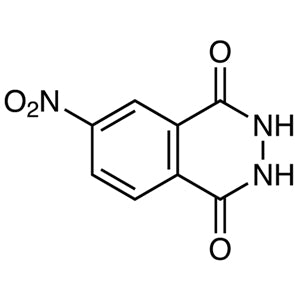
4-Nitrophthalic Hydrazide is a chemical compound widely used as a building block in various chemical reactions, particularly in the synthesis of heterocyclic compounds. Its unique molecular structure features a hydrazide group, which makes it highly reactive and versatile in organic chemistry applications. This compound is essential for researchers aiming to develop new substances with specific functional properties, such as pharmaceuticals or bioactive materials. Its role in the laboratory is critical for advancing chemical synthesis and innovation.
The compound’s high reactivity and ability to participate in multiple reaction types, including condensation, hydrolysis, and substitution, make it a preferred choice for chemists. Its stability under certain conditions also facilitates safe handling and storage, ensuring consistent performance in experimental processes. These properties contribute to its popularity among researchers working in both academic and industrial settings.
In Indonesian laboratories, 4-Nitrophthalic Hydrazide is commonly used in both fundamental and applied chemical research. It plays a key role in the development of new compounds with potential applications in pharmaceuticals, materials science, and environmental chemistry. Its availability and reliability make it a valuable resource for institutions and research groups focused on chemical innovation.
- Synthesis of Heterocyclic Compounds: This compound is ideal for creating complex ring structures due to its reactive hydrazide group, which facilitates bond formation in organic synthesis.
- Pharmaceutical Research: Its ability to form biologically active molecules makes it a key reagent in drug development and bioactive compound synthesis.
- Material Science Applications: It is used in the development of new polymers and functional materials due to its chemical versatility and reactivity.
- Environmental Chemistry Studies: It contributes to the synthesis of compounds used in pollution control and remediation processes.
- Academic Teaching and Research: Its role in chemical education and research makes it a standard item in university and research laboratory settings.
| Brand | TCI |
|---|---|
| CAS number | 3682-19-7 |
| Molecular formula | — |
| Purity | — |
| Category | Chemistry > Building Blocks > Heterocyclic Building Blocks |
| Pack sizes | Available in various quantities as per supplier specifications |
| Physical form | Solid |
| Storage | Store in a cool, dry place away from moisture and direct sunlight |
4-Nitrophthalic Hydrazide should be stored in a cool, dry place, away from moisture and direct sunlight to maintain its stability and reactivity. It is recommended to use airtight containers to prevent exposure to air and humidity, which may affect its chemical integrity. Due to its reactive nature, it should be handled with care, using appropriate personal protective equipment such as gloves and safety goggles. It is important to ensure that the compound is stored separately from incompatible substances to avoid any potential chemical interactions. Proper labeling and storage conditions help ensure the safety of laboratory personnel and the consistency of experimental results.
—
Produk Terkait
-
2-ThiophenecarboxylicHydrazide TCI T1140
Regular price Rp 2.439.150,00Regular price -
MaleicHydrazide TCI M0015
Regular price From Rp 530.250,00Regular price -
3-NitrophthalicHydrazide TCI N0622
Regular price From Rp 875.700,00Regular price -
4-NitrophthalicAnhydride TCI N0246
Regular price From Rp 4.797.450,00Regular price -
3-NitrophthalicAnhydride TCI N0245
Regular price From Rp 1.829.100,00Regular price -
4-NitrophthalicAcid TCI N0244
Regular price From Rp 610.050,00Regular price -
3-NitrophthalicAcid TCI N0243
Regular price From Rp 477.750,00Regular price -
N-Chloromethyl-4-nitrophthalimide[forHPLCLabeling] TCI A5503
Regular price From Rp 2.254.350,00Regular price



![54455-37-7 N-Chloromethyl-4-nitrophthalimide [for HPLC Labeling] - AMI Scientific](http://amiscientific.com/cdn/shop/files/TCI2510A5503.jpg?v=1769141516&width=533)