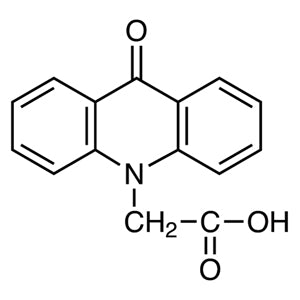
9-Oxoacridine-10-acetic Acid is a chemical compound widely used in laboratory settings for the synthesis of complex heterocyclic compounds. This versatile building block plays a crucial role in organic chemistry, enabling the creation of a wide range of molecular structures through various chemical reactions. Its unique molecular framework makes it an essential reagent in the development of new compounds with potential applications in pharmaceuticals and industrial chemistry. Due to its structural complexity, it is frequently utilized in research aimed at discovering novel compounds with therapeutic or functional properties.
The compound is valued for its chemical stability under controlled conditions, which allows for consistent performance in synthetic processes. Its ability to participate in nucleophilic, electrophilic, and substitution reactions makes it a preferred choice for chemists working on intricate molecular designs. Additionally, its reactivity and structural features enable it to be a key component in the synthesis of bioactive molecules. These properties make it a reliable and effective tool in advanced chemical research.
In Indonesian laboratories, 9-Oxoacridine-10-acetic Acid is commonly used in chemical synthesis projects, particularly in the field of heterocyclic compound development. It is a favored material among researchers and academic institutions due to its reliability and effectiveness. Its availability and high quality make it a popular choice for experiments requiring complex molecular structures. This compound is integral to many research initiatives in Indonesia, contributing to advancements in both academic and industrial chemical applications.
TCI brochures (PDF)
- Pharmaceutical Ingredients for Research and Experimental Use 2026-03-09 · p. 47
Related TCI products
- TCI T2941 652-37-9 Theophylline-7-acetic Acid
- TCI T2737 21743-75-9 1H-Tetrazole-5-acetic Acid
- TCI B2912 4865-84-3 1,2-Benzisoxazole-3-acetic Acid
- TCI B1941 6295-57-4 (2-Benzothiazolylthio)acetic Acid
- TCI A2478 65872-41-5 (Z)-2-(2-Amino-4-thiazolyl)-2-(methoxyimino)acetic Acid
- TCI A0954 29676-71-9 (2-Amino-4-thiazolyl)acetic Acid
- Heterocyclic Compound Synthesis: This compound is ideal for creating complex ring structures, making it essential for developing new pharmaceuticals and industrial chemicals.
- Medicinal Chemistry Research: Its structural versatility supports the synthesis of bioactive molecules, aiding in drug discovery and development.
- Organic Reaction Studies: The compound's reactivity in nucleophilic and electrophilic reactions makes it a valuable tool for studying reaction mechanisms and pathways.
- Academic Research Projects: It is widely used in university and research laboratory settings for advanced chemical synthesis experiments.
- Industrial Chemical Development: Its role in producing complex compounds makes it a key reagent in the development of specialty chemicals and materials.
| Brand | TCI |
|---|---|
| CAS number | 38609-97-1 |
| Molecular formula | — |
| Purity | — |
| Category | Chemistry > Building Blocks > Heterocyclic Building Blocks |
| Pack sizes | Available in various quantities as per supplier specifications |
| Physical form | Solid (as per standard chemical properties) |
| Storage | Requires protection from moisture and air exposure |
This compound should be stored in a cool, dry place away from moisture and direct exposure to air. It is recommended to use airtight containers to prevent degradation and maintain its chemical integrity. Due to its sensitivity, it should be handled with care, using appropriate personal protective equipment such as gloves and safety goggles. Storage conditions should be controlled to ensure stability and prevent unwanted reactions. Proper labeling and storage practices are essential to ensure safe handling and long-term usability in laboratory environments.
—
Product Categories
Produk Terkait
-
Theophylline-7-aceticAcid TCI T2941
Regular price Rp 1.035.300,00Regular price -
1H-Tetrazole-5-aceticAcid TCI T2737
Regular price From Rp 5.619.600,00Regular price -
1,2-Benzisoxazole-3-aceticAcid TCI B2912
Regular price Rp 2.782.500,00Regular price -
(2-Benzothiazolylthio)aceticAcid TCI B1941
Regular price From Rp 1.008.000,00Regular price -
(Z)-2-(2-Amino-4-thiazolyl)-2-(methoxyimino)aceticAcid TCI A2478
Regular price From Rp 689.850,00Regular price -
(2-Amino-4-thiazolyl)aceticAcid TCI A0954
Regular price From Rp 1.326.150,00Regular price -
Thiophene-3-aceticAcid TCI T1152
Regular price From Rp 1.936.200,00Regular price -
Thiophene-2-aceticAcid TCI T0217
Regular price Rp 3.738.000,00Regular price