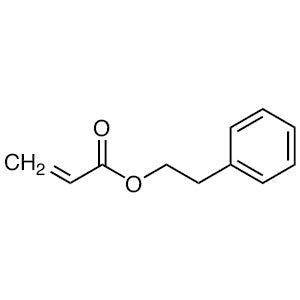
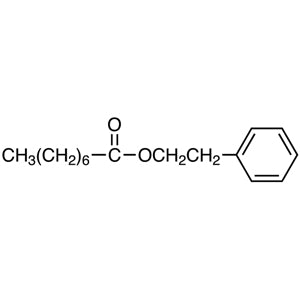
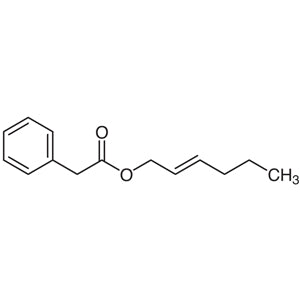
2-Phenylethyl Phenylacetate is an ester formed from phenylacetic acid and 2-phenylethyl alcohol. Its molecule carries two phenyl rings separated by an ester group. The compound is well known in the fragrance field for its soft, sweet aroma with honey and rose notes. In the chemistry laboratory, 2-Phenylethyl Phenylacetate serves as a non-heterocyclic building block, as a model compound in studies of aromatic esters, and as a reference standard in the analysis of aroma materials and flavour products. Supplied under the TCI brand, it suits both synthetic and analytical work.
Laboratories choose this compound mainly because of its relatively large molecular size. It is much less volatile than short-chain phenylacetate esters, which makes it useful as a fixative component or "base note" in perfume formulation research, where scent needs to last. Chemically, the ester group can be hydrolysed back into its two aromatic components, phenylacetic acid and 2-phenylethyl alcohol. The alpha hydrogens on the phenylacetyl portion also remain available for further reactions. This gives chemists a predictable, well-defined scaffold to work with. Because it is packed in gram quantities, it is handled by weighing, so doses can be measured precisely.
In Indonesia, 2-Phenylethyl Phenylacetate is relevant to laboratories in the perfume, soap, and cosmetics industries that need aroma materials with honey and floral character. Research and development teams can use it to test fragrance formulations and to study how long a scent lasts in finished products. Quality control laboratories can use it as a comparison standard when checking aroma raw materials. University chemistry departments may also use it in teaching and research on ester synthesis, hydrolysis, and the reactivity of aromatic compounds.
Related TCI products
- Non-heterocyclic building block synthesis: the reactive alpha hydrogens on the phenylacetyl portion and the hydrolysable ester group let chemists build more complex aromatic molecules from it.
- Aromatic ester model studies: two phenyl rings joined by a single ester linkage make it a clear, well-defined model for studying ester hydrolysis and aromatic ester behaviour.
- Fragrance formulation research: its low volatility compared with short-chain phenylacetate esters makes it a good candidate for testing fixatives and base notes in perfume prototypes.
- Reference standard for aroma analysis: its distinctive honey-rose character and defined structure make it useful as a comparison standard when analysing aroma materials and flavour products.
- Quality control in soap and cosmetics: industrial laboratories can use it to check incoming aroma raw materials and to confirm the fragrance profile of finished personal care products.
| Brand | TCI (product code P0126) |
|---|---|
| CAS number | 102-20-5 |
| Molecular formula | — |
| Purity | — |
| Category | Chemistry > Building Blocks > Non-Heterocyclic Building Blocks |
| Pack sizes | supplied in gram quantities |
| Physical form | not stated; refer to the TCI label and Certificate of Analysis |
| Storage | keep in a cool, dry place in the original tightly closed container |
Store 2-Phenylethyl Phenylacetate in its original tightly sealed container in a cool, dry, well-ventilated area, away from direct sunlight, heat sources, and ignition sources. Keep it apart from strong oxidising agents, strong acids, and strong bases, which could hydrolyse the ester group. If you transfer it, use clean, chemically resistant glass containers that are clearly labelled. Wear safety glasses, gloves, and a lab coat when handling it. Weigh and dispense it in a fume hood or a well-ventilated area, avoid contact with skin and eyes, and do not breathe in vapours. Always read the supplier's Safety Data Sheet before use, and dispose of waste according to local regulations.
—
Produk Terkait
-
2-PhenylethylAcetate TCI A0692
Regular price From Rp 769.650,00Regular price -
N-(1-Phenylethyl)acetamide TCI P3170
Regular price From Rp 1.035.300,00Regular price -
2-PhenylethylAcrylate TCI P2888
Regular price From Rp 1.538.250,00Regular price -
2-Phenylethyln-Octanoate TCI P2741
Regular price From Rp 1.298.850,00Regular price -
2-PhenylethylMethacrylate(stabilizedwithHQ) TCI P2714
Regular price From Rp 1.298.850,00Regular price -
2-PhenylethylPropionate TCI P1823
Regular price Rp 689.850,00Regular price -
N-(2-Phenylethyl)acetamide TCI P1066
Regular price Rp 1.724.100,00Regular price -
trans-2-Hexen-1-ylPhenylacetate TCI P1045
Regular price Rp 1.298.850,00Regular price