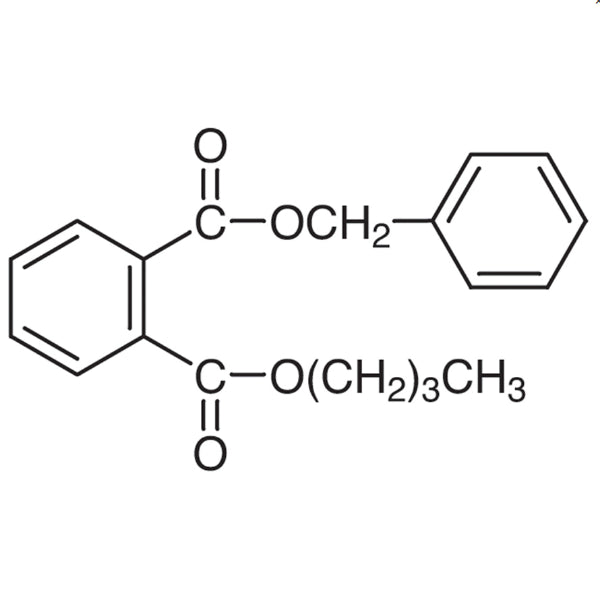
Benzyl Butyl Phthalate (BBP), with CAS number 85-68-7, is a chemical compound widely used as a polymer additive in laboratory applications related to materials science. It serves as a plasticizer, playing a crucial role in modifying the physical properties of polymers. BBP is commonly utilized in research settings to enhance the flexibility, durability, and overall performance of polymer-based materials. Its versatility makes it an essential component in the development of advanced materials with specific functional characteristics.
BBP is prized for its chemical stability, non-volatile nature, and ability to disperse uniformly within polymer matrices. These properties ensure consistent performance and long-term reliability in various applications. Its solubility in organic solvents further simplifies handling and integration into polymer formulations. The compound is colorless and has a mild odor, making it suitable for use in a wide range of laboratory environments. Its predictable behavior and compatibility with different polymer systems contribute to its popularity among researchers and industrial chemists.
In Indonesian laboratories, BBP is frequently employed in polymer research and development. It is used to create materials with specific properties such as flexibility, thermal resistance, and mechanical strength. Its role in enhancing the performance of polymer-based products is vital in both academic and industrial settings. BBP is also used in the formulation of coatings, adhesives, and other composite materials, supporting a variety of scientific and commercial applications.
Related TCI products
- TCI B2715 126198-74-1 Benzyl Isononyl Phthalate (mixture of branched chain isomers)
- TCI P1344 84-75-3 Dihexyl Phthalate
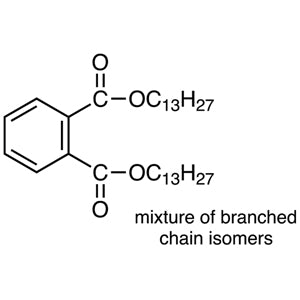
- TCI P0307 75359-31-8 Ditridecyl Phthalate (mixture of branched chain isomers)
- TCI P0306 131-16-8 Dipropyl Phthalate
- TCI P0305 84-62-8 Diphenyl Phthalate
- TCI P0302 131-11-3 Dimethyl Phthalate
- Polymer modification research for enhancing flexibility and mechanical strength in synthetic materials.
- Development of thermoplastic compounds requiring improved thermal stability and durability.
- Formulation of adhesives and coatings where consistent performance and chemical stability are essential.
- Testing of polymer blends to optimize physical properties such as elasticity and impact resistance.
- Creation of composite materials with tailored properties for use in industrial and scientific applications.
| Brand | TCI |
|---|---|
| CAS number | 85-68-7 |
| Molecular formula | — |
| Purity | — |
| Category | Materials Science > Polymer/Macromolecule Reagents > Polymer Additives |
| Pack sizes | Available in standard laboratory quantities |
| Physical form | Colorless liquid |
| Storage | Store in a cool, dry place away from direct sunlight |
BBP should be stored in a cool, dry environment, away from direct sunlight and sources of heat. It is recommended to use sealed containers made of glass or high-density polyethylene to prevent contamination and evaporation. Due to its chemical stability, it does not require refrigeration but should be kept in a well-ventilated area. When handling BBP, it is advisable to use appropriate personal protective equipment such as gloves and safety goggles to ensure safety. The compound is non-volatile and does not emit harmful vapors under normal conditions, making it suitable for routine laboratory use with standard safety protocols in place.
—
Produk Terkait
-
BenzylIsononylPhthalate(mixtureofbranchedchainisomers) TCI B2715
Regular price Rp 955.500,00Regular price -
DihexylPhthalate TCI P1344
Regular price From Rp 1.565.550,00Regular price -
DitridecylPhthalate(mixtureofbranchedchainisomers) TCI P0307
Regular price Rp 477.750,00Regular price -
DipropylPhthalate TCI P0306
Regular price From Rp 1.590.750,00Regular price -
DiphenylPhthalate TCI P0305
Regular price From Rp 875.700,00Regular price -
DimethylPhthalate TCI P0302
Regular price From Rp 505.050,00Regular price -
DiisopropylPhthalate TCI P0301
Regular price From Rp 2.227.050,00Regular price -
DiisononylPhthalate(mixtureofbranchedchainisomers) TCI P0300
Regular price Rp 769.650,00Regular price