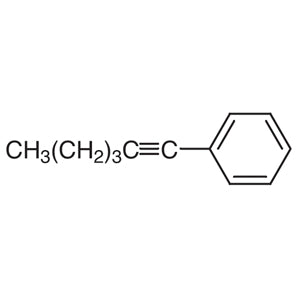
TCI P0360 1-Phenyl-1-hexyne is an internal alkyne with a phenyl group on one side of the carbon–carbon triple bond and a butyl chain on the other. It belongs to the non-heterocyclic building block category and suits researchers who need an unsymmetrical alkyne substrate with both aryl and alkyl character. In synthetic chemistry laboratories, 1-phenyl-1-hexyne is a starting material for substituted alkenes, carbonyl compounds and a range of cyclic frameworks, all prepared through reactions at the triple bond. It is also widely used as a model substrate when chemists develop new catalytic methods.
Researchers choose this compound mainly because it is unsymmetrical. The phenyl and butyl groups give the two alkyne carbons different electronic and steric environments, which makes the molecule well suited to testing the regioselectivity of a reaction. In semi-hydrogenation studies, it shows whether a catalyst stops at the alkene stage and whether it gives the cis or trans isomer selectively. The phenyl group also absorbs UV light, so reaction progress is easy to follow with UV detectors and thin-layer chromatography. As a TCI product, it is supplied at consistent quality, which helps keep experimental results reproducible from batch to batch.
In Indonesian laboratories, 1-phenyl-1-hexyne is mostly used in university organic chemistry research groups, catalysis laboratories and graduate research projects that study alkyne transformations. Research teams developing hydrogenation, hydrofunctionalization or cyclization methods often use it as a benchmark substrate to compare catalyst performance against published results. It also has a place in advanced synthesis coursework and in industrial research and development laboratories that build intermediate scaffolds, where a reliable, well-characterized alkyne supports method validation and routine synthetic planning.
- Regioselectivity studies: the phenyl and butyl substituents give the two alkyne carbons distinct electronic and steric environments, so product ratios show clearly how selective a reaction is.
- Semi-hydrogenation catalyst testing: the substrate helps researchers judge whether a catalyst stops at the alkene stage and gives the cis or trans isomer selectively.
- Synthesis of substituted alkenes: reactions at the triple bond turn this internal alkyne into substituted alkene products that are useful as intermediates in multistep organic synthesis.
- Preparation of carbonyl compounds and cyclic frameworks: the triple bond can be converted into carbonyl compounds or used to build cyclic frameworks, which makes the compound a versatile non-heterocyclic building block.
- Reaction monitoring in method development: the phenyl group makes UV detection and thin-layer chromatography straightforward, so researchers can follow conversion easily while optimizing new catalytic methods.
| Brand | TCI (product code P0360) |
|---|---|
| CAS number | 1129-65-3 |
| Molecular formula | — |
| Purity | — |
| Category | Chemistry > Building Blocks > Non-Heterocyclic Building Blocks |
| Pack sizes | please confirm the available pack sizes with AMI Scientific when ordering |
| Physical form | refer to the TCI product specification and certificate of analysis |
| Storage | follow the storage conditions stated on the TCI label and safety data sheet |
Store 1-Phenyl-1-hexyne in its original, tightly closed TCI container in a cool, dry and well-ventilated area, away from heat, sparks, open flames and direct sunlight. Keep it apart from strong oxidizing agents, and follow any specific temperature or inert-atmosphere requirements on the product label or safety data sheet. Handle the compound in a fume hood, wearing chemical-resistant gloves, safety glasses and a laboratory coat. Avoid inhaling vapors and avoid contact with skin and eyes. After use, reseal the container promptly. Dispose of waste and residues according to institutional procedures and local regulations for organic chemical waste.
—
Produk Terkait
-
5-Methyl-1-hexyne TCI M0271
Regular price Rp 1.008.000,00Regular priceRp 704.550,00Sale price Rp 1.008.000,00 -
3-Hexyne TCI H0430
Regular price From Rp 1.035.300,00Regular priceRp 723.450,00Sale price From Rp 1.035.300,00 -
2-Hexyne TCI H0429
Regular price From Rp 637.350,00Regular priceRp 445.200,00Sale price From Rp 637.350,00 -
1-Hexyne TCI H0140
Regular price From Rp 1.590.750,00Regular priceRp 1.111.950,00Sale price From Rp 1.590.750,00 -
2,5-Dimethyl-3-hexyne-2,5-diol TCI D0738
Regular price From Rp 689.850,00Regular priceRp 497.700,00Sale price From Rp 689.850,00 -
6-Chloro-1-hexyne TCI C1493
Regular price Rp 1.298.850,00Regular priceRp 908.250,00Sale price Rp 1.298.850,00 -
1,3,5-Triethynylbenzene TCI T2760
Regular price From Rp 3.578.400,00Regular priceRp 2.502.150,00Sale price From Rp 3.578.400,00 -
1-Butyl-4-ethynylbenzene TCI B2301
Regular price From Rp 980.700,00Regular priceRp 685.650,00Sale price From Rp 980.700,00