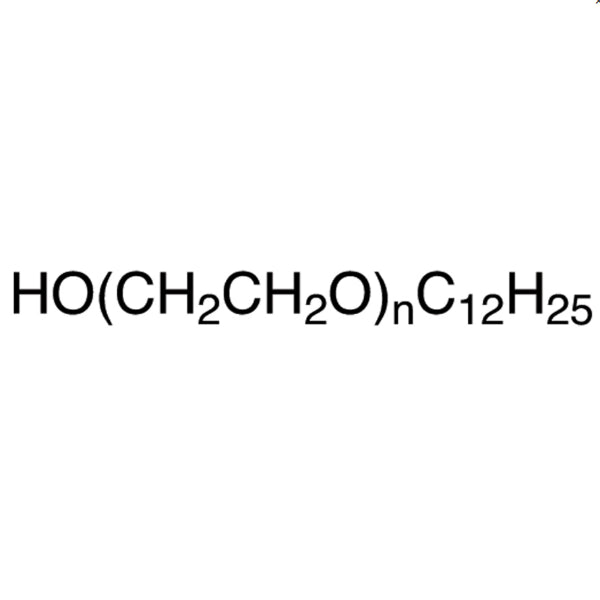
Polyethylene Glycol Monododecyl Ether (n=approx 25) from TCI (product code P0671) is a nonionic surfactant. Its hydrophobic dodecyl (C12) tail is attached to a polyethylene glycol chain that carries an average of about 25 ethylene oxide units. The compound is an alkyl polyethoxylate, a class of surfactants used widely in materials chemistry, biochemistry and formulation laboratories. In the lab it lowers surface tension, stabilises emulsions and dispersions, and helps hydrophobic compounds dissolve in water.
The long polyethoxylate chain makes this surfactant fairly hydrophilic. It dissolves or disperses readily in water and forms micelles at suitable concentrations. Because the molecule carries no charge, it is less likely to disrupt protein structure than ionic surfactants. It is also less sensitive to the ionic strength of the solution. For these reasons, researchers often choose it for formulations that must stay stable in buffer solutions and for work with sensitive biological systems where harsher ionic detergents could change the results.
In Indonesia, this material suits pharmaceutical laboratories that develop emulsion or nanoparticle dosage forms. It also suits biochemistry laboratories that need a mild detergent for wash buffers and protein extraction, and materials science groups that study polymer additives, dispersion stability and surface modification. University research groups, quality control laboratories and product development teams can use it as a well-characterised reference surfactant when they compare formulations or build their own experimental protocols.
Related TCI products
- TCI T0768 3055-94-5 Triethylene Glycol Monododecyl Ether
- TCI P3064 9005-00-9 Polyethylene Glycol Monostearyl Ether (n=approx. 20)
- TCI P2885 9005-08-7 Polyethylene Glycol Distearate (n=approx. 10)
- TCI P0873 9002-93-1 Polyethylene Glycol Mono-4-octylphenyl Ether (n=approx. 10)
- TCI P0872 9004-81-3 Polyethylene Glycol Monolaurate (n=approx. 10)
- TCI P0841 9004-95-9 Polyethylene Glycol Monocetyl Ether (n=approx. 23)
- Emulsion formulation: as a nonionic surfactant, it lowers interfacial tension between oil and water phases, so researchers can prepare and stabilise emulsions for pharmaceutical or cosmetic development work.
- Nanoparticle preparation: its hydrophilic polyethoxylate chain helps stabilise particle dispersions in water, which makes it useful when developing nanoparticle-based delivery systems in pharmaceutical laboratories.
- Protein extraction and wash buffers: it carries no charge and tends not to denature proteins, so it works well as a mild detergent in biochemistry buffers used for washing steps and protein extraction.
- Solubilisation of hydrophobic compounds: above suitable concentrations it forms micelles that can hold poorly water-soluble substances in aqueous media, which supports analytical and formulation experiments.
- Polymer additive research: as a polymer additive, it suits materials science studies of dispersion stability, surface tension behaviour and surface modification of polymer systems.
| Brand | TCI (product code P0671) |
|---|---|
| CAS number | 9002-92-0 |
| Molecular formula | — |
| Purity | — |
| Category | Materials Science > Polymer/Macromolecule Reagents > Polymer Additives |
| Pack sizes | available in the pack sizes offered by TCI for this product code |
| Physical form | — |
| Storage | keep tightly closed in a cool, dry place; follow the TCI label and Safety Data Sheet |
- Composition: dodecyl (C12) ether of polyethylene glycol, average of approximately 25 ethylene oxide units
Store Polyethylene Glycol Monododecyl Ether (n=approx 25) in its original, tightly sealed container, in a cool, dry, well-ventilated area away from direct sunlight, heat sources and strong oxidising agents. Close the container promptly after each use so the material does not absorb moisture or get contaminated. When handling it, wear standard laboratory protective equipment, including gloves, safety glasses and a lab coat, and avoid contact with eyes and skin. Use clean spatulas or pipettes to prevent cross-contamination. Read the TCI Safety Data Sheet before use for specific hazard, handling and disposal guidance, and dispose of waste according to local regulations.
—
Product Categories
Produk Terkait
-
TriethyleneGlycolMonododecylEther TCI T0768
Regular price Rp 18.628.050,00Regular price -
PolyethyleneGlycolMonostearylEther(n=approx.20) TCI P3064
Regular price From Rp 505.050,00Regular price -
PolyethyleneGlycolDistearate(n=approx.10) TCI P2885
Regular price Rp 1.220.100,00Regular price -
PolyethyleneGlycolMono-4-octylphenylEther(n=approx.10) TCI P0873
Regular price From Rp 557.550,00Regular price -
PolyethyleneGlycolMonolaurate(n=approx.10) TCI P0872
Regular price From Rp 477.750,00Regular price -
PolyethyleneGlycolMonocetylEther(n=approx.23) TCI P0841
Regular price From Rp 477.750,00Regular price -
PolyethyleneGlycolMonostearate(n=approx.55)(palmitateandstearatemixture) TCI P0723
Regular price From Rp 477.750,00Regular price -
PolyethyleneGlycolMonostearate(n=approx.45)(palmitateandstearatemixture) TCI P0722
Regular price From Rp 477.750,00Regular price