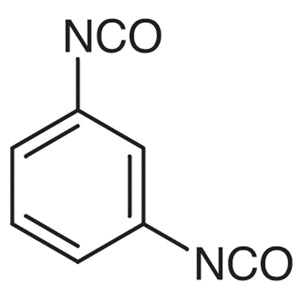
1,3-Phenylene Diisocyanate from TCI, also known as m-phenylene diisocyanate, is an aromatic compound that carries two isocyanate groups (–N=C=O) at the meta positions of a benzene ring. It belongs to the monomer group within polymer and macromolecule reagents. In the laboratory, it is used to prepare polyurethanes and polyureas through reaction with diols or diamines. It also serves as a crosslinking agent that links polymer chains together. Because each molecule has two reactive groups, it can join two other molecules at the same time.
Researchers choose 1,3-Phenylene Diisocyanate because its aromatic isocyanate groups react strongly with nucleophiles such as alcohols, amines, and water, so polymerization can proceed efficiently. The meta geometry on the ring gives polymer chains a bent shape. Compared with the para isomer, this shape changes the crystallinity, stiffness, and thermal behavior of the final material. The molecule is also small and structurally simple. That makes it a good model monomer for studying how polymer structure relates to properties, and a useful reagent for modifying material surfaces that carry hydroxyl or amine groups.
In Indonesia, this material is relevant to university and research laboratories that work in polymer chemistry, materials science, and coatings or adhesives development. Research groups can use it to synthesize polyurethane and polyurea samples, test how monomer geometry affects material properties, and prepare crosslinked networks for thesis and applied research projects. Industrial R&D laboratories can also use it for formulation studies and surface modification experiments, where a well-defined aromatic diisocyanate from an established brand such as TCI keeps results consistent.
TCI brochures (PDF)
- Raw Materials for Polyimide Synthesis 2026-05-11 · p. 7
- Biomaterials Research Reagents 2025-02-19 · p. 17
- Monomers 2025-05-28 · p. 28
Related TCI products
- TCI P1640 104-49-4 1,4-Phenylene Diisocyanate
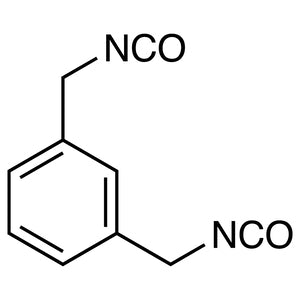
- TCI X0022 3634-83-1 m-Xylylene Diisocyanate
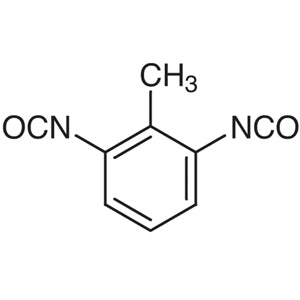
- TCI T1153 91-08-7 Tolylene-2,6-diisocyanate
- TCI T0264 26471-62-5 Tolylene Diisocyanate (2,4- ca. 80%, 2,6- ca. 20%)
- TCI T0263 584-84-9 Tolylene-2,4-diisocyanate
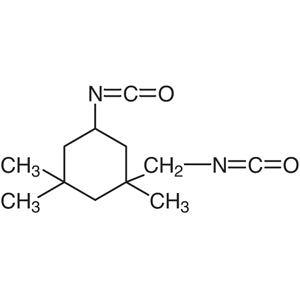
- TCI I0314 4098-71-9 Isophorone Diisocyanate (mixture of isomers)
- Polyurethane synthesis: the two aromatic isocyanate groups react efficiently with diols, so the compound works as a reactive monomer for building polyurethane chains in controlled laboratory polymerizations.
- Polyurea preparation: its high reactivity toward amines lets researchers form polyurea linkages with diamines, which makes it practical for synthesizing and comparing polyurea materials at research scale.
- Polymer crosslinking: because each molecule has two reactive isocyanate groups, it can join two polymer chains at once, which makes it an effective crosslinker for building network structures.
- Structure–property studies: its small, simple structure and bent meta geometry make it a useful model monomer for studying how chain shape affects crystallinity, stiffness, and thermal behavior compared with the para isomer.
- Surface modification: the isocyanate groups react readily with hydroxyl and amine groups, so the compound can be used to functionalize or modify material surfaces that carry these reactive sites.
| Brand | TCI (product code P1092) |
|---|---|
| CAS number | 123-61-5 |
| Molecular formula | — |
| Purity | — |
| Category | Materials Science > Polymer/Macromolecule Reagents > Monomers |
| Pack sizes | check the product listing for available TCI pack sizes |
| Physical form | see the TCI product specification and certificate of analysis |
| Storage | keep tightly sealed and protected from moisture, following TCI's label recommendations |
Isocyanate groups react with water, so store 1,3-Phenylene Diisocyanate in its original, tightly closed container and protect it from moisture and humid air. Keep the container in a cool, dry, well-ventilated area, away from alcohols, amines, and other nucleophilic substances it can react with. Follow the storage conditions on the TCI label and safety data sheet. Handle the compound in a fume hood and wear suitable gloves, safety glasses, and a lab coat. Avoid inhaling dust or vapors and avoid contact with skin and eyes, because isocyanates are known respiratory and skin sensitizers. Reseal the container promptly after each use, and dispose of waste according to local laboratory chemical waste regulations.
—
Product Categories
- Polymer/Macromolecule ReagentsMonomersIsocyanate Monomers
- Polymer/Macromolecule ReagentsPolyimide Raw MaterialsDiisocyanates [Polyimide Raw Materials]
- Biomaterials/Biocompatible Materials Research ReagentsMonomers and Macromonomers [Biomaterials/Biocompatible Materials Research Reagents]Isocyanate Monomers [Biomaterials/Biocompatible Materials Research Reagents]
Produk Terkait
-
1,4-PhenyleneDiisocyanate TCI P1640
Regular price Rp 2.491.650,00Regular priceRp 1.741.950,00Sale price Rp 2.491.650,00 -
m-XylyleneDiisocyanate TCI X0022
Regular price Rp 848.400,00Regular priceRp 593.250,00Sale price Rp 848.400,00 -
Tolylene-2,6-diisocyanate TCI T1153
Regular price Rp 823.200,00Regular priceRp 575.400,00Sale price Rp 823.200,00 -
TolyleneDiisocyanate(2,4-ca.80%,2,6-ca.20%) TCI T0264
Regular price Rp 717.150,00Regular priceRp 500.850,00Sale price Rp 717.150,00 -
Tolylene-2,4-diisocyanate TCI T0263
Regular price Rp 505.050,00Regular priceRp 352.800,00Sale price Rp 505.050,00 -
IsophoroneDiisocyanate(mixtureofisomers) TCI I0314
Regular price Rp 530.250,00Regular priceRp 370.650,00Sale price Rp 530.250,00 -
Dicyclohexylmethane4,4'-Diisocyanate(mixtureofisomers) TCI D2380
Regular price Rp 795.900,00Regular priceRp 556.500,00Sale price Rp 795.900,00 -
TrimethylhexamethyleneDiisocyanate(2,2,4-and2,4,4-mixture) TCI T1176
Regular price Rp 743.400,00Regular priceRp 519.750,00Sale price Rp 743.400,00