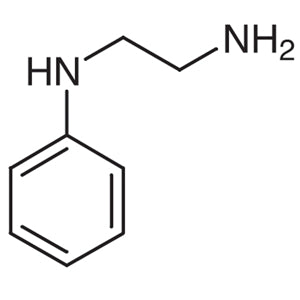
N-Phenylethylenediamine is a chemical compound widely used as a building block in various chemical reactions, particularly in the synthesis of complex molecules. Its unique structure enables substitution and condensation reactions with other molecules, making it a key component in the creation of heterocyclic compounds and organic molecules. In the laboratory, this compound plays a crucial role in constructing more complex chemical structures, supporting both research and product development efforts. Its versatility allows it to be applied across multiple scientific disciplines, contributing to advancements in organic chemistry and industrial chemical processes.
The compound is chemically stable under certain conditions but remains highly sensitive to temperature and humidity. Its basic nature requires careful handling during storage and use to maintain its integrity. These properties make it a preferred choice for researchers seeking reliable and effective reagents for synthetic applications. Its stability and reactivity are well-suited for controlled laboratory environments, ensuring consistent results in chemical synthesis and experimentation.
In Indonesian laboratories, N-Phenylethylenediamine is extensively used by researchers and educational institutions for research and development purposes. Its relevance spans across organic chemistry, pharmaceuticals, and material science, making it a fundamental reagent in both academic and industrial settings. The compound’s availability and applicability further enhance its importance in the chemical research landscape of Indonesia.
- Organic synthesis: N-Phenylethylenediamine is ideal for organic synthesis due to its ability to participate in substitution and condensation reactions, enabling the formation of complex molecular structures.
- Heterocyclic compound development: Its structural versatility makes it a valuable reagent in the synthesis of heterocyclic compounds, which are essential in pharmaceutical and material science applications.
- Industrial chemical processes: The compound is used in industrial chemical processes where controlled reactivity and structural modification are required to produce specialized organic products.
- Research and development in academia: Indonesian laboratories rely on this compound for experimental research, supporting innovation in chemical and pharmaceutical studies.
- Material science applications: Its ability to form stable chemical bonds makes it suitable for the development of new materials with specific functional properties.
| Brand | TCI |
|---|---|
| CAS number | 1664-40-0 |
| Molecular formula | — |
| Purity | — |
| Category | Chemistry > Building Blocks > Non-Heterocyclic Building Blocks |
| Pack sizes | Available in various pack sizes to suit different laboratory needs |
| Physical form | Solid or liquid, depending on the specific product variant |
| Storage | Store in a cool, dry place away from moisture and heat |
N-Phenylethylenediamine should be stored in a cool, dry place to prevent degradation due to temperature and humidity exposure. It is recommended to use airtight containers to minimize moisture absorption, which can affect its chemical stability. Due to its basic nature, it should be handled with appropriate personal protective equipment, such as gloves and goggles, to ensure safety. In laboratory settings, it should be stored separately from strong oxidizing agents to avoid potential chemical interactions. Regular monitoring of storage conditions is advised to maintain the compound’s integrity and effectiveness for experimental use. Proper labeling and storage practices are essential to ensure safe handling and prevent accidental exposure.
—
Produk Terkait
-
meso-1,2-Diphenylethylenediamine TCI D3930
Regular price From Rp 1.908.900,00Regular price -
(+/-)-1,2-Diphenylethylenediamine TCI D2519
Regular price Rp 5.300.400,00Regular price -
N,N'-Diphenylethylenediamine TCI D0887
Regular price Rp 2.359.350,00Regular price -
Triphenylethylene TCI T1834
Regular price Rp 1.724.100,00Regular price -
2-PhenylethylAcetate TCI A0692
Regular price From Rp 769.650,00Regular price -
Tetraphenylethylene TCI T0167
Regular price From Rp 875.700,00Regular price -
N-(1-Phenylethyl)acetamide TCI P3170
Regular price From Rp 1.035.300,00Regular price -
2-PhenylethylAcrylate TCI P2888
Regular price From Rp 1.538.250,00Regular price