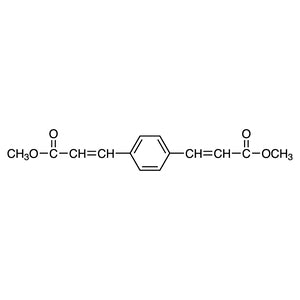
Dimethyl 1,4-Phenylenediacrylate is a chemical compound widely used as a building block in organic synthesis. It serves as a key reagent in the creation of polymers, coatings, and composite materials due to its ability to undergo efficient polymerization reactions. In laboratory settings, this compound plays a crucial role in the development of various chemical processes, particularly those involving cross-linking and chain extension. Its versatility makes it an essential component in both academic and industrial research environments.
The compound is known for its chemical stability and favorable reactivity under a range of reaction conditions. These properties make it a preferred choice for applications requiring high performance and durability. Its ability to maintain consistent behavior across different experimental setups ensures reliable results, which is vital for scientific research. The compound’s high purity and predictable physical properties further enhance its value in laboratory applications where precision is critical.
In Indonesian laboratories, Dimethyl 1,4-Phenylenediacrylate is commonly used in organic chemistry, material science, and polymer technology. It is a staple in research institutions and universities, supporting experiments related to polymer synthesis, material modification, and the development of new products. Its widespread use reflects its importance in advancing scientific knowledge and innovation in the region.
- Polymer synthesis for the development of advanced composite materials due to its efficient cross-linking properties.
- Coating formulation in industrial and academic settings to create durable and protective layers on various surfaces.
- Material modification research to enhance the mechanical and thermal properties of polymers and composites.
- Organic chemistry experiments where controlled polymerization reactions are required for structural analysis and functional group manipulation.
- Development of new products in polymer technology, leveraging the compound’s reactivity and stability in different chemical environments.
| Brand | TCI |
|---|---|
| CAS number | 7549-44-2 |
| Molecular formula | — |
| Purity | — |
| Category | Chemistry > Building Blocks > Non-Heterocyclic Building Blocks |
| Pack sizes | Available in various quantities as per standard laboratory supply options |
| Physical form | Solid, typically in crystalline or powder form |
| Storage | Store in a cool, dry place away from direct sunlight and moisture |
Dimethyl 1,4-Phenylenediacrylate should be stored in a cool, dry environment to maintain its chemical stability. It is recommended to keep the compound in a sealed container to prevent exposure to moisture and air, which could affect its reactivity. Suitable storage containers include glass or high-density polyethylene vessels that are resistant to chemical degradation. In laboratory settings, it is important to handle the compound with appropriate personal protective equipment, such as gloves and safety goggles, to ensure safe handling. The compound should be stored away from incompatible materials, such as strong oxidizing agents, to prevent any potential chemical interactions. Regular inspection of storage conditions and container integrity is advised to maintain the compound’s quality and safety for use in experiments.
—
Produk Terkait
-
TCI B5774 5,10-Bis(4,4,5,5-tetramethyl-1,3,2-dioxaborolan-2-yl)naphtho[1,2-c:5,6-c']bis([1,2,5]oxadiazole)
Regular price Rp 10.255.350,00Regular price -
Dihydroiodide TCI B6569
Regular price From Rp 1.936.200,00Regular price -
Trifluoromethanesulfonate TCI B7003
Regular price From Rp 1.936.200,00Regular price
![5,10-Bis(4,4,5,5-tetramethyl-1,3,2-dioxaborolan-2-yl)naphtho[1,2-c:5,6-c']bis([1,2,5]oxadiazole) - TCI B5774 - AMI Scientific](http://amiscientific.com/cdn/shop/files/TCI2510B5774.jpg?v=1769180228&width=533)