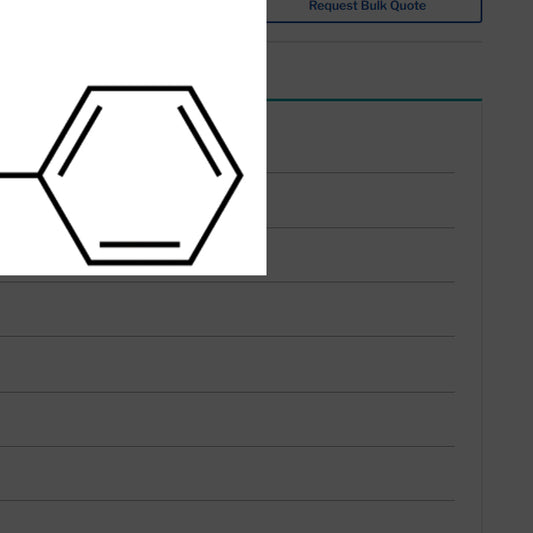
4-Phenoxybutyl Chloride from TCI is an alkyl chloride with a four-carbon chain whose other end is joined to a phenoxy group through an ether bond. The molecule has three parts: a phenyl ring, an ether bridge, and a butyl chain that ends in a chlorine atom. It is classed as a non-heterocyclic building block. In the laboratory it works as an alkylating agent that attaches a 4-phenoxybutyl group to nitrogen, oxygen, sulfur, or carbon atoms on other molecules. This makes it a linker that carries a phenyl ether unit into the target structure.
Its reactivity profile makes it a common choice. The primary chlorine atom at the end of the chain is a reasonably good leaving group for bimolecular nucleophilic substitution. The reaction runs faster with heating, in polar aprotic solvents, or when an iodide salt is added. The phenyl ether bond holds up under many reaction conditions, so the phenoxy part usually stays intact during alkylation. The four-carbon chain puts a flexible gap between the aromatic group and the new functional group. Chemists often use this spacing when they design bioactive compounds and ligands, which is why the reagent is useful in synthetic work that needs predictable results.
In organic chemistry and pharmaceutical laboratories in Indonesia, compounds like this are used to make amine, ether, and thioether derivatives that carry a phenoxybutyl side chain. University research groups use it in synthesis projects and student research that explore how chain length and aromatic groups affect a molecule's properties. Pharmaceutical development and contract research laboratories use it to prepare intermediates and analog series for structure–activity studies. Because it comes from TCI, users can expect consistent material from batch to batch.
Related TCI products
- N-alkylation of amines: the primary chloride reacts with amine nucleophiles by bimolecular substitution, attaching a 4-phenoxybutyl group to nitrogen to form secondary or tertiary amine derivatives.
- O-alkylation of phenols and alcohols: alkoxide or phenoxide nucleophiles displace the chlorine to form new ether linkages, and the original phenyl ether bond stays intact under these conditions.
- S-alkylation to form thioethers: thiol and thiolate nucleophiles react readily with the primary alkyl chloride, so the reagent can add a phenoxybutyl chain to sulfur-containing substrates.
- Linker introduction in medicinal chemistry: the flexible four-carbon spacer between the aromatic ring and the new functional group is useful when designing bioactive compounds and preparing analog series.
- Ligand design and synthesis: chemists can use the phenyl ether unit and butyl spacer to place an aromatic group at a set distance from a coordinating or binding site.
| Brand | TCI (product code P1386) |
|---|---|
| CAS number | 2651-46-9 |
| Molecular formula | — |
| Purity | — |
| Category | Chemistry > Building Blocks > Non-Heterocyclic Building Blocks |
| Pack sizes | as listed for TCI product P1386; please check the available options when ordering |
| Physical form | see the TCI product label and Safety Data Sheet |
| Storage | follow the storage conditions on the TCI label and Safety Data Sheet |
Store 4-Phenoxybutyl Chloride in its original tightly closed container in a cool, dry, well-ventilated place. Keep it away from heat, ignition sources, strong bases, strong oxidizers, and moisture. Follow the specific storage temperature on the TCI label. Handle it in a fume hood and wear chemical-resistant gloves, safety glasses, and a lab coat. Alkyl halides used as alkylating agents can irritate skin, eyes, and the respiratory tract, so avoid direct contact and do not breathe in vapors. Read the Safety Data Sheet before use, label secondary containers clearly, and dispose of waste as halogenated organic waste under local regulations.
—
Produk Terkait
-
4-PhenoxybutylBromide TCI P1851
Regular price Rp 1.829.100,00Regular priceRp 1.278.900,00Sale price Rp 1.829.100,00 -
Ethyl4-Phenoxybutyrate TCI P1286
Regular price Rp 3.207.750,00Regular priceRp 2.258.550,00Sale price Rp 3.207.750,00 -
4-IsopropoxybenzenesulfonylChloride TCI I0802
Regular price From Rp 2.597.700,00Regular priceRp 1.816.500,00Sale price From Rp 2.597.700,00 -
4-(Benzyloxy)benzylChloride TCI B5121
Regular price From Rp 1.724.100,00Regular priceRp 1.205.400,00Sale price From Rp 1.724.100,00 -
2-PhenoxypropionylChloride TCI P0638
Regular price From Rp 1.351.350,00Regular priceRp 960.750,00Sale price From Rp 1.351.350,00 -
beta-MethylcholineChloride TCI M1293
Regular price Rp 4.081.350,00Regular priceRp 2.869.650,00Sale price Rp 4.081.350,00 -
4-Methoxy-2-nitrobenzenesulfonylChloride TCI M1006
Regular price From Rp 1.115.100,00Regular priceRp 779.100,00Sale price From Rp 1.115.100,00 -
3-MethoxybenzylChloride TCI M0820
Regular price From Rp 1.035.300,00Regular priceRp 723.450,00Sale price From Rp 1.035.300,00