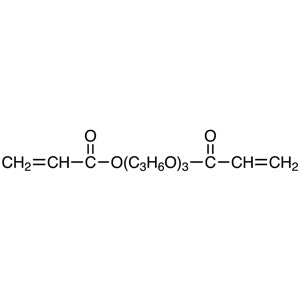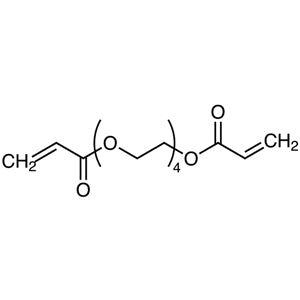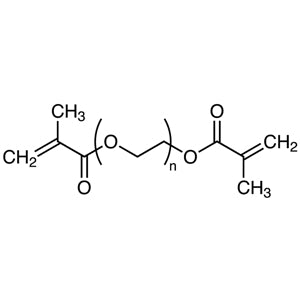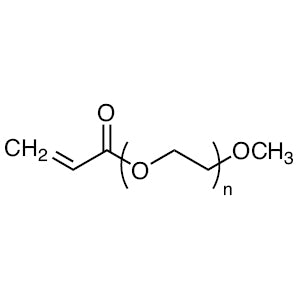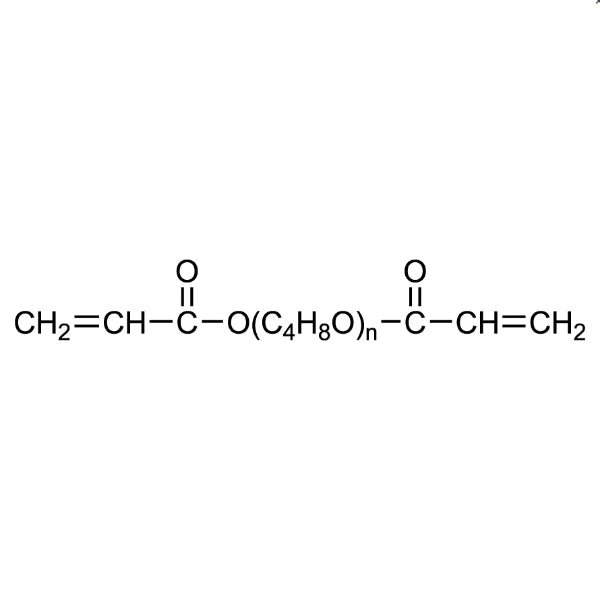
Polytetramethylene Glycol Diacrylate (n=approx. 9) from TCI is a diacrylate monomer. It consists of a polytetramethylene glycol chain, averaging about nine repeating units, with an acrylate group at each end. The product is stabilized with MEHQ to prevent premature polymerization. In the laboratory, it serves as a difunctional crosslinking agent for building polymer networks. It is mainly used in UV-curable resin formulations, elastomers, and soft materials where flexibility is required, which makes it a useful reagent for polymer and materials science research.
Researchers choose this compound because it combines the reactivity of two acrylate groups with a flexible, relatively hydrophobic polytetramethylene ether segment. The resulting polymer networks are less brittle, show good elasticity, and resist hydrolysis better than some polyester-based segments. The chain length of about nine units leaves enough distance between crosslinking points that researchers can tune the hardness and flexibility of the final material. The MEHQ stabilizer keeps the monomer stable during storage, and a suitable initiator can still overcome it when polymerization is wanted.
In Indonesia, this monomer suits research laboratories working on coatings, inks, adhesives, and resin-based three-dimensional printing through photopolymerization. University polymer chemistry groups, materials science departments, and industrial R&D teams can use it to study how crosslink density and the length of the flexible segment affect the mechanical behavior of cured networks. It also works well in teaching and exploratory projects that compare different diacrylate crosslinkers when developing flexible, durable polymer materials for local applications.
TCI brochures (PDF)
- Monomers 2025-05-28 · p. 9
Related TCI products
- TCI T2389 42978-66-5 Tripropylene Glycol Diacrylate (stabilized with MEHQ)
- TCI T1569 17831-71-9 Tetraethylene Glycol Diacrylate (stabilized with MEHQ)
- TCI T1352 25852-47-5 Polyethylene Glycol Dimethacrylate (n=approx 4) (stabilized with MEHQ)
- TCI P3110 26915-72-0 Polyethylene Glycol Monomethyl Ether Methacrylate (n=approx. 23) (stabilized with MEHQ)
- TCI P3108 26915-72-0 Polyethylene Glycol Monomethyl Ether Methacrylate (n=approx. 4) (stabilized with MEHQ)
- TCI P3107 32171-39-4 Polyethylene Glycol Monomethyl Ether Acrylate (n=approx. 23) (stabilized with MEHQ)
- UV-curable resin formulation: the two acrylate end groups react under photoinitiation, so the compound works well as a crosslinker for fast-curing, flexible resin systems.
- Elastomer and soft-material research: the polytetramethylene ether segment adds flexibility and elasticity, which helps produce networks that are less brittle than those made with shorter crosslinkers.
- Coatings and inks development: its hydrophobic, hydrolysis-resistant backbone helps researchers formulate cured films that perform well where moisture resistance and flexibility both matter.
- Adhesive formulation studies: as a difunctional monomer it builds crosslinked networks, and its flexible chain lets researchers balance bond strength against flexibility in adhesive systems.
- Resin-based 3D printing research: in photopolymerization printing resins, the spacing of about nine repeating units lets researchers tune the hardness and flexibility of printed parts.
| Brand | TCI (product code P2895) |
|---|---|
| CAS number | 52277-33-5 |
| Molecular formula | — |
| Purity | — |
| Category | Materials Science > Polymer/Macromolecule Reagents > Monomers |
| Pack sizes | available in the pack sizes listed for this TCI product; please check the product listing |
| Physical form | — |
| Storage | keep the stabilized monomer away from heat and light to prevent premature polymerization |
- Composition: polytetramethylene glycol diacrylate, n=approx. 9, stabilized with MEHQ
Store this product in its original, tightly closed manufacturer container in a cool, dry, well-ventilated area, away from direct sunlight, heat sources, and UV light. All of these can trigger premature polymerization of acrylate monomers. Keep it away from polymerization initiators, strong oxidizers, and incompatible reagents. Follow the storage conditions on the TCI label and safety data sheet. Acrylate monomers can irritate skin and eyes and may cause sensitization, so handle the material in a fume hood or well-ventilated workspace. Wear nitrile gloves, safety glasses, and a lab coat. Avoid prolonged contact. Clean up spills promptly, and dispose of waste according to local regulations and institutional laboratory safety procedures.
—
Product Categories
Produk Terkait
-
TripropyleneGlycolDiacrylate(stabilizedwithMEHQ) TCI T2389
Regular price From Rp 477.750,00Regular price -
TetraethyleneGlycolDiacrylate(stabilizedwithMEHQ) TCI T1569
Regular price Rp 955.500,00Regular price -
PolyethyleneGlycolDimethacrylate(n=approx4)(stabilizedwithMEHQ) TCI T1352
Regular price From Rp 505.050,00Regular price -
PolyethyleneGlycolMonomethylEtherMethacrylate(n=approx.23)(stabilizedwithMEHQ) TCI P3110
Regular price From Rp 1.220.100,00Regular price -
PolyethyleneGlycolMonomethylEtherMethacrylate(n=approx.4)(stabilizedwithMEHQ) TCI P3108
Regular price From Rp 1.220.100,00Regular price -
PolyethyleneGlycolMonomethylEtherAcrylate(n=approx.23)(stabilizedwithMEHQ) TCI P3107
Regular price From Rp 1.326.150,00Regular price -
PolyethyleneGlycolMonomethacrylate(n=approx5)(stabilizedwithMEHQ) TCI P3010
Regular price From Rp 1.193.850,00Regular price -
PolyethyleneGlycolMonomethylEtherAcrylate(n=approx13)(stabilizedwithMEHQ) TCI P2870
Regular price From Rp 1.035.300,00Regular price