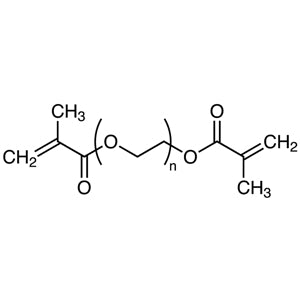
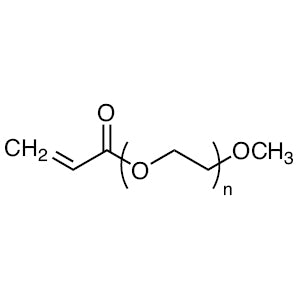
Polyethylene Glycol Monomethyl Ether Methacrylate (PEG-MEMA), also known as TCI P3108, is a monomer widely used in polymer synthesis within laboratory settings. It serves as a key building block for creating polymers with tailored properties, such as elasticity, thermal stability, and solubility. This material is particularly valuable in materials science and polymer chemistry due to its ability to undergo polymerization reactions, forming complex structures with specific functional characteristics. Its versatility makes it a preferred choice for researchers working on advanced polymer development and functional material synthesis.
The chemical stability and reactivity of PEG-MEMA make it a preferred choice in various scientific applications. Stabilized with MEHQ (methyl ethyl glycol hydroperoxide), this compound resists oxidation and maintains its integrity over extended periods, ensuring consistent performance in experiments. Its molecular structure allows for controlled crosslinking and chain extension, enabling the creation of polymers with precise mechanical and chemical properties. These features are essential for applications in biomedical engineering, coatings, and composite materials, where reliability and reproducibility are critical.
In Indonesian laboratories, PEG-MEMA is commonly used in polymer chemistry, material science, and biomedical research. It plays a vital role in the development of polymer-based products, including coatings, adhesives, and biocompatible materials. Its stability and reactivity make it a reliable component in both academic and industrial research settings, supporting innovation in advanced material development and scientific exploration.
TCI brochures (PDF)
- Biomaterials Research Reagents 2025-02-19 · p. 10
- Monomers 2025-05-28 · p. 8
Related TCI products
- TCI T1352 25852-47-5 Polyethylene Glycol Dimethacrylate (n=approx 4) (stabilized with MEHQ)
- TCI P3111 26915-72-0 Polyethylene Glycol Monomethyl Ether Methacrylate (Mw=ca 2100) (stabilized with MEHQ)
- TCI P3110 26915-72-0 Polyethylene Glycol Monomethyl Ether Methacrylate (n=approx. 23) (stabilized with MEHQ)
- TCI P3107 32171-39-4 Polyethylene Glycol Monomethyl Ether Acrylate (n=approx. 23) (stabilized with MEHQ)
- TCI P3010 25736-86-1 Polyethylene Glycol Monomethacrylate (n=approx 5) (stabilized with MEHQ)
- TCI P2895 52277-33-5 Polytetramethylene Glycol Diacrylate (n=approx. 9) (stabilized with MEHQ)
- Polymer synthesis for creating elastomers and thermoplastic materials due to its ability to undergo controlled polymerization reactions.
- Development of biocompatible materials for biomedical applications because of its non-toxic and stable chemical properties.
- Formulation of coatings and adhesives where controlled crosslinking and mechanical strength are required.
- Research in functional materials for applications in electronics and nanotechnology due to its tunable molecular structure.
- Preparation of composite materials where polymer matrix reinforcement and compatibility are essential factors.
| Brand | TCI |
|---|---|
| CAS number | 26915-72-0 |
| Molecular formula | — |
| Purity | — |
| Category | Materials Science > Polymer/Macromolecule Reagents > Monomers |
| Pack sizes | Available in various quantities as per supplier specifications |
| Physical form | Liquid |
| Storage | Store in a cool, dark place away from heat and direct sunlight |
This material should be stored in a cool, dark place to maintain its stability and prevent degradation. It is recommended to use airtight containers to minimize exposure to moisture and air, which can affect its chemical integrity. Due to its stabilizing agent, MEHQ, it is less prone to oxidation but still requires careful handling to ensure long-term performance. Laboratory personnel should wear appropriate personal protective equipment, such as gloves and safety goggles, when handling this compound. Avoid contact with skin and eyes, and ensure proper ventilation in the workspace to maintain a safe environment. Regular monitoring of storage conditions is advised to ensure optimal preservation of the material's properties.
—
Product Categories
Produk Terkait
-
PolyethyleneGlycolDimethacrylate(n=approx4)(stabilizedwithMEHQ) TCI T1352
Regular price Rp 505.050,00Regular priceRp 352.800,00Sale price Rp 505.050,00 -
PolyethyleneGlycolMonomethylEtherMethacrylate(Mw=ca2100)(stabilizedwithMEHQ) TCI P3111
Regular price Rp 1.326.150,00Regular priceRp 927.150,00Sale price Rp 1.326.150,00 -
PolyethyleneGlycolMonomethylEtherMethacrylate(n=approx.23)(stabilizedwithMEHQ) TCI P3110
Regular price Rp 1.220.100,00Regular priceRp 852.600,00Sale price Rp 1.220.100,00 -
PolyethyleneGlycolMonomethylEtherAcrylate(n=approx.23)(stabilizedwithMEHQ) TCI P3107
Regular price Rp 1.326.150,00Regular priceRp 927.150,00Sale price Rp 1.326.150,00 -
PolyethyleneGlycolMonomethacrylate(n=approx5)(stabilizedwithMEHQ) TCI P3010
Regular price Rp 1.246.350,00Regular priceRp 887.250,00Sale price Rp 1.246.350,00 -
PolytetramethyleneGlycolDiacrylate(n=approx.9)(stabilizedwithMEHQ) TCI P2895
Regular price Rp 1.008.000,00Regular priceRp 720.300,00Sale price Rp 1.008.000,00 -
PolyethyleneGlycolMonomethylEtherAcrylate(n=approx13)(stabilizedwithMEHQ) TCI P2870
Regular price Rp 1.087.800,00Regular priceRp 775.950,00Sale price Rp 1.087.800,00 -
PolyethyleneGlycolDimethacrylate(n=approx14)(stabilizedwithMEHQ) TCI P2760
Regular price Rp 610.050,00Regular priceRp 426.300,00Sale price Rp 610.050,00