

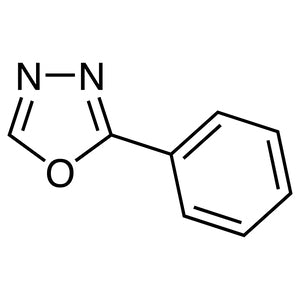
2-Phenyl-1,3,4-oxadiazole from TCI is a five-membered aromatic heterocyclic compound. Its ring contains one oxygen atom and two nitrogen atoms, and a phenyl group sits at the 2-position. The 1,3,4-oxadiazole ring is an important motif in both medicinal chemistry and materials science. In the laboratory, the compound serves as a heterocyclic building block for making oxadiazole derivatives. It is also used as a model compound for studying the reactivity of this ring system and as a starting material in organic materials research.
Researchers choose this compound because the 1,3,4-oxadiazole ring is electron-deficient and relatively stable, both thermally and chemically. In drug design, the ring can act as a bioisostere of ester or amide groups. Chemists often make this replacement to improve the metabolic stability of a molecule. In materials science, oxadiazole derivatives are known as electron-transport materials in organic electronic devices such as OLEDs. Because the 5-position is still unsubstituted, there is room for further functionalization, which lets researchers build more elaborate structures from this simple scaffold.
The compound is available in 200mg and 1g pack sizes, which suit exploratory research where small, well-defined quantities are needed. In Indonesia, it is relevant to medicinal chemistry research groups designing antimicrobial and other bioactive candidate molecules based on the oxadiazole ring. University organic synthesis laboratories, graduate research projects and materials science groups working on organic electronic materials may also find it useful as a reliable starting point for derivative synthesis and reactivity studies.
Related TCI products
- TCI B4473 273-09-6 2,1,3-Benzoxadiazole
- TCI B2169 2425-95-8 2,5-Bis(4-aminophenyl)-1,3,4-oxadiazole
- TCI B1066 1679-98-7 2,5-Bis(4-diethylaminophenyl)-1,3,4-oxadiazole
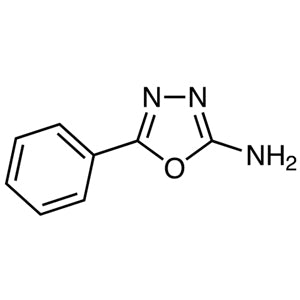
- TCI A3074 1612-76-6 2-Amino-5-phenyl-1,3,4-oxadiazole
- TCI P3198 15264-63-8 5-(Pyridin-4-yl)-1,3,4-oxadiazole-2(3H)-thione
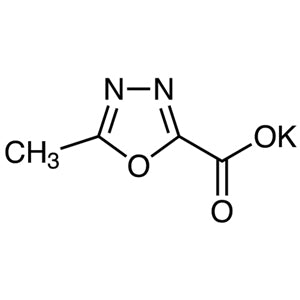
- TCI P2220 888504-28-7 Potassium 5-Methyl-1,3,4-oxadiazole-2-carboxylate
- Heterocyclic building block synthesis: the phenyl-substituted oxadiazole core gives a ready scaffold for preparing a range of 1,3,4-oxadiazole derivatives for further study.
- Medicinal chemistry and bioisostere design: the oxadiazole ring can replace ester or amide groups, so it helps researchers explore ways to improve the metabolic stability of candidate molecules.
- Reactivity model studies: as a simple, well-defined oxadiazole, it is a convenient model compound for investigating the chemical behaviour of the electron-deficient 1,3,4-oxadiazole ring.
- Organic electronic materials research: oxadiazole derivatives are known electron-transport materials in OLEDs, so this compound is a useful starting material for developing related organic materials.
- Further functionalization at the 5-position: the unsubstituted 5-position lets chemists introduce new groups, making it possible to build structurally diverse compound libraries for screening and exploratory research.
| Brand | TCI (product code P2946) |
|---|---|
| CAS number | 825-56-9 |
| Molecular formula | — |
| Purity | — |
| Category | Chemistry > Building Blocks > Heterocyclic Building Blocks |
| Pack sizes | 200mg and 1g |
| Physical form | refer to the manufacturer's label and Certificate of Analysis |
| Storage | follow the storage conditions stated on the TCI label and Safety Data Sheet |
Keep this compound in its original, tightly closed container in a cool, dry and well-ventilated place, away from direct sunlight, heat sources and incompatible substances such as strong oxidizing agents. Always follow the specific storage conditions given on the TCI label and Safety Data Sheet. Handle the material in a fume hood or a well-ventilated area. Wear suitable personal protective equipment, including a lab coat, safety glasses and chemical-resistant gloves. Avoid creating dust, and avoid inhalation and contact with skin or eyes. Label every container clearly, and dispose of waste according to institutional and local chemical waste regulations.
—
Produk Terkait
-
2,1,3-Benzoxadiazole TCI B4473
Regular price From Rp 928.200,00Regular price -
2,5-Bis(4-aminophenyl)-1,3,4-oxadiazole TCI B2169
Regular price From Rp 1.115.100,00Regular price -
2,5-Bis(4-diethylaminophenyl)-1,3,4-oxadiazole TCI B1066
Regular price Rp 1.378.650,00Regular price -
2-Amino-5-phenyl-1,3,4-oxadiazole TCI A3074
Regular price From Rp 1.140.300,00Regular price -
5-(Pyridin-4-yl)-1,3,4-oxadiazole-2(3H)-thione TCI P3198
Regular price From Rp 848.400,00Regular price -
Potassium5-Methyl-1,3,4-oxadiazole-2-carboxylate TCI P2220
Regular price Rp 769.650,00Regular price -
1H-[1,2,4]Oxadiazolo[4,3-a]quinoxalin-1-one TCI O0400
Regular price Rp 5.539.800,00Regular price -
4-Methoxy-7-nitrobenzo[c][1,2,5]oxadiazole TCI M3965
Regular price Rp 6.281.100,00Regular price



![41443-28-1 1H-[1,2,4]Oxadiazolo[4,3-a]quinoxalin-1-one - AMI Scientific](http://amiscientific.com/cdn/shop/files/TCI2510O0400.jpg?v=1767131865&width=533)
![18333-73-8 4-Methoxy-7-nitrobenzo[c][1,2,5]oxadiazole - AMI Scientific](http://amiscientific.com/cdn/shop/files/TCI2510M3965.jpg?v=1767129021&width=533)