TCI P3322, 2-(1,3-Dioxoisoindolin-2-yl)-1,1,3,3-tetramethylisouronium Hexafluorophosphate, is a uronium/isouronium salt coupling reagent that carries a phthalimide group. Its structure resembles popular coupling reagents such as HBTU, but its activating group comes from N-hydroxyphthalimide. In organic synthesis laboratories it is used to activate carboxylic acids, mainly to form N-(acyloxy)phthalimide esters. These esters are known as redox-active esters and are widely used in modern radical chemistry.
Its main advantage is that it converts a carboxylic acid directly into an active ester in a single step. This approach avoids using a carbodiimide and N-hydroxyphthalimide as separate components. The procedure is therefore shorter, and purification can be simpler because no urea by-products from carbodiimides need to be removed. The redox-active esters it produces are key precursors for decarboxylative reactions, such as nickel-catalysed cross-coupling and photoredox transformations. The hexafluorophosphate anion makes the reagent a solid salt that is easy to weigh accurately.
In Indonesia, this reagent suits organic chemistry and medicinal chemistry laboratories that are starting to use photocatalysis and other radical-based synthetic methods. University research groups, pharmaceutical development laboratories and synthetic chemistry teams can use it to make redox-active esters from many different carboxylic acids. Because it simplifies the activation step, it fits well in methodology development, building-block preparation and the exploratory synthesis of new compounds for research projects.
Advantages (TCI brochure)
- Enables easy preparation of redox active esters (RAEs)
- Suitable for in situ decarboxylative cross coupling via electrochemical reactions
- Available in large quantities to support bulk supply requirements
TCI brochures (PDF)
- Condensing Agent Enabling Redox Active Ester (RAEs) Formation 2026-04-14 · p. 1
Related TCI products
- TCI T2929 265651-18-1 N,N,N',N'-Tetramethyl-O-(N-succinimidyl)uronium Hexafluorophosphate
- TCI B4805 105379-24-6 O-(Benzotriazol-1-yl)-N,N,N',N'-bis(tetramethylene)uronium Hexafluorophosphate
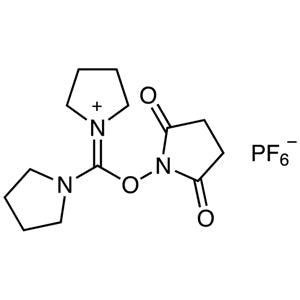
- TCI B3817 207683-26-9 N,N,N',N'-Bis(tetramethylene)-O-(N-succinimidyl)uronium Hexafluorophosphate
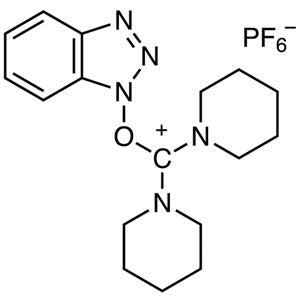
- TCI B3816 206752-41-2 O-(Benzotriazol-1-yl)-N,N,N',N'-bis(pentamethylene)uronium Hexafluorophosphate
- TCI B2680 132705-51-2 Bromotripyrrolidinophosphonium Hexafluorophosphate
- TCI B1774 128625-52-5 1H-Benzotriazol-1-yloxytripyrrolidinophosphonium Hexafluorophosphate [Coupling Reagent for Peptide]
- Carboxylic acid activation: the reagent turns carboxylic acids directly into N-(acyloxy)phthalimide active esters in one step, without a separate carbodiimide.
- Redox-active ester preparation: it gives straightforward access to the N-(acyloxy)phthalimide esters used as radical precursors in modern decarboxylative radical chemistry.
- Nickel-catalysed decarboxylative cross-coupling: the esters it produces are important starting materials for nickel-catalysed reactions that build new carbon–carbon bonds from carboxylic acids.
- Photoredox catalysis research: laboratories studying visible-light photoredox reactions can use the redox-active esters it forms as convenient sources of carbon-centred radicals.
- Medicinal chemistry building-block synthesis: its single-step activation and simpler purification help chemists turn diverse carboxylic acids into new structural fragments more efficiently.
From the TCI brochure
- Preparation of RAE from a carboxylic acid with DIPEA as base in CH2Cl2 at r.t.
- Decarboxylative sp2–sp3 cross-coupling with NiCl2dme (cat.), dtbbpy (cat.), NaI in DMA at r.t. under electrochemical conditions, using sodium carboxylates as starting materials
| Brand | TCI (product code P3322) |
|---|---|
| CAS number | 2226728-58-9 |
| Molecular formula | — |
| Purity | — |
| Category | Chemistry > Synthetic Reagents > Coupling [Synthetic Reagents] |
| Pack sizes | as listed on the product page |
| Physical form | solid (hexafluorophosphate salt) |
| Storage | follow the conditions on the TCI label and Safety Data Sheet |
Store this reagent in its original, tightly closed container, as stated on the manufacturer's label and Safety Data Sheet. Keep it in a cool, dry, well-ventilated area away from moisture, heat and incompatible materials. Like other coupling reagents, it should be protected from humidity to keep it reactive, so reseal the container promptly after use. Weigh and handle it in a fume hood or a well-ventilated area. Wear suitable personal protective equipment, including a lab coat, safety glasses and chemical-resistant gloves. Avoid creating dust, breathing it in, or letting it touch skin and eyes. Dispose of waste according to institutional and local chemical waste regulations.
References cited in the TCI brochure
- Jiang Wang. Ketones from Nickel‐Catalyzed Decarboxylative, Non‐Symmetric Cross‐Electrophile Coupling of Carboxylic Acid Esters Angewandte Chemie International Edition, 2019. doi:10.1002/anie.201906000
- Takaoki Koyanagi. One-Pot Electrochemical Nickel-Catalyzed Decarboxylative Sp2–Sp3 Cross-Coupling Organic Letters, 2019. doi:10.1021/acs.orglett.8b04090
Produk Terkait
-
N,N,N',N'-Tetramethyl-O-(N-succinimidyl)uroniumHexafluorophosphate TCI T2929
Regular price From Rp 1.246.350,00Regular priceRp 887.250,00Sale price From Rp 1.246.350,00 -
O-(Benzotriazol-1-yl)-N,N,N',N'-bis(tetramethylene)uroniumHexafluorophosphate TCI B4805
Regular price From Rp 1.220.100,00Regular priceRp 868.350,00Sale price From Rp 1.220.100,00 -
N,N,N',N'-Bis(tetramethylene)-O-(N-succinimidyl)uroniumHexafluorophosphate TCI B3817
Regular price From Rp 1.351.350,00Regular priceRp 960.750,00Sale price From Rp 1.351.350,00 -
O-(Benzotriazol-1-yl)-N,N,N',N'-bis(pentamethylene)uroniumHexafluorophosphate TCI B3816
Regular price From Rp 875.700,00Regular priceRp 627.900,00Sale price From Rp 875.700,00 -
BromotripyrrolidinophosphoniumHexafluorophosphate TCI B2680
Regular price From Rp 1.510.950,00Regular priceRp 1.072.050,00Sale price From Rp 1.510.950,00 -
1H-Benzotriazol-1-yloxytripyrrolidinophosphoniumHexafluorophosphate[CouplingReagentforPeptide] TCI B1774
Regular price From Rp 1.033.200,00Regular priceRp 738.150,00Sale price From Rp 1.033.200,00 -
1H-Benzotriazol-1-yloxytris(dimethylamino)phosphoniumHexafluorophosphate[CouplingReagentforPeptide] TCI B1651
Regular price From Rp 848.400,00Regular priceRp 609.000,00Sale price From Rp 848.400,00 -
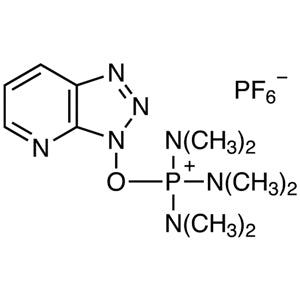
(7-Azabenzotriazol-1-yloxy)tris(dimethylamino)phosphoniumHexafluorophosphate TCI A2782
Regular price Rp 2.147.250,00Regular priceRp 1.517.250,00Sale price Rp 2.147.250,00