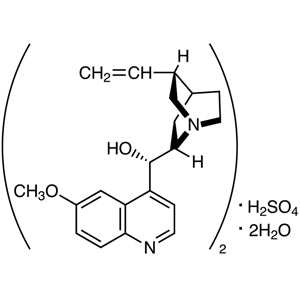
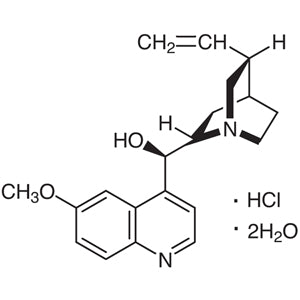
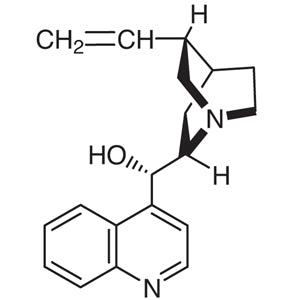
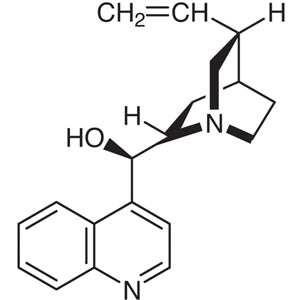
Quinidine from TCI, product code Q0006, is a natural cinchona alkaloid obtained from the bark of the Cinchona tree, with CAS number 56-54-2. Quinidine is a diastereomer of quinine: the two compounds share the same molecular formula but differ in spatial configuration at certain chiral centres. In modern chemistry laboratories, quinidine is valued as a chiral catalyst, chiral ligand and chiral reagent for asymmetric synthesis, the branch of synthesis that selectively produces one enantiomer of a target molecule over the other.
Chemists choose quinidine because its rigid chiral framework holds several functional groups. These include a basic quinuclidine nitrogen, a hydroxyl group that can form hydrogen bonds, and an aromatic quinoline ring. Together, these features let quinidine activate substrates and steer how reactants approach each other, so reactions proceed stereoselectively. For this reason, quinidine and its derivatives are widely used in organocatalysis, in phase-transfer catalysis, and as ligand scaffolds for asymmetric dihydroxylation. Quinidine also has a pseudo-enantiomeric relationship with quinine, so researchers can obtain the opposite enantiomer of a product by switching between the two alkaloids.
In Indonesia, quinidine is relevant to university organic chemistry research groups, pharmaceutical and natural product laboratories, and synthesis teams working on enantiomerically enriched compounds. Researchers studying stereoselective methods, building chiral intermediates, or teaching the principles of asymmetric catalysis can use quinidine as a dependable starting point. Because it is supplied under the TCI brand, laboratories can run comparative studies with quinine and build on a large body of published research that uses cinchona alkaloids as chiral tools.
TCI brochures (PDF)
- Asymmetric Organocatalysts 2025-06-12 · p. 8
- Traditional Medicine/Crude Medicine Research Reagents 2024-09-11 · p. 1
- Chiral Auxiliaries and Optical Resolving Agents 2025-06-17 · p. 6
- Alkaloids 2025-10-10 · p. 5
- Asymmetric Synthesis 2026-03-18 · p. 5
- Plant Research Reagents 2026-02-24 · p. 8
- Asymmetric organocatalysis: the basic quinuclidine nitrogen and the hydrogen-bonding hydroxyl group work together to activate substrates and favour one enantiomer of the product.
- Phase-transfer catalysis: quinidine-derived catalysts transfer reactive species between phases inside a chiral environment, which makes them suitable for enantioselective reactions under mild biphasic conditions.
- Ligand scaffold for asymmetric dihydroxylation: the rigid chiral quinidine framework is a well-established base for ligands that guide the stereoselective dihydroxylation of alkenes.
- Access to opposite enantiomers: because quinidine is the pseudo-enantiomer of quinine, researchers can switch between the two alkaloids to obtain either enantiomer of a target product.
- Chiral reagent in stereoselective synthesis research: its combination of a quinoline ring, a hydroxyl group and a quinuclidine nitrogen makes it useful for studying how a chiral environment directs the approach of reactants.
| Brand | TCI (product code Q0006) |
|---|---|
| CAS number | 56-54-2 |
| Molecular formula | — |
| Purity | — |
| Category | Chemistry > Asymmetric Synthesis > Chiral Catalysts, Chiral Ligands, Chiral Reagents |
| Pack sizes | as listed on the product page |
| Physical form | solid |
| Storage | keep tightly closed in a cool, dry place, protected from light |
Store quinidine in its original, tightly sealed container in a cool, dry, well-ventilated area, away from direct light, moisture and sources of heat. Keep it apart from strong oxidising agents and strong acids. Follow the storage conditions on the TCI label and Safety Data Sheet. Handle it while wearing suitable personal protective equipment, including gloves, safety glasses and a laboratory coat. Weigh and transfer the material in a fume hood or another well-ventilated area to avoid inhaling dust and to prevent contact with skin and eyes. Clean up spills promptly, label containers clearly, and dispose of waste according to local regulations and institutional laboratory procedures.
—
Product Categories
- Biochemicals and ReagentsAlkaloidsQuinoline Alkaloids
- Biochemicals and ReagentsCrude Medicine Ingredients for Research and Experimental Use
- Cell BiologyCancer ResearchChemopreventive Agents [Cancer Research]
- Cell BiologyCancer Research
- Cell BiologyNutrition ResearchPhytochemicals
- Pharmaceutical Development and Drug Discovery ResearchCrude Medicine Ingredients for Research and Experimental Use
Produk Terkait
-
Quinine TCI Q0028
Regular price From Rp 3.232.950,00Regular priceRp 2.276.400,00Sale price From Rp 3.232.950,00 -
QuinidineSulfateDihydrate TCI Q0010
Regular price From Rp 848.400,00Regular priceRp 609.000,00Sale price From Rp 848.400,00 -
(-)-Dihydroquinine TCI D6112
Regular price From Rp 2.147.250,00Regular priceRp 1.517.250,00Sale price From Rp 2.147.250,00 -
QuinineHydrochlorideDihydrate TCI Q0030
Regular price Rp 1.670.550,00Regular priceRp 1.183.350,00Sale price Rp 1.670.550,00 -
Cinchonine TCI C0350
Regular price From Rp 1.590.750,00Regular priceRp 1.127.700,00Sale price From Rp 1.590.750,00 -
Cinchonidine TCI C0347
Regular price From Rp 2.439.150,00Regular priceRp 1.720.950,00Sale price From Rp 2.439.150,00 -
(8alpha,9S)-6'-Methoxycinchonan-9-amineTrihydrochloride TCI M3873
Regular price Rp 3.153.150,00Regular priceRp 2.220.750,00Sale price Rp 3.153.150,00 -
UrsolicAcid TCI U0065
Regular price From Rp 1.908.900,00Regular priceRp 1.350.300,00Sale price From Rp 1.908.900,00