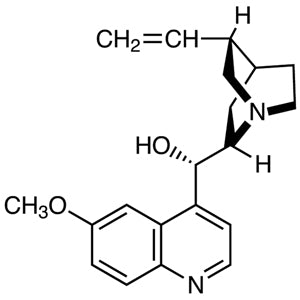
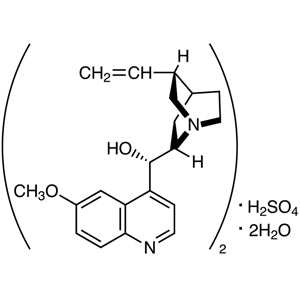
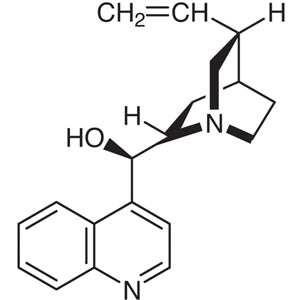
Quinine Hydrochloride Dihydrate TCI Q0030 is the hydrochloride salt of the cinchona alkaloid quinine, supplied as the dihydrate. The salt keeps the chiral framework of quinine and dissolves better in water and polar solvents than the free base. It belongs to the chiral catalysts, chiral ligands, and chiral reagents category. In the laboratory, it is used in asymmetric synthesis research and analytical studies. It is also a convenient source of quinine for preparing aqueous solutions.
Researchers choose the hydrochloride dihydrate form because its composition is well defined and it is easy to handle. Its fixed water content allows accurate stoichiometric calculations when preparing solutions of a specific concentration. Because it dissolves better in water, it works well in aqueous systems such as fluorescence measurements and biological assays. When a synthesis needs free quinine, the free base can be recovered by neutralization and extraction. The salt also keeps quinine's value as a resolving agent and as a starting material for chiral catalysts.
In Indonesia, quinine hydrochloride dihydrate serves analytical chemistry, pharmaceutical, and organic synthesis laboratories at universities and research institutions. Analytical groups use it to prepare aqueous quinine solutions. Synthesis groups working on asymmetric methods use it as a stable, well-characterized source of the cinchona scaffold. Its defined composition and practical handling make it a sensible stock reagent for teaching laboratories, graduate research projects, and institutional research programs across the country.
TCI brochures (PDF)
- Asymmetric Organocatalysts 2025-06-12 · p. 8
- Traditional Medicine/Crude Medicine Research Reagents 2024-09-11 · p. 1
- Alkaloids 2025-10-10 · p. 5
- Asymmetric Synthesis 2026-03-18 · p. 5
- Plant Research Reagents 2026-02-24 · p. 8
- Phytochemicals 2025-12-17 · p. 4
- Asymmetric synthesis research: the salt keeps the chiral quinine framework intact, so it can serve as a reliable source of a cinchona alkaloid for developing and studying enantioselective reactions.
- Preparation of aqueous quinine solutions: it dissolves better in water than the free base, which makes it practical for solutions used in aqueous experimental systems.
- Fluorescence measurements: its good water solubility makes it easy to use in aqueous fluorescence work, and its defined composition supports reproducible solution preparation.
- Chiral resolution studies: the salt keeps quinine's potential as a resolving agent, and the free base can be recovered by neutralization and extraction when needed.
- Starting material for chiral catalysts: the free base can be regenerated from the salt, giving synthesis laboratories a convenient entry point for preparing quinine-derived chiral catalysts and ligands.
| Brand | TCI (product code Q0030) |
|---|---|
| CAS number | 6119-47-7 |
| Molecular formula | — |
| Purity | — |
| Category | Chemistry > Asymmetric Synthesis > Chiral Catalysts, Chiral Ligands, Chiral Reagents |
| Pack sizes | available in TCI standard pack sizes; please ask for the available options |
| Physical form | hydrochloride salt in dihydrate form; refer to the TCI certificate of analysis for details |
| Storage | keep tightly closed under the conditions given on the TCI label and safety data sheet |
Store Quinine Hydrochloride Dihydrate in its original, tightly closed container in a cool, dry, well-ventilated place, away from direct sunlight and incompatible materials. Follow the storage conditions given on the TCI label and safety data sheet. A tightly sealed container helps keep the defined water content stable, which matters for accurate stoichiometry. When handling the material, wear gloves, safety glasses, and a laboratory coat. Weigh and transfer it in a way that keeps dust to a minimum, ideally under local exhaust ventilation. Avoid contact with skin and eyes, and do not breathe in the dust. Label all prepared solutions clearly, and dispose of waste according to institutional and local chemical waste rules.
—
Product Categories
- Biochemicals and ReagentsAlkaloidsQuinoline Alkaloids
- Biochemicals and ReagentsAntibioticsAntibiotics (by Application)
- Biochemicals and ReagentsCrude Medicine Ingredients for Research and Experimental Use
- Biochemicals and ReagentsPharmaceutical Research Reagents (for Experimental Use)Antiparasitic Ingredients, Antiprotozoal Ingredients, Antihelminthic Ingredients (for Research and Experimental Use)
- Cell BiologyNutrition ResearchPhytochemicals
- MicrobiologyAntibioticsAntibiotics (by Application)
- MicrobiologyEfflux Pump ResearchEfflux Pump Inhibitors
- Pharmaceutical Development and Drug Discovery ResearchPharmaceutical Research Reagents (for Experimental Use)Antiparasitic Ingredients, Antiprotozoal Ingredients, Antihelminthic Ingredients (for Research and Experimental Use)
- Pharmaceutical Development and Drug Discovery ResearchAntibioticsAntibiotics (by Application)
- Pharmaceutical Development and Drug Discovery ResearchCrude Medicine Ingredients for Research and Experimental Use
Produk Terkait
-
Quinine TCI Q0028
Regular price From Rp 3.232.950,00Regular priceRp 2.276.400,00Sale price From Rp 3.232.950,00 -
Quinidine TCI Q0006
Regular price From Rp 1.538.250,00Regular priceRp 1.090.950,00Sale price From Rp 1.538.250,00 -
(-)-Dihydroquinine TCI D6112
Regular price From Rp 2.147.250,00Regular priceRp 1.517.250,00Sale price From Rp 2.147.250,00 -
QuinidineSulfateDihydrate TCI Q0010
Regular price From Rp 848.400,00Regular priceRp 609.000,00Sale price From Rp 848.400,00 -
(8alpha,9S)-6'-Methoxycinchonan-9-amineTrihydrochloride TCI M3873
Regular price Rp 3.153.150,00Regular priceRp 2.220.750,00Sale price Rp 3.153.150,00 -
Cinchonine TCI C0350
Regular price From Rp 1.590.750,00Regular priceRp 1.127.700,00Sale price From Rp 1.590.750,00 -
Cinchonidine TCI C0347
Regular price From Rp 2.439.150,00Regular priceRp 1.720.950,00Sale price From Rp 2.439.150,00 -
LevamisoleHydrochloride TCI T1215
Regular price From Rp 1.801.800,00Regular priceRp 1.275.750,00Sale price From Rp 1.801.800,00