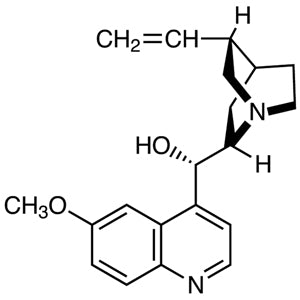
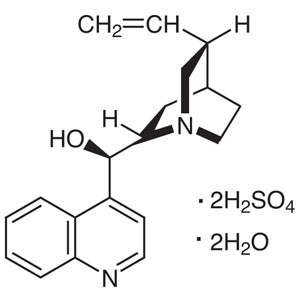
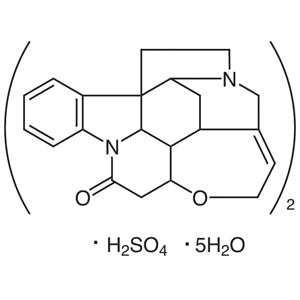
Quinidine Sulfate Dihydrate from TCI, product code Q0010, is the sulfate salt of the cinchona alkaloid quinidine in its dihydrate form, with CAS number 6591-63-5. The salt has the same chiral quinidine framework: a quinoline ring, a quinuclidine system and a secondary hydroxyl group. Because it is a salt, it is easier to handle than the free base. In the laboratory it is used as an organocatalyst, as a source of quinidine for asymmetric synthesis, and as a reference material in pharmaceutical research.
Researchers often choose the sulfate dihydrate salt because it is generally more soluble in water and polar solvents than the free base. This makes stock solutions easier to prepare for experiments in aqueous media or mixed solvent systems. As a stable crystalline salt, it can also be weighed accurately, which helps keep results reproducible. When the free base is needed, quinidine can be recovered by simple neutralization before it is used as a catalyst or ligand. Its rigid chiral framework, with a hydrogen-bond donor group and a basic nitrogen, is what drives its catalytic activity in enantioselective reactions.
In Indonesia, quinidine sulfate dihydrate is relevant to research groups working on organocatalysis and asymmetric synthesis at universities, research institutes and industrial R&D laboratories. Pharmaceutical research teams can also use it as a reference material when studying cinchona alkaloids and related compounds. Its water solubility suits laboratories that run reactions or analyses in aqueous or polar solvent systems. Its convenient salt form supports routine teaching, method development and exploratory synthesis work.
TCI brochures (PDF)
- Asymmetric Organocatalysts 2025-06-12 · p. 8
- Traditional Medicine/Crude Medicine Research Reagents 2024-09-11 · p. 1
- Alkaloids 2025-10-10 · p. 5
- Asymmetric Synthesis 2026-03-18 · p. 5
- Plant Research Reagents 2026-02-24 · p. 8
- Phytochemicals 2025-12-17 · p. 4
- Organocatalysis: the rigid chiral quinidine framework, with its basic nitrogen and hydrogen-bond donor group, can promote enantioselective reactions in research on metal-free catalytic methods.
- Source of quinidine for asymmetric synthesis: researchers can neutralize the sulfate salt to recover the quinidine free base, then use it as a chiral catalyst, ligand or starting scaffold.
- Pharmaceutical reference material: as a well-defined salt of a known cinchona alkaloid, it can serve as a reference substance in pharmaceutical research and comparative analytical work.
- Aqueous and polar solvent experiments: the salt is generally more soluble in water and polar solvents than the free base, so stock solutions for these media are easier to prepare.
- Chiral ligand preparation: once neutralized, the quinidine framework with its quinoline and quinuclidine units can serve as a chiral ligand in studies of stereoselective transformations.
| Brand | TCI (product code Q0010) |
|---|---|
| CAS number | 6591-63-5 |
| Molecular formula | — |
| Purity | — |
| Category | Chemistry > Catalysis and Inorganic Chemistry > Organocatalysts [Catalysis] |
| Pack sizes | available in TCI standard pack sizes; please check the product page or contact AMI Scientific for current options |
| Physical form | crystalline sulfate salt, dihydrate form |
| Storage | follow the storage conditions on the TCI label and Safety Data Sheet |
Keep Quinidine Sulfate Dihydrate in its original tightly closed container, in a cool, dry and well-ventilated place away from direct light and incompatible materials. Follow the storage conditions on the TCI label and Safety Data Sheet. Close the container promptly after use to protect the dihydrate form from changes in moisture. Quinidine is a pharmacologically active alkaloid, so handle it with suitable personal protective equipment, including gloves, safety glasses and a lab coat. Avoid creating dust or inhaling it, and avoid contact with skin and eyes. Weigh the material in a fume hood or ventilated enclosure. Dispose of any waste according to local regulations and institutional laboratory safety procedures.
—
Product Categories
Produk Terkait
-
Quinidine TCI Q0006
Regular price From Rp 1.538.250,00Regular priceRp 1.090.950,00Sale price From Rp 1.538.250,00 -
QuinineHydrochlorideDihydrate TCI Q0030
Regular price Rp 1.670.550,00Regular priceRp 1.183.350,00Sale price Rp 1.670.550,00 -
Quinine TCI Q0028
Regular price From Rp 3.232.950,00Regular priceRp 2.276.400,00Sale price From Rp 3.232.950,00 -
(8alpha,9S)-6'-Methoxycinchonan-9-amineTrihydrochloride TCI M3873
Regular price Rp 3.153.150,00Regular priceRp 2.220.750,00Sale price Rp 3.153.150,00 -
CinchonidineSulfateDihydrate TCI C0349
Regular price Rp 1.326.150,00Regular priceRp 942.900,00Sale price Rp 1.326.150,00 -
(-)-Dihydroquinine TCI D6112
Regular price From Rp 2.147.250,00Regular priceRp 1.517.250,00Sale price From Rp 2.147.250,00 -
BerberineSulfate TCI B0451
Regular price From Rp 1.378.650,00Regular priceRp 979.650,00Sale price From Rp 1.378.650,00 -
StrychnineSulfatePentahydrate TCI S0094
Regular price Rp 4.213.650,00Regular priceRp 2.962.050,00Sale price Rp 4.213.650,00