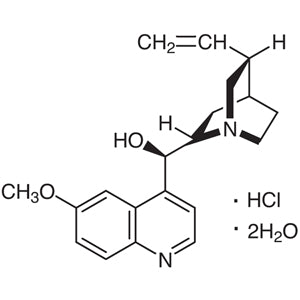
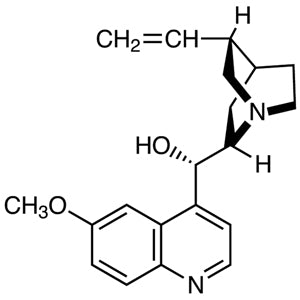
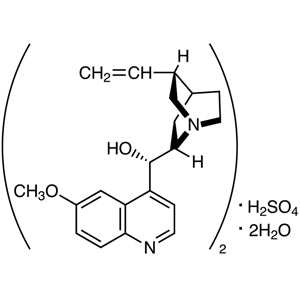
TCI Q0028 Quinine (CAS 130-95-0) is a natural alkaloid taken from the bark of the cinchona tree. It is best known as an antimalarial drug, but in modern chemistry laboratories it is used for much more than pharmaceuticals. The molecule has several chiral centres and joins a quinoline ring to a quinuclidine system. For this reason, quinine belongs to the category of chiral catalysts, chiral ligands and chiral reagents for asymmetric synthesis. This branch of chemistry aims to make one enantiomer selectively instead of a racemic mixture.
Chemists choose quinine because its chiral structure is well defined and it is readily available from natural sources. Its basic quinuclidine nitrogen and its secondary hydroxyl group can work together in bifunctional organocatalysis. Together they activate a nucleophile and an electrophile at the same time inside a chiral environment, which steers the reaction towards one stereochemical outcome. Derivatives of cinchona alkaloids are also important ligands in metal-catalysed asymmetric reactions. Quinine can also act as a resolving agent, separating racemic acids by forming diastereomeric salts. It is also known to fluoresce strongly in acidic solution.
In Indonesian laboratories, TCI Quinine is used in university organic chemistry research groups, in pharmaceutical development laboratories and in analytical facilities that study chiral separation or fluorescence methods. Research groups working on enantioselective methods use it as a starting catalyst or as a reference compound, while teaching laboratories use it to show the principles of stereochemistry. Quinine also has a special place in Indonesia's history, because Java was once an important source of cinchona bark. That makes this compound both scientifically useful and culturally meaningful for local researchers.
TCI brochures (PDF)
- Asymmetric Organocatalysts 2025-06-12 · p. 8
- Traditional Medicine/Crude Medicine Research Reagents 2024-09-11 · p. 1
- Chiral Auxiliaries and Optical Resolving Agents 2025-06-17 · p. 6
- Alkaloids 2025-10-10 · p. 5
- Plant Research Reagents 2026-02-24 · p. 8
- Phytochemicals 2025-12-17 · p. 4
- Bifunctional organocatalysis: the basic quinuclidine nitrogen and the secondary hydroxyl group activate the nucleophile and the electrophile at the same time inside a single chiral framework.
- Chiral ligand development for metal catalysis: cinchona alkaloid derivatives are key ligands in asymmetric metal-catalysed reactions, so quinine is a practical starting scaffold for building and modifying ligands.
- Resolution of racemic acids: quinine forms diastereomeric salts with chiral acids, so the enantiomers can be separated by classical crystallisation methods in preparative work.
- Fluorescence studies and method development: quinine fluoresces strongly in acidic solution, which makes it a useful compound for fluorescence experiments and instrument-related work in analytical laboratories.
- Teaching stereochemistry and asymmetric synthesis: its natural origin, multiple chiral centres and long history make quinine a clear example for showing chirality concepts to chemistry students.
| Brand | TCI (product code Q0028) |
|---|---|
| CAS number | 130-95-0 |
| Molecular formula | — |
| Purity | — |
| Category | Chemistry > Asymmetric Synthesis > Chiral Catalysts, Chiral Ligands, Chiral Reagents |
| Pack sizes | available in the pack sizes listed on this product page |
| Physical form | solid; see the TCI product specification for details |
| Storage | keep tightly closed in a cool, dry and dark place |
Store TCI Quinine in its original tightly closed container in a cool, dry, well-ventilated area, away from direct light and heat. Amber glass or other light-protective containers are best if the material has to be repackaged. Keep it away from strong oxidising agents and incompatible chemicals. When handling the compound, wear standard laboratory protective equipment, including gloves, safety glasses and a lab coat. Weigh the powder in a fume hood or ventilated enclosure so you do not breathe in dust. Label every container clearly, avoid contact with skin and eyes, and always read the TCI Safety Data Sheet before use and disposal.
—
Product Categories
- Biochemicals and ReagentsAlkaloidsQuinoline Alkaloids
- Biochemicals and ReagentsAntibioticsAntibiotics (by Application)
- Biochemicals and ReagentsCrude Medicine Ingredients for Research and Experimental Use
- Biochemicals and ReagentsPharmaceutical Research Reagents (for Experimental Use)Antiparasitic Ingredients, Antiprotozoal Ingredients, Antihelminthic Ingredients (for Research and Experimental Use)
- Cell BiologyNutrition ResearchPhytochemicals
- MicrobiologyAntibioticsAntibiotics (by Application)
- MicrobiologyEfflux Pump ResearchEfflux Pump Inhibitors
- Pharmaceutical Development and Drug Discovery ResearchPharmaceutical Research Reagents (for Experimental Use)Antiparasitic Ingredients, Antiprotozoal Ingredients, Antihelminthic Ingredients (for Research and Experimental Use)
- Pharmaceutical Development and Drug Discovery ResearchAntibioticsAntibiotics (by Application)
- Pharmaceutical Development and Drug Discovery ResearchCrude Medicine Ingredients for Research and Experimental Use
Produk Terkait
-
QuinineHydrochlorideDihydrate TCI Q0030
Regular price Rp 1.670.550,00Regular priceRp 1.183.350,00Sale price Rp 1.670.550,00 -
Quinidine TCI Q0006
Regular price From Rp 1.538.250,00Regular priceRp 1.090.950,00Sale price From Rp 1.538.250,00 -
(-)-Dihydroquinine TCI D6112
Regular price From Rp 2.147.250,00Regular priceRp 1.517.250,00Sale price From Rp 2.147.250,00 -
Cinchonine TCI C0350
Regular price From Rp 1.590.750,00Regular priceRp 1.127.700,00Sale price From Rp 1.590.750,00 -
Cinchonidine TCI C0347
Regular price From Rp 2.439.150,00Regular priceRp 1.720.950,00Sale price From Rp 2.439.150,00 -
QuinidineSulfateDihydrate TCI Q0010
Regular price From Rp 848.400,00Regular priceRp 609.000,00Sale price From Rp 848.400,00 -
(8alpha,9S)-6'-Methoxycinchonan-9-amineTrihydrochloride TCI M3873
Regular price Rp 3.153.150,00Regular priceRp 2.220.750,00Sale price Rp 3.153.150,00 -
LevamisoleHydrochloride TCI T1215
Regular price From Rp 1.801.800,00Regular priceRp 1.275.750,00Sale price From Rp 1.801.800,00