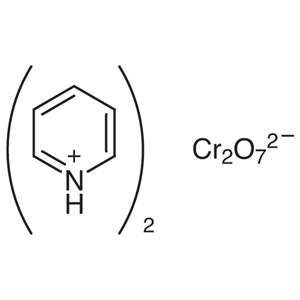
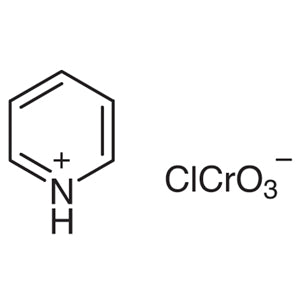
Quinolinium Dichromate (TCI Q0058), with the CAS number 56549-24-7, is a chemical reagent widely used in synthetic chemistry as an oxidizing agent. It plays a crucial role in laboratory settings by facilitating oxidation reactions, which are essential for the synthesis of complex organic and inorganic compounds. Its ability to selectively oxidize functional groups makes it a valuable tool for chemists aiming to modify molecular structures with precision. This reagent is particularly useful in reactions where controlled oxidation is required to achieve desired chemical transformations.
One of the key properties that make Quinolinium Dichromate a preferred choice is its chemical stability under specific conditions, which ensures consistent performance in laboratory experiments. It is highly reactive towards reducing agents, allowing it to efficiently accelerate oxidation processes without interfering with other reactions. Its solid form also simplifies storage and handling, making it a practical option for both research and educational laboratories. These characteristics contribute to its reliability and effectiveness in various chemical applications.
In Indonesian laboratories, Quinolinium Dichromate is commonly used in chemical research, especially in the synthesis of organic compounds and analytical chemistry. Its effectiveness in oxidation reactions makes it a trusted reagent among researchers and students. The compound’s versatility and performance in controlled environments ensure that it remains a key component in many laboratory workflows. Its consistent results and ease of use further enhance its popularity in both academic and industrial research settings.
TCI brochures (PDF)
- Oxidizing Agents 2025-06-11 · p. 6
- Transition Metal Catalysts 2026-04-10 · p. 6
Related TCI products
- Used in the synthesis of aromatic compounds due to its ability to selectively oxidize functional groups, enabling the formation of complex organic structures with high yield and purity.
- Applied in oxidation reactions for organic synthesis where controlled oxidation is necessary to achieve specific molecular transformations without unwanted side reactions.
- Employed in analytical chemistry for the oxidation of organic compounds, aiding in the identification and quantification of various chemical species through spectroscopic and chromatographic methods.
- Utilized in the preparation of chromate derivatives, where its strong oxidizing properties facilitate the formation of stable chromate complexes in solution.
- Integrated into laboratory protocols for the modification of functional groups, allowing chemists to introduce or remove specific chemical functionalities in target molecules.
| Brand | TCI |
|---|---|
| CAS number | 56549-24-7 |
| Molecular formula | — |
| Purity | — |
| Category | Chemistry > Synthetic Reagents > Oxidation [Synthetic Reagents] |
| Pack sizes | Available in various quantities as per supplier specifications |
| Physical form | Solid |
| Storage | Store in a cool, dry place away from reducing agents and moisture |
Quinolinium Dichromate should be stored in a cool, dry environment to maintain its chemical stability and prevent degradation. It is recommended to keep the reagent in a tightly sealed container to avoid exposure to moisture and air, which can affect its reactivity. Due to its strong oxidizing properties, it should be stored separately from reducing agents to prevent hazardous reactions. In laboratory settings, it is advisable to handle the compound with appropriate personal protective equipment, such as gloves and safety goggles, to ensure safety. Proper labeling and storage conditions are essential to maintain the integrity of the reagent and ensure safe usage in all laboratory applications.
—
Product Categories
Produk Terkait
-
Bis(tetrabutylammonium)Dichromate[OxidizingReagent] TCI B1123
Regular price Rp 1.723.050,00Regular priceRp 1.220.100,00Sale price Rp 1.723.050,00 -
PotassiumDichromate TCI P3156
Regular price From Rp 505.050,00Regular priceRp 352.800,00Sale price From Rp 505.050,00 -
PyridiniumDichromate TCI P0931
Regular price From Rp 795.900,00Regular priceRp 556.500,00Sale price From Rp 795.900,00 -
SodiumDichromateDihydrate TCI O0671
Regular price From Rp 530.250,00Regular priceRp 370.650,00Sale price From Rp 530.250,00 -
PyridiniumFluorochromate TCI P1088
Regular price Rp 2.094.750,00Regular priceRp 1.464.750,00Sale price Rp 2.094.750,00 -
PyridiniumChlorochromate TCI P0930
Regular price From Rp 875.700,00Regular priceRp 612.150,00Sale price From Rp 875.700,00