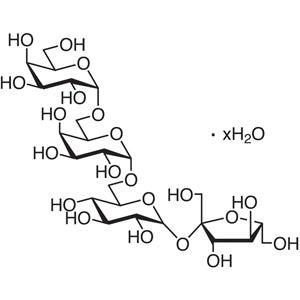
D-(+)-Raffinose Pentahydrate is a carbohydrate compound widely used in chemical and biochemical experiments. As a pentahydrate, it contains five water molecules per molecule of raffinose, making it highly soluble and easy to handle in laboratory settings. This compound plays a crucial role in various research areas, particularly in glycoscience, where it serves as a substrate or reagent in enzymatic reactions and the synthesis of complex molecules. Its presence in biological systems makes it a valuable tool for studying molecular interactions and structural analysis.
The stability of D-(+)-Raffinose Pentahydrate in terms of both physical and chemical properties makes it a preferred choice for laboratory applications. It maintains its integrity under a wide range of experimental conditions, ensuring reliable results in research. Its high purity and well-defined molecular structure allow for precise experimentation, especially in studies requiring accuracy and reproducibility. The pentahydrate form also facilitates easier handling and dissolution, enhancing its usability in diverse laboratory protocols.
In Indonesian laboratories, D-(+)-Raffinose Pentahydrate is commonly used in molecular biology, pharmaceutical, and organic chemistry research. It is frequently employed in studies related to carbohydrate metabolism and the development of new compounds. Many research institutions and universities in Indonesia rely on this compound for its versatility and reliability in experimental setups. Its application extends to both basic and applied research, supporting advancements in various scientific fields.
TCI brochures (PDF)
- Used in glycoscience research for studying molecular structure and interactions due to its well-defined chemical structure.
- Applied in enzymatic reaction studies as a substrate for enzymes involved in carbohydrate metabolism.
- Employed in the synthesis of complex organic compounds due to its reactivity and solubility properties.
- Utilized in biochemical experiments to investigate molecular interactions in biological systems.
- Integrated into pharmaceutical research for the development of new drug compounds and metabolic studies.
| Brand | TCI |
|---|---|
| CAS number | 17629-30-0 |
| Molecular formula | — |
| Purity | — |
| Category | Chemistry > Chemical Biology > Glycoscience |
| Pack sizes | Available in various quantities as per standard laboratory supply options |
| Physical form | Crystalline solid in pentahydrate form |
| Storage | Store in a cool, dry place away from moisture and direct sunlight |
D-(+)-Raffinose Pentahydrate should be stored in a cool, dry environment to maintain its stability and prevent degradation. It is recommended to keep it in airtight containers to avoid moisture absorption, which could affect its purity and usability. Due to its hygroscopic nature, it is important to handle the compound in a controlled environment to prevent clumping or contamination. In laboratory settings, it should be stored away from incompatible substances and handled with appropriate personal protective equipment. Regular monitoring of storage conditions ensures the compound remains suitable for use in various experimental applications.
—
Product Categories
- GlycoscienceApplications Using Glyco-materialsGlyco-chemical Analysis [Applications Using Glyco-materials]
- GlycoscienceFunctional OligosaccharidesNatural Oligosaccharides [Functional Oligosaccharides]
- GlycoscienceOligosaccharides by Component SugarGalactose [Oligosaccharides by Component Sugar]
- GlycoscienceTrisaccharides [Glycoscience]
- Biochemicals and ReagentsCarbohydrates
Produk Terkait
-
6'-SialyllactoseSodiumSalt TCI S0886
Regular price From Rp 5.485.200,00Regular priceRp 3.851.400,00Sale price From Rp 5.485.200,00 -
3'-SialyllactoseSodiumSalt TCI S0885
Regular price From Rp 4.399.500,00Regular priceRp 3.092.250,00Sale price From Rp 4.399.500,00 -
ChitotrioseTrihydrochloride TCI C2642
Regular price Rp 8.797.950,00Regular priceRp 6.167.700,00Sale price Rp 8.797.950,00 -
StachyoseHydrate TCI S0397
Regular price From Rp 5.405.400,00Regular priceRp 3.795.750,00Sale price From Rp 5.405.400,00 -
D-(+)-MelibioseMonohydrate TCI M0050
Regular price From Rp 557.550,00Regular priceRp 405.300,00Sale price From Rp 557.550,00 -
Lactulose TCI L0140
Regular price Rp 2.068.500,00Regular priceRp 1.461.600,00Sale price Rp 2.068.500,00 -
D-(+)-LactoseMonohydrate TCI L0008
Regular price Rp 637.350,00Regular priceRp 460.950,00Sale price Rp 637.350,00 -
1-Kestose TCI K0032
Regular price From Rp 4.849.950,00Regular priceRp 3.407.250,00Sale price From Rp 4.849.950,00