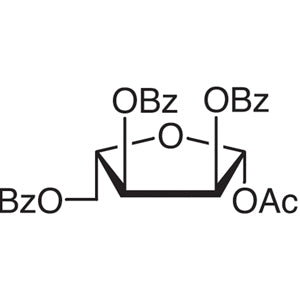
Beta-D-Ribofuranose 1-Acetate 2,3,5-Tribenzoate is a specialized chemical compound used in laboratory research across multiple scientific disciplines. This compound plays a crucial role in chemical biology and glycoscience, serving as a key component in studies related to molecular interactions and structural analysis. Its unique chemical structure, derived from ribofuranose—a pentose sugar found in vitamin B2—makes it an essential tool for researchers exploring enzymatic reactions and molecular characterization. In the laboratory, it is often employed as a substrate or inhibitor, contributing to the understanding of biochemical pathways and molecular behavior.
The compound’s properties make it a preferred choice for advanced chemical research. It exhibits good solubility in organic solvents such as ethyl acetate, which facilitates its use in analytical techniques like chromatography and spectroscopy. Its strong molecular interactions with specific chemical structures enhance its utility in structural studies. Additionally, the compound demonstrates stability under certain conditions, allowing for reliable long-term storage and consistent performance in experimental settings. These characteristics ensure its effectiveness in a variety of laboratory applications.
In Indonesian laboratories, Beta-D-Ribofuranose 1-Acetate 2,3,5-Tribenzoate is commonly used in biochemical, pharmacological, and molecular structure studies. Researchers at universities and research institutions rely on this compound for its reliability and versatility. Its role in supporting scientific inquiry makes it an important resource for advancing research in the fields of chemistry and biology.
TCI brochures (PDF)
Related TCI products
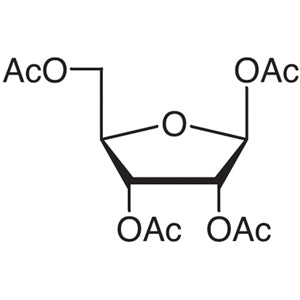
- TCI R0066 13035-61-5 Tetra-O-acetyl-beta-D-ribofuranose
- TCI R0080 3080-30-6 beta-L-Ribofuranose 1-Acetate 2,3,5-Tribenzoate
- TCI M1965 7473-45-2 Methyl beta-D-Ribofuranoside
- TCI T2641 22224-41-5 1,3,5-Tri-O-benzoyl-alpha-D-ribofuranose
- TCI T2607 62211-93-2 1,2,3-Tri-O-acetyl-5-deoxy-beta-D-ribofuranose
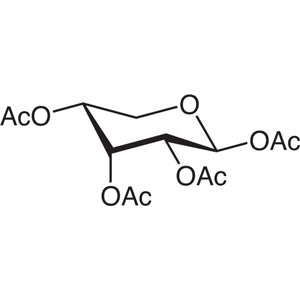
- TCI R0065 4049-34-7 Tetra-O-acetyl-beta-D-ribopyranose
- Biochemical Research: This compound is ideal for studying enzyme-substrate interactions and metabolic pathways due to its structural similarity to ribofuranose.
- Molecular Characterization: Its solubility and molecular interactions make it suitable for advanced spectroscopic and chromatographic analyses.
- Glycoscience Studies: It serves as a model compound for investigating carbohydrate-based structures and their biological functions.
- Pharmacological Investigations: Researchers use it to explore the effects of modified ribofuranose derivatives on biological systems.
- Structural Analysis: Its stability and reactivity support studies aimed at understanding molecular conformation and intermolecular forces.
| Brand | TCI |
|---|---|
| CAS number | 6974-32-9 |
| Molecular formula | — |
| Purity | — |
| Category | Chemistry > Chemical Biology > Glycoscience |
| Pack sizes | Available in standard laboratory quantities |
| Physical form | Solid or crystalline, depending on formulation |
| Storage | Store in a cool, dry place away from direct light |
This compound should be stored in a cool, dry environment, away from direct sunlight and sources of heat. It is recommended to use airtight containers to prevent moisture absorption and contamination. Due to its chemical nature, it should be handled with appropriate personal protective equipment, such as gloves and safety goggles, to ensure laboratory safety. While it is stable under normal storage conditions, it is important to avoid exposure to incompatible substances. Proper labeling and storage practices help maintain its integrity and ensure safe usage in the laboratory setting.
—
Product Categories
- Chemical BiologyGlycoscienceGlyco Building Blocks
- Chemical BiologyGlycoscienceMonosaccharides [Glycoscience]
- Chemical BiologyNucleic Acid ChemistryRiboses and 2'-Deoxyriboses [Nucleic Acid Synthesis]
- Pharmaceutical Development and Drug Discovery Research ReagentsNucleic Acid ChemistryRiboses and 2'-Deoxyriboses [Nucleic Acid Synthesis]
- GlycoscienceGlyco Building BlocksProtected Sugars [Oligosaccharides by Component Sugar]
- GlycoscienceMonosaccharides [Glycoscience]Riboses [Glycoscience]
- Biochemicals and ReagentsCarbohydrates
- Pharmaceutical Development and Drug Discovery ResearchNucleic Acid ChemistryRiboses and 2'-Deoxyriboses [Nucleic Acid Synthesis]
Produk Terkait
-
Tetra-O-acetyl-beta-D-ribofuranose TCI R0066
Regular price From Rp 582.750,00Regular priceRp 423.150,00Sale price From Rp 582.750,00 -
beta-L-Ribofuranose1-Acetate2,3,5-Tribenzoate TCI R0080
Regular price Rp 2.252.250,00Regular priceRp 1.590.750,00Sale price Rp 2.252.250,00 -
Methylbeta-D-Ribofuranoside TCI M1965
Regular price From Rp 2.279.550,00Regular priceRp 1.609.650,00Sale price From Rp 2.279.550,00 -
1,3,5-Tri-O-benzoyl-alpha-D-ribofuranose TCI T2641
Regular price From Rp 1.829.100,00Regular priceRp 1.294.650,00Sale price From Rp 1.829.100,00 -
1,2,3-Tri-O-acetyl-5-deoxy-beta-D-ribofuranose TCI T2607
Regular price From Rp 530.250,00Regular priceRp 386.400,00Sale price From Rp 530.250,00 -
Tetra-O-acetyl-beta-D-ribopyranose TCI R0065
Regular price Rp 1.881.600,00Regular priceRp 1.331.400,00Sale price Rp 1.881.600,00 -
Methyl2,3-O-Isopropylidene-beta-D-ribofuranoside TCI M3528
Regular price From Rp 822.150,00Regular priceRp 590.100,00Sale price From Rp 822.150,00 -
2-Deoxy-2-fluoro-1,3,5-tri-O-benzoyl-alpha-D-arabinofuranose TCI D4594
Regular price From Rp 1.458.450,00Regular priceRp 1.035.300,00Sale price From Rp 1.458.450,00