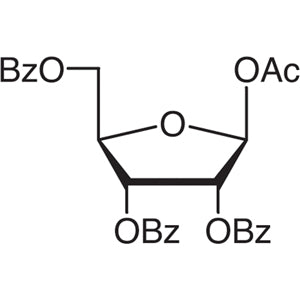
Beta-L-Ribofuranose 1-Acetate 2,3,5-Tribenzoate is a specialized chemical compound used in advanced research within the fields of chemical biology and glycoscience. This compound is derived from ribofuranose, a pentose sugar, and is chemically modified with an acetyl group and three benzoyl groups. Its complex structure makes it a valuable tool in laboratory settings where precise molecular interactions are required. It is commonly utilized in studies involving enzyme kinetics and carbohydrate metabolism, where its unique chemical properties enable detailed analysis of molecular behavior.
The compound’s stability under controlled conditions is a key factor in its preference for laboratory use. Its chemical structure allows it to act as both a substrate and an inhibitor in various biochemical reactions, making it versatile for different experimental setups. Additionally, its well-defined molecular composition ensures consistency in experimental results, which is crucial for reproducibility in scientific research. These properties make it a reliable choice for researchers working on enzyme activity and metabolic pathways.
In Indonesian laboratories, this compound is frequently employed in biochemical research, particularly in academic and industrial settings focused on molecular mechanisms and enzyme function. Its use is common in both basic and applied research, where accurate and stable reagents are essential. Researchers rely on its predictable behavior and chemical integrity to conduct experiments that require high precision and reliability. Its role in understanding complex biological systems underscores its importance in modern scientific inquiry.
TCI brochures (PDF)
Related TCI products
- TCI R0067 6974-32-9 beta-D-Ribofuranose 1-Acetate 2,3,5-Tribenzoate
- TCI T2641 22224-41-5 1,3,5-Tri-O-benzoyl-alpha-D-ribofuranose
- TCI T2607 62211-93-2 1,2,3-Tri-O-acetyl-5-deoxy-beta-D-ribofuranose
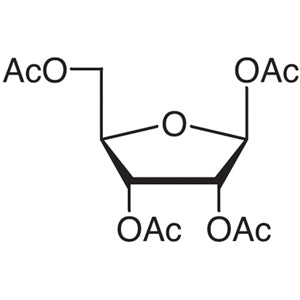
- TCI R0066 13035-61-5 Tetra-O-acetyl-beta-D-ribofuranose
- TCI M1965 7473-45-2 Methyl beta-D-Ribofuranoside
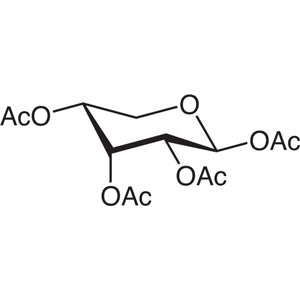
- TCI R0065 4049-34-7 Tetra-O-acetyl-beta-D-ribopyranose
- Enzyme Kinetics Studies – This compound is ideal for studying enzyme activity and substrate specificity due to its defined chemical structure and predictable reaction behavior.
- Carbohydrate Metabolism Research – Its role as a modified sugar derivative makes it useful in investigating metabolic pathways and enzyme-substrate interactions.
- Glycoscience Investigations – The compound’s complex structure supports research into glycosylation processes and carbohydrate-based molecular interactions.
- Molecular Interaction Analysis – Its ability to act as both a substrate and inhibitor allows for detailed studies of molecular binding and reaction mechanisms.
- Biochemical Assay Development – Its stability and chemical clarity make it suitable for creating and validating new biochemical assays and protocols.
| Brand | TCI |
|---|---|
| CAS number | 3080-30-6 |
| Molecular formula | — |
| Purity | — |
| Category | Chemistry > Chemical Biology > Glycoscience |
| Pack sizes | Available in various quantities as per supplier specifications |
| Physical form | Solid powder |
| Storage | Store in a cool, dry place away from light and moisture |
This compound should be stored in a cool, dry environment, away from direct light and moisture to maintain its chemical stability. It is recommended to use airtight containers to prevent exposure to humidity and contaminants. Due to its chemical nature, it should be handled with appropriate personal protective equipment, such as gloves and safety goggles, to ensure laboratory safety. Proper ventilation is advised when working with the compound to minimize inhalation risks. The compound is non-hazardous under normal storage conditions but should be treated with care to avoid accidental spills or contamination. Regular monitoring of storage conditions is essential to ensure the integrity of the material over time.
—
Product Categories
Produk Terkait
-
beta-D-Ribofuranose1-Acetate2,3,5-Tribenzoate TCI R0067
Regular price From Rp 1.167.600,00Regular priceRp 831.600,00Sale price From Rp 1.167.600,00 -
1,3,5-Tri-O-benzoyl-alpha-D-ribofuranose TCI T2641
Regular price From Rp 1.829.100,00Regular priceRp 1.294.650,00Sale price From Rp 1.829.100,00 -
1,2,3-Tri-O-acetyl-5-deoxy-beta-D-ribofuranose TCI T2607
Regular price From Rp 530.250,00Regular priceRp 386.400,00Sale price From Rp 530.250,00 -
Tetra-O-acetyl-beta-D-ribofuranose TCI R0066
Regular price From Rp 582.750,00Regular priceRp 423.150,00Sale price From Rp 582.750,00 -
Methylbeta-D-Ribofuranoside TCI M1965
Regular price From Rp 2.279.550,00Regular priceRp 1.609.650,00Sale price From Rp 2.279.550,00 -
Tetra-O-acetyl-beta-D-ribopyranose TCI R0065
Regular price Rp 1.881.600,00Regular priceRp 1.331.400,00Sale price Rp 1.881.600,00 -
Methyl2,3-O-Isopropylidene-beta-D-ribofuranoside TCI M3528
Regular price From Rp 822.150,00Regular priceRp 590.100,00Sale price From Rp 822.150,00 -
2,3-O-Isopropylidene-D-ribose TCI M3445
Regular price From Rp 2.464.350,00Regular priceRp 1.738.800,00Sale price From Rp 2.464.350,00