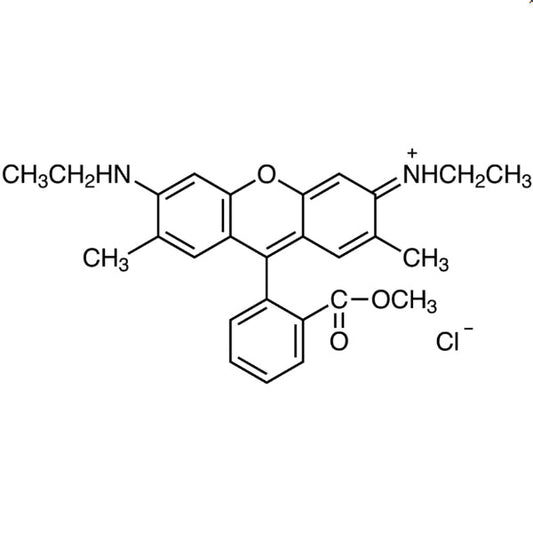
Rhodamine 640 Perchlorate is an organic compound widely used in optical and materials science applications. This material is a key component in the development of fluorescent indicators, optical sensors, and light-reflecting materials. Its presence in laboratory settings is essential for researchers working on photonic and optical material projects. Due to its unique optical properties, it plays a crucial role in various scientific investigations, especially those involving light interaction and spectroscopic analysis.
The compound is known for its strong fluorescence and sensitivity to specific wavelengths of light, making it a preferred choice for optical research. Its ability to emit light at a wavelength of approximately 640 nm makes it ideal for applications requiring red light emission. Additionally, its chemical stability and resistance to environmental conditions contribute to its reliability in laboratory environments. These properties ensure consistent performance and accuracy in scientific experiments.
In Indonesian laboratories, Rhodamine 640 Perchlorate is commonly used in fluorescence-based experiments, environmental monitoring, and biomedical research. Its utility extends to analytical chemistry and optical material development, where precise light emission and sensitivity are required. Researchers rely on this compound for its predictable behavior and compatibility with various experimental setups, making it a valuable resource in scientific studies.
- Fluorescence Imaging: Rhodamine 640 Perchlorate is used for labeling and tracking biological molecules due to its strong red emission and high fluorescence efficiency.
- Optical Sensor Development: Its sensitivity to specific wavelengths makes it suitable for creating optical sensors that detect environmental or chemical changes.
- Photonic Material Research: The compound is integral in developing materials that interact with light, such as light-emitting or reflective surfaces.
- Spectroscopic Analysis: Its distinct emission wavelength allows for accurate spectral measurements in analytical and research settings.
- Biomedical Applications: It is used in diagnostic tools and imaging techniques to enhance visibility and accuracy in biological systems.
| Brand | TCI |
|---|---|
| CAS number | 72102-91-1 |
| Molecular formula | — |
| Purity | — |
| Category | Materials Science > Photonic Materials and Optical Materials > Xanthene Dyes |
| Pack sizes | Available in various quantities as per standard laboratory supply options |
| Physical form | Solid powder |
| Storage | Store in a cool, dry place away from direct light and moisture |
Rhodamine 640 Perchlorate should be stored in a cool, dry place, away from direct light and moisture to maintain its chemical stability. It is recommended to use sealed containers to prevent exposure to air and humidity. In laboratory settings, it should be handled with appropriate personal protective equipment, such as gloves and safety goggles, to ensure safe handling. Due to its fluorescent properties, it is important to avoid prolonged exposure to light during storage. The compound is generally considered safe for laboratory use, but standard safety protocols should be followed to prevent accidental contamination or exposure. Proper labeling and storage conditions are essential to maintain the integrity and effectiveness of the material in research applications.
—
Product Categories
Produk Terkait
-
Rhodamine19Perchlorate TCI R0191
Regular price From Rp 2.068.500,00Regular priceRp 1.461.600,00Sale price From Rp 2.068.500,00 -
TetramethylrhodamineMethylEsterPerchlorate TCI T3608
Regular price From Rp 3.498.600,00Regular priceRp 2.462.250,00Sale price From Rp 3.498.600,00 -
Rhodamine800 TCI R0190
Regular price Rp 6.756.750,00Regular priceRp 4.740.750,00Sale price Rp 6.756.750,00 -
Rhodamine700 TCI R0189
Regular price Rp 5.009.550,00Regular priceRp 3.518.550,00Sale price Rp 5.009.550,00 -
Rhodamine590Chloride TCI R0187
Regular price Rp 2.041.200,00Regular priceRp 1.426.950,00Sale price Rp 2.041.200,00 -
Rhodamine19 TCI R0186
Regular price From Rp 2.359.350,00Regular priceRp 1.665.300,00Sale price From Rp 2.359.350,00 -
RhodamineB TCI R0040
Regular price From Rp 1.167.600,00Regular priceRp 815.850,00Sale price From Rp 1.167.600,00 -
Rhodamine6G TCI R0039
Regular price Rp 1.298.850,00Regular priceRp 908.250,00Sale price Rp 1.298.850,00