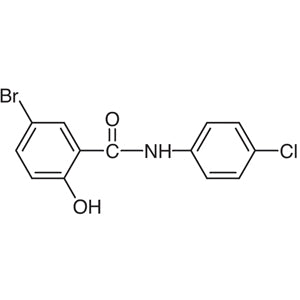
Salicylanilide is a chemical compound widely used in various chemical reactions, particularly in the synthesis of organic compounds. As a fundamental building block in organic chemistry, it features a structure composed of a salicylate group and an aniline group, enabling it to react with a variety of functional groups. In the laboratory, Salicylanilide serves as a key reagent in the development of pharmaceuticals, pesticides, and industrial chemicals. Its versatility makes it a valuable tool for researchers and chemists working on complex molecular structures.
The chemical properties of Salicylanilide, including its stability and moderate reactivity, make it a preferred choice for synthetic processes. It exhibits good solubility in organic solvents such as ethyl acetate and ethanol, which facilitates processing and separation in laboratory settings. This solubility, combined with its chemical stability, ensures that it remains effective in a wide range of experimental conditions. These characteristics make it an essential component in both academic and industrial research environments.
In Indonesian laboratories, Salicylanilide is commonly used in organic chemistry research, particularly by higher education institutions and research organizations. It is a fundamental chemical required for various experiments that demand reactivity and solubility. Its availability and reliability make it a standard reagent in both teaching and research laboratories across the country.
Related TCI products
- Organic synthesis applications benefit from Salicylanilide's ability to participate in a variety of chemical reactions, making it ideal for creating complex molecular structures.
- Pharmaceutical research often utilizes Salicylanilide due to its structural versatility, which allows for the development of new drug compounds with desired properties.
- Pesticide formulation relies on Salicylanilide's chemical stability and reactivity, enabling the synthesis of effective agricultural chemicals.
- Industrial chemical production uses Salicylanilide as a building block for manufacturing a wide range of chemical products.
- Teaching laboratories incorporate Salicylanilide to demonstrate fundamental chemical reactions and synthesis techniques to students.
| Brand | TCI |
|---|---|
| CAS number | 87-17-2 |
| Molecular formula | — |
| Purity | — |
| Category | Chemistry > Building Blocks > Non-Heterocyclic Building Blocks |
| Pack sizes | Available in various quantities as per standard laboratory supply |
| Physical form | Solid |
| Storage | Store in a cool, dry place away from direct sunlight |
Salicylanilide should be stored in a cool, dry place away from direct sunlight to maintain its chemical stability. It is recommended to use airtight containers to prevent moisture absorption and contamination. Due to its reactivity, it should be handled in a well-ventilated area to minimize exposure. Proper personal protective equipment, such as gloves and safety goggles, should be worn when handling the compound. Avoid contact with skin and eyes, and ensure that spillage is cleaned up promptly. Storage conditions should be controlled to ensure the compound remains effective for its intended use in laboratory applications.
—
Produk Terkait
-
4'-Bromosalicylanilide TCI B0919
Regular price Rp 5.855.850,00Regular priceRp 4.110.750,00Sale price Rp 5.855.850,00 -
5-Bromo-4'-chlorosalicylanilide TCI B0897
Regular price Rp 7.048.650,00Regular priceRp 4.944.450,00Sale price Rp 7.048.650,00 -
3',4',5-Trichlorosalicylanilide TCI T0668
Regular price Rp 8.533.350,00Regular priceRp 5.982.900,00Sale price Rp 8.533.350,00 -
3,5,4'-Tribromosalicylanilide TCI T0356
Regular price Rp 2.013.900,00Regular priceRp 1.423.800,00Sale price Rp 2.013.900,00 -
3',4'-Dichlorosalicylanilide TCI D1077
Regular price Rp 9.671.550,00Regular priceRp 6.778.800,00Sale price Rp 9.671.550,00 -
5-Chlorosalicylanilide TCI C0286
Regular price From Rp 822.150,00Regular priceRp 590.100,00Sale price From Rp 822.150,00 -
4-BiphenylaceticAcid TCI B1278
Regular price From Rp 1.696.800,00Regular priceRp 1.202.250,00Sale price From Rp 1.696.800,00 -
AcetylsalicylicAcid TCI A2262
Regular price From Rp 530.250,00Regular priceRp 386.400,00Sale price From Rp 530.250,00