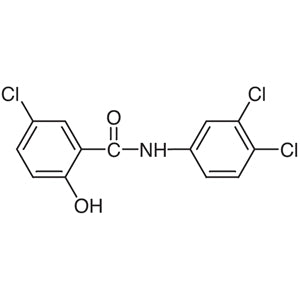
3',4',5-Trichlorosalicylanilide is a chemical compound widely used as a building block in the synthesis of complex organic compounds. It plays a crucial role in laboratory settings where substitution reactions involving chloro groups are required. This compound is particularly valuable in organic chemistry for its ability to participate in various reaction mechanisms, making it an essential tool for researchers aiming to develop new compounds. Its versatility allows it to be integrated into a wide range of synthetic pathways, supporting advancements in pharmaceutical and industrial chemistry.
The compound's chemical properties, including its stable structure and good reactivity, make it a preferred choice for laboratory use. It exhibits compatibility with a variety of reagents such as amines, alcohols, and strong bases, enabling diverse chemical transformations. Its ability to undergo electrophilic substitution and catalytic reactions further enhances its utility in synthetic chemistry. These characteristics ensure that it remains a reliable and effective component in the synthesis of active pharmaceutical ingredients and other complex organic molecules.
In Indonesian laboratories, 3',4',5-Trichlorosalicylanilide is extensively used in organic chemistry research, especially in pharmacology and the synthesis of bioactive compounds. It is a key component in experiments aimed at creating new compounds with specific biological activities. Its widespread application in academic and research institutions highlights its importance in advancing chemical and pharmaceutical sciences in the region.
- Organic synthesis of pharmaceutical compounds due to its reactivity and compatibility with various reagents.
- Development of bioactive molecules through electrophilic substitution and catalytic reactions.
- Research in pharmacology for the creation of new drug candidates with targeted biological activities.
- Industrial chemical production where chlorinated aromatic compounds are required for intermediate steps.
- Educational purposes in chemistry laboratories for teaching synthetic methods and reaction mechanisms.
| Brand | TCI |
|---|---|
| CAS number | 642-84-2 |
| Molecular formula | — |
| Purity | — |
| Category | Chemistry > Building Blocks > Non-Heterocyclic Building Blocks |
| Pack sizes | Available in standard laboratory quantities as per supplier specifications |
| Physical form | Solid, crystalline appearance |
| Storage | Store in a cool, dry place away from light and moisture |
This compound should be stored in a cool, dry environment, away from direct light and moisture to maintain its chemical integrity. It is recommended to use airtight containers made of materials compatible with its chemical nature, such as glass or high-density polyethylene. Laboratory personnel should handle it with appropriate personal protective equipment, including gloves and safety goggles, to prevent skin contact and inhalation. Due to its reactivity, it should be kept separate from strong bases, amines, and other reactive substances. Proper labeling and storage conditions are essential to ensure safety and maintain the compound’s effectiveness in research applications.
—
Produk Terkait
-
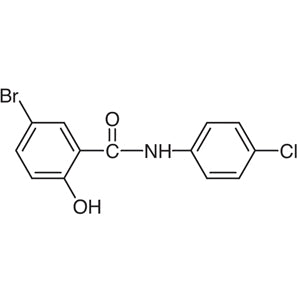
5-Bromo-4'-chlorosalicylanilide TCI B0897
Regular price Rp 6.996.150,00Regular price -
3,5,6-TrichlorosalicylicAcid TCI T1406
Regular price From Rp 769.650,00Regular price -
3-ChlorosalicylicAcid TCI C3522
Regular price Rp 848.400,00Regular price -
4'-Bromosalicylanilide TCI B0919
Regular price Rp 5.803.350,00Regular price -
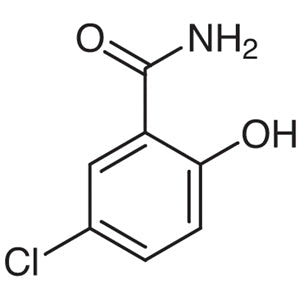
5-Chlorosalicylamide TCI C0787
Regular price From Rp 1.193.850,00Regular price -
3,5,4'-Tribromosalicylanilide TCI T0356
Regular price Rp 1.961.400,00Regular price -
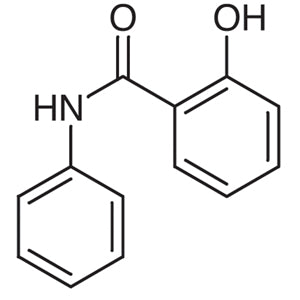
Salicylanilide TCI S0007
Regular price From Rp 1.008.000,00Regular price -
3',4'-Dichlorosalicylanilide TCI D1077
Regular price Rp 9.619.050,00Regular price