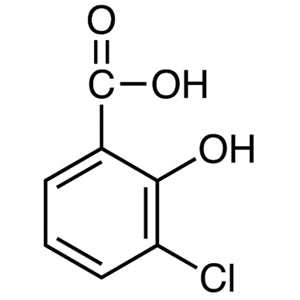
3-Chlorosalicylic Acid (CAS 1829-32-9) is a salicylic acid derivative with one chlorine atom at the 3-position, next to the phenolic hydroxyl group. Salicylic acid and its derivatives are a classic group of compounds in organic and pharmaceutical chemistry. Their framework places a carboxylic acid group and a hydroxyl group in ortho positions on the aromatic ring. In the laboratory, this TCI product serves as a non-heterocyclic building block. It is used to synthesize substituted salicylate derivatives, chelating ligands and bioactive molecules that need a specific chlorination pattern on the aromatic ring.
Researchers choose this compound for how its functional groups work together. The ortho hydroxyl and carboxylic acid groups form an intramolecular hydrogen bond and give the molecule strong chelating ability toward many metal ions. The chlorine atom at the 3-position withdraws electrons and adds steric hindrance around the hydroxyl group. As a result, its acidity, solubility and coordination behaviour differ from those of unsubstituted salicylic acid. Each of the three functional groups can be modified separately through esterification, amidation or etherification, which gives chemists many possible synthetic routes from one starting material.
For Indonesian laboratories, 3-Chlorosalicylic Acid suits medicinal chemistry research groups that study salicylate derivatives and how structure relates to activity. Organic synthesis laboratories can use it as a starting material for multistep routes that need a chlorinated aromatic core. Coordination chemistry groups can also use its chelating ability when designing metal complexes. University research teams, graduate students and industrial R&D units will find it a practical, well-defined building block for exploratory synthesis and method development.
- Synthesis of substituted salicylate derivatives: the chlorine at the 3-position gives a fixed substitution pattern, so researchers can build new salicylate analogues without having to chlorinate the ring selectively themselves.
- Preparation of chelating ligands: the ortho hydroxyl and carboxylic acid pair binds strongly to metal ions, which makes this compound a useful starting point for designing ligands for coordination chemistry studies.
- Medicinal chemistry research: salicylic acid derivatives are a classic class of pharmaceutical compounds, and this chlorinated analogue helps researchers study how ring substitution affects the behaviour of bioactive molecules.
- Esterification and amidation studies: the carboxylic acid group can be converted into esters or amides on its own, so chemists can create compound libraries while keeping the rest of the molecule unchanged.
- Etherification and selective functionalization: the phenolic hydroxyl group can be modified separately from the carboxylic acid, which supports multistep synthetic routes that need precise control over each functional group.
| Brand | TCI (product code C3522) |
|---|---|
| CAS number | 1829-32-9 |
| Molecular formula | — |
| Purity | — |
| Category | Chemistry > Building Blocks > Non-Heterocyclic Building Blocks |
| Pack sizes | available in the pack sizes listed on the product page |
| Physical form | refer to the TCI product documentation and certificate of analysis |
| Storage | keep tightly closed in a cool, dry place, following the supplier's Safety Data Sheet |
Store 3-Chlorosalicylic Acid in its original, tightly closed container in a cool, dry, well-ventilated area, away from direct sunlight, moisture and incompatible materials such as strong oxidizing agents and strong bases. Label containers clearly, and if you transfer the material, use clean, dry glass or chemically resistant containers. Handle the compound in a fume hood or another well-ventilated area to avoid inhaling dust. Wear appropriate personal protective equipment, including safety glasses, chemical-resistant gloves and a laboratory coat. Avoid contact with skin and eyes, and wash hands thoroughly after handling. Read the TCI Safety Data Sheet before use for specific hazard information, first-aid measures and disposal instructions. Dispose of waste according to local regulations and your institution's chemical waste procedures.
—
Produk Terkait
-
3,5,6-TrichlorosalicylicAcid TCI T1406
Regular price From Rp 822.150,00Regular priceRp 590.100,00Sale price From Rp 822.150,00 -
5-Bromo-4'-chlorosalicylanilide TCI B0897
Regular price Rp 7.048.650,00Regular priceRp 4.944.450,00Sale price Rp 7.048.650,00 -
3',4',5-Trichlorosalicylanilide TCI T0668
Regular price Rp 8.533.350,00Regular priceRp 5.982.900,00Sale price Rp 8.533.350,00 -
3-Chlorosalicylaldehyde TCI C3166
Regular price From Rp 1.431.150,00Regular priceRp 1.000.650,00Sale price From Rp 1.431.150,00 -
4-Chlorosalicylaldehyde TCI C2653
Regular price From Rp 1.988.700,00Regular priceRp 1.390.200,00Sale price From Rp 1.988.700,00 -
5-Chlorosalicylamide TCI C0787
Regular price From Rp 1.246.350,00Regular priceRp 887.250,00Sale price From Rp 1.246.350,00 -
4-ChlorosalicylicAcid TCI C1282
Regular price Rp 1.008.000,00Regular priceRp 720.300,00Sale price Rp 1.008.000,00 -
5-ChlorosalicylicAcid TCI C0287
Regular price From Rp 689.850,00Regular priceRp 497.700,00Sale price From Rp 689.850,00