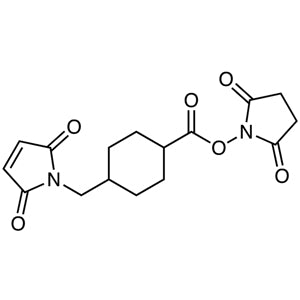
TCI S0881, also known as N-Succinimidyl 6-[[4-(N-Maleimidomethyl)cyclohexyl]carboxamido]hexanoate, is a chemical compound widely used in biochemical and biomedical laboratories. This molecule functions as a versatile linker or crosslinker, enabling the specific attachment of proteins or other molecules. Its role is critical in applications that require precise molecular interactions, such as conjugation and crosslinking. Due to its unique chemical structure, it is highly reactive towards amino and sulfhydryl groups found in proteins, making it a valuable tool in various research settings.
The compound's high reactivity and specificity make it a preferred choice for researchers working with protein-based systems. Its ability to form stable covalent bonds ensures reliable and reproducible results in experimental setups. Additionally, its chemical structure allows for efficient coupling with a wide range of biomolecules, enhancing its utility in diverse applications. These properties make it an essential component in advanced biochemical research, particularly in studies involving molecular interactions and conjugation processes.
In Indonesian laboratories, TCI S0881 is commonly used in biomedical, pharmacological, and biotechnological research. It plays a crucial role in protein complex formation, ligand-protein interactions, and biosensor development. Its stability and specificity make it a preferred reagent for experiments requiring accurate and consistent outcomes. Researchers in Indonesia rely on this compound to advance their studies in molecular biology and related fields.
TCI brochures (PDF)
- Cross-linkers 2026-04-14 · p. 2
- Drug Delivery System (DDS) Research Reagents 2025-01-29 · p. 3
- Bioconjugation Reagents 2026-07-07 · p. 8
- Reagents for Biological Research 2025-03-11 · p. 29
Related TCI products
- TCI U0144 125559-00-4 N-Succinimidyl 6-[[4-(N-Maleimidomethyl)cyclohexyl]carboxamido]hexanoate (2mg*5)
- TCI U0143 64987-85-5 N-Succinimidyl 4-(N-Maleimidomethyl)cyclohexanecarboxylate (2mg*5)
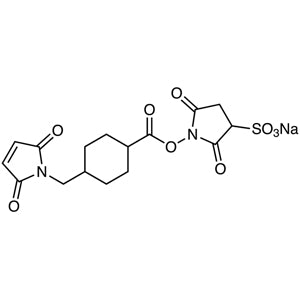
- TCI S0883 92921-24-9 3-Sulfo-N-succinimidyl 4-(N-Maleimidomethyl)cyclohexane-1-carboxylate Sodium Salt
- TCI S0853 64987-85-5 N-Succinimidyl 4-(N-Maleimidomethyl)cyclohexanecarboxylate
- TCI S0814 38862-24-7 N-Succinimidyl Acrylate
- TCI S0812 38862-25-8 N-Succinimidyl Methacrylate
- Protein conjugation and labeling applications benefit from its ability to form stable covalent bonds with amino and sulfhydryl groups, ensuring reliable molecular attachment.
- Biosensor development utilizes its high reactivity and specificity to create sensitive and accurate detection systems for biomolecules.
- Molecular interaction studies leverage its capacity to link proteins and other biomolecules, enabling detailed analysis of structural and functional relationships.
- Crosslinking experiments benefit from its role in forming stable linkages between biomolecules, enhancing the accuracy of structural analysis.
- Biomedical research applications rely on its stability and reactivity to support the development of therapeutic and diagnostic tools.
| Brand | TCI |
|---|---|
| CAS number | 125559-00-4 |
| Molecular formula | — |
| Purity | — |
| Category | Chemistry > Chemical Biology > Linkers and Crosslinkers |
| Pack sizes | Available in various quantities as per standard laboratory supply |
| Physical form | Solid or liquid, depending on formulation |
| Storage | Store in a cool, dry place away from light |
This compound should be stored in a cool, dry environment, away from direct light to maintain its chemical integrity. It is recommended to use airtight containers to prevent moisture absorption and contamination. Due to its reactive nature, it should be handled with care in a well-ventilated laboratory setting. Proper personal protective equipment, such as gloves and safety goggles, should be worn when handling the material. Avoid exposure to incompatible substances to ensure safety and maintain the compound's effectiveness in experimental applications.
—
Product Categories
Produk Terkait
-
N-Succinimidyl6-[[4-(N-Maleimidomethyl)cyclohexyl]carboxamido]hexanoate(2mg*5) TCI U0144
Regular price Rp 4.161.150,00Regular priceRp 2.925.300,00Sale price Rp 4.161.150,00 -
N-Succinimidyl4-(N-Maleimidomethyl)cyclohexanecarboxylate(2mg*5) TCI U0143
Regular price Rp 1.988.700,00Regular priceRp 1.405.950,00Sale price Rp 1.988.700,00 -
3-Sulfo-N-succinimidyl4-(N-Maleimidomethyl)cyclohexane-1-carboxylateSodiumSalt TCI S0883
Regular price From Rp 2.121.000,00Regular priceRp 1.498.350,00Sale price From Rp 2.121.000,00 -
N-Succinimidyl4-(N-Maleimidomethyl)cyclohexanecarboxylate TCI S0853
Regular price From Rp 1.696.800,00Regular priceRp 1.202.250,00Sale price From Rp 1.696.800,00 -
N-SuccinimidylAcrylate TCI S0814
Regular price From Rp 3.207.750,00Regular priceRp 2.258.550,00Sale price From Rp 3.207.750,00 -
N-SuccinimidylMethacrylate TCI S0812
Regular price From Rp 2.650.200,00Regular priceRp 1.869.000,00Sale price From Rp 2.650.200,00 -
N-SuccinimidylMaleimidoacetate TCI S0968
Regular price Rp 6.306.300,00Regular priceRp 4.425.750,00Sale price Rp 6.306.300,00 -
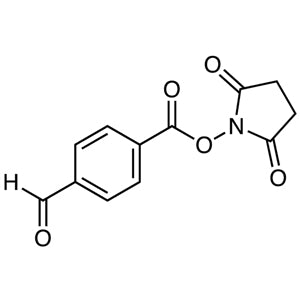
N-Succinimidyl4-Formylbenzoate TCI S0893
Regular price Rp 4.716.600,00Regular priceRp 3.313.800,00Sale price Rp 4.716.600,00