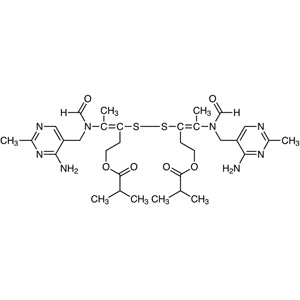
Sulbutiamine, with the CAS number 3286-46-2, is a chemical compound widely used in pharmacological and biochemical research. It belongs to the category of pharmaceutical research reagents and is commonly employed in experimental studies related to neurological effects and metabolic processes. This compound is valued for its ability to enhance cognitive function and influence the central nervous system, making it an essential component in neurology and psychopharmacology research. In the laboratory, Sulbutiamine serves as a key tool for acquiring scientific data relevant to drug development and health-related research.
One of the key reasons Sulbutiamine is preferred in laboratory settings is its chemical stability and solubility in organic solvents such as ethyl acetate and ethanol. These properties make it suitable for various analytical methods and experimental protocols. Additionally, its non-toxic nature and safe handling characteristics contribute to its reliability as a research material. Sulbutiamine is also easy to handle and store under appropriate conditions, ensuring consistent performance in experiments.
In Indonesian laboratories, Sulbutiamine is commonly used in studies related to mental health, neurodegenerative diseases, and the development of new pharmaceuticals. Its role as a research reagent supports both academic and industrial research efforts, providing a foundation for understanding complex biological processes and therapeutic applications.
TCI brochures (PDF)
- Vitamins for Research and Experimental Use 2025-06-27 · p. 3
- Pharmaceutical Ingredients for Research and Experimental Use 2026-03-09 · p. 48
- Reagents for Biological Research 2025-03-11 · p. 51
- Neurological research utilizes Sulbutiamine to study cognitive enhancement and central nervous system effects due to its known impact on neurotransmitter activity.
- Psychopharmacology experiments benefit from Sulbutiamine’s ability to influence brain function, aiding in the development of therapeutic agents for mental health disorders.
- Metabolic studies incorporate Sulbutiamine to investigate its role in energy metabolism and biochemical pathways within the body.
- Drug development projects use Sulbutiamine as a model compound to test new formulations and evaluate pharmacological properties in controlled environments.
- Health-related research employs Sulbutiamine to explore its potential in treating neurodegenerative conditions and improving cognitive performance in experimental models.
| Brand | TCI |
|---|---|
| CAS number | 3286-46-2 |
| Molecular formula | — |
| Purity | — |
| Category | Life Science > Biochemicals and Reagents > Pharmaceutical Research Reagents |
| Pack sizes | Available in various quantities as per standard laboratory requirements |
| Physical form | Solid (as per standard product specifications) |
| Storage | Store in a cool, dry place away from direct light and moisture |
Sulbutiamine should be stored in a cool, dry environment to maintain its chemical stability and prevent degradation. It is recommended to use airtight containers to protect it from moisture and contaminants. Due to its non-toxic nature, standard laboratory safety protocols apply, but care should still be taken to avoid inhalation or skin contact during handling. The compound is compatible with most standard laboratory storage conditions, making it suitable for routine use in research settings. Proper labeling and secure storage are essential to ensure safe handling and prevent accidental exposure.
—
Product Categories
- Biochemicals and ReagentsPharmaceutical Research Reagents (for Experimental Use)Pharmaceutical Research Reagents (Others)
- Biochemicals and ReagentsVitamins and Related CompoundsVitamin Derivatives
- Cell BiologyNutrition ResearchVitamins [Nutrition Research]
- Pharmaceutical Development and Drug Discovery ResearchPharmaceutical Research Reagents (for Experimental Use)Pharmaceutical Research Reagents (Others)
Produk Terkait
-
Tazarotene TCI T3108
Regular price Rp 1.563.450,00Regular priceRp 1.108.800,00Sale price Rp 1.563.450,00 -
Benfotiamine TCI B4711
Regular price From Rp 1.749.300,00Regular priceRp 1.239.000,00Sale price From Rp 1.749.300,00 -
Acitretin TCI A3097
Regular price From Rp 2.332.050,00Regular priceRp 1.646.400,00Sale price From Rp 2.332.050,00 -
Bexarotene TCI B4798
Regular price Rp 5.087.250,00Regular priceRp 3.573.150,00Sale price Rp 5.087.250,00 -
Alfacalcidol TCI A3125
Regular price From Rp 3.472.350,00Regular priceRp 2.443.350,00Sale price From Rp 3.472.350,00 -
Acipimox TCI M2053
Regular price From Rp 1.298.850,00Regular priceRp 924.000,00Sale price From Rp 1.298.850,00 -
all-trans-N-(4-Hydroxyphenyl)retinamide TCI H1464
Regular price From Rp 2.491.650,00Regular priceRp 1.757.700,00Sale price From Rp 2.491.650,00 -
CalciumFolinate TCI C2235
Regular price From Rp 2.173.500,00Regular priceRp 1.535.100,00Sale price From Rp 2.173.500,00