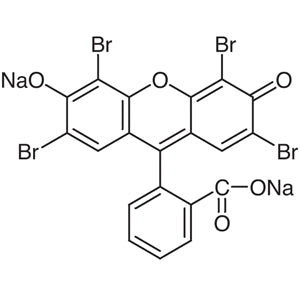
Tetrabromofluorescein is a chemical compound widely used in various analytical and synthetic applications within laboratory settings. It is a fluorescent dye that plays a crucial role in chemical reactions, particularly those requiring light-induced processes. Its ability to emit light under specific conditions makes it an essential component in experiments involving photocatalysis and photoreactions. This compound is commonly used as an indicator or active ingredient in chemical processes where visual detection or light interaction is required.
The strong fluorescent properties of Tetrabromofluorescein make it a preferred choice in laboratory environments. It exhibits stability under certain conditions, which ensures consistent performance in experiments. Its resistance to unwanted chemical reactions further enhances its reliability. The compound’s distinct color also aids in visual observation, making it ideal for analytical procedures. Additionally, its responsiveness to light allows it to be effectively utilized in applications that rely on photokatalytic processes.
In Indonesian laboratories, Tetrabromofluorescein is commonly used in chemical research, particularly in the fields of photocatalysis and quantitative analysis. It is frequently found in chemical, environmental, and industrial laboratories that require accurate and efficient chemical analysis. Due to its stable and responsive nature, this compound is a valuable tool for researchers and technicians working in these specialized areas.
TCI brochures (PDF)
- Iridium Photoredox Catalyst with Highly Oxidizing Excited State 2023-07-21 · p. 2
- Iodinated Fluorescein for Various Applications 2024-11-22 · p. 1
- RAFT Agents for Controlled Radical Polymerization 2025-01-14 · p. 2
- Visible Light Photoredox Catalysts 2026-04-28 · p. 2
- Organic Photoreaction Reagents 2025-02-13 · p. 8
- Titration Reagents and TLC Stains 2026-05-07 · p. 11
Related TCI products
- Photocatalytic reactions benefit from Tetrabromofluorescein due to its light-responsive properties, enabling efficient light-induced chemical transformations.
- Quantitative analysis utilizes this compound for its fluorescent characteristics, allowing precise detection and measurement of substances in solution.
- Environmental monitoring applications rely on its stability and color visibility to assess pollutants and chemical contaminants in water and soil samples.
- Chemical synthesis processes incorporate it as an indicator to monitor reaction progress and ensure accurate control over reaction conditions.
- Industrial quality control uses Tetrabromofluorescein for its consistent performance in detecting impurities and ensuring product purity in manufacturing processes.
| Brand | TCI |
|---|---|
| CAS number | 15086-94-9 |
| Molecular formula | — |
| Purity | — |
| Category | Chemistry > Catalysis and Inorganic Chemistry > Photocatalysts [Catalysis] |
| Pack sizes | Available in various quantities as per standard laboratory supply options |
| Physical form | Solid or powder, depending on the specific formulation |
| Storage | Store in a cool, dry place away from direct sunlight |
Data from the TCI brochure
| PC*/PC.- | +0.83 V (vs. SCE) |
|---|---|
| PC.+/PC | +0.78 V (vs. SCE) |
| PC/PC.- | -1.06 (vs. SCE) |
| PC.+/PC* | -1.11 V (vs. SCE) |
Source: TCI brochure RR187 (2023-07-21)
Tetrabromofluorescein should be stored in a cool, dry environment to maintain its stability and prevent degradation. It is recommended to keep the compound in airtight containers to avoid exposure to moisture and contaminants. Proper labeling of storage containers is essential for safe handling and easy identification. Laboratory personnel should wear appropriate personal protective equipment, such as gloves and safety goggles, when handling this compound. It is important to ensure that storage areas are well-ventilated to minimize any potential risks associated with prolonged exposure. Adhering to standard laboratory safety protocols will help maintain a safe and efficient working environment.
—
Product Categories
Produk Terkait
-
Fluorescein TCI F0095
Regular price Rp 875.700,00Regular priceRp 612.150,00Sale price Rp 875.700,00 -
AcidRed87 TCI T0037
Regular price Rp 903.000,00Regular priceRp 631.050,00Sale price Rp 903.000,00 -
Rhodamine6G TCI R0039
Regular price Rp 1.298.850,00Regular priceRp 908.250,00Sale price Rp 1.298.850,00 -
TetrabromofluoresceinPotassiumSalt TCI T0036
Regular price Rp 3.976.350,00Regular priceRp 2.780.400,00Sale price Rp 3.976.350,00 -
2',7'-DichlorofluoresceinSodiumSalt TCI D0424
Regular price From Rp 1.192.800,00Regular priceRp 849.450,00Sale price From Rp 1.192.800,00 -
2',7'-Dichlorofluorescein[forFluorescentindicator] TCI D0371
Regular price From Rp 1.008.000,00Regular priceRp 720.300,00Sale price From Rp 1.008.000,00 -
3,4,5,6-Tetrabromo-o-cresol TCI T1528
Regular price Rp 610.050,00Regular priceRp 426.300,00Sale price Rp 610.050,00 -
2,3,5,6-Tetrabromo-p-cresol TCI T1430
Regular price From Rp 2.147.250,00Regular priceRp 1.501.500,00Sale price From Rp 2.147.250,00