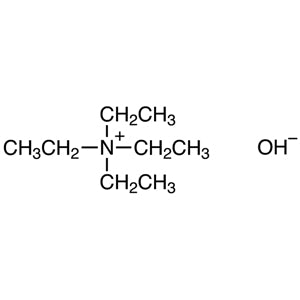
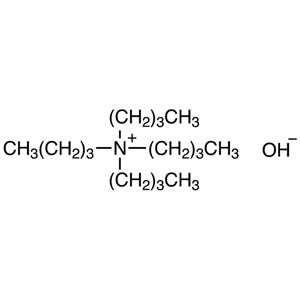
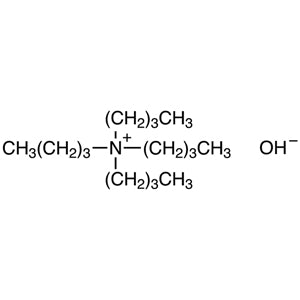
Tetraethylammonium Hydroxide (10% in Water) from TCI (product code T0096) is an aqueous solution of a quaternary ammonium base, in which the tetraethylammonium cation is paired with the hydroxide ion. In the laboratory it serves as a strong organic base that contains no alkali metal ions. It can replace sodium or potassium hydroxide wherever metal ions are unwanted. Because the solution comes at a fixed concentration, it is easy to measure and use straight from the bottle, so there is no need to prepare a solution from a solid.
Chemists choose this reagent because it combines strong basicity with a large, soluble organic cation. The absence of sodium or potassium ions matters most in the synthesis of zeolites and other porous materials. In that work, the tetraethylammonium cation also acts as a structure-directing agent that shapes the pore architecture of the crystal. Calcination removes the organic cation without leaving any metal residue, so the final framework stays clean. The cation's solubility and stable behaviour in solution also make the reagent useful well beyond materials chemistry.
In Indonesia, this solution is in steady demand at university research laboratories, catalysis and materials science groups, and industrial R&D facilities. Researchers working on zeolite catalysts and porous adsorbents use it as a metal-free base and template. Organic synthesis laboratories use it as a base catalyst or phase-transfer base. Analytical laboratories use it to adjust pH and as an ion-pairing reagent. The ready-to-use aqueous form suits routine work and research-scale experiments alike.
TCI brochures (PDF)
- Quaternary Ammonium Salts 2025-11-10 · p. 2
- Colloidal Quantum Dot (QD) Research Reagents 2026-05-21 · p. 10
Related TCI products
- TCI T2589 77-98-5 Tetraethylammonium Hydroxide (35% in Water)
- TCI T1685 2052-49-5 Tetrabutylammonium Hydroxide (40% in Water)
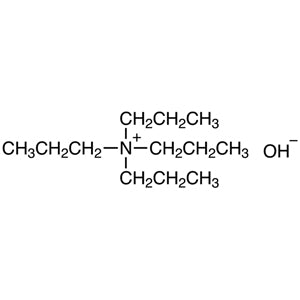
- TCI T1565 4499-86-9 Tetrapropylammonium Hydroxide (ca. 40% in Water)
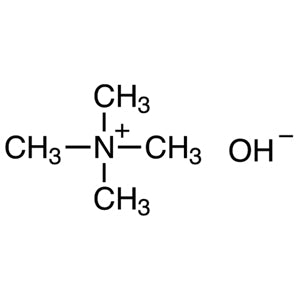
- TCI T1460 75-59-2 Tetramethylammonium Hydroxide (ca. 25% in Water)
- TCI T1020 4499-86-9 Tetrapropylammonium Hydroxide (20-25% in Water)
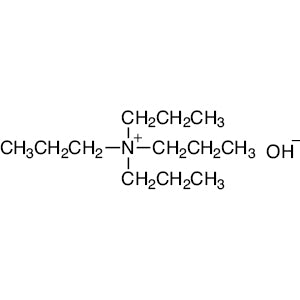
- TCI T0964 4499-86-9 Tetrapropylammonium Hydroxide (10% in Water)
- Zeolite and molecular sieve synthesis: the tetraethylammonium cation acts as a structure-directing agent that shapes the crystal pores, and it supplies hydroxide without adding sodium or potassium.
- Porous material preparation: because the organic cation burns off during calcination without leaving metal residue, the reagent suits the preparation of clean, metal-free porous frameworks for catalysis and adsorption research.
- Base catalysis in organic synthesis: as a strong quaternary ammonium base, it can catalyse base-promoted reactions where an organic, metal-free base gives better compatibility than inorganic hydroxides.
- Phase-transfer reactions: the large, soluble tetraethylammonium cation lets the solution act as a phase-transfer base, carrying hydroxide reactivity between aqueous and organic phases during synthesis.
- Analytical pH adjustment and ion pairing: analysts use it to adjust pH without adding alkali metal ions and as an ion-pairing reagent that improves the separation and analysis of charged species.
| Brand | TCI (product code T0096) |
|---|---|
| CAS number | 77-98-5 |
| Molecular formula | — |
| Purity | — |
| Category | Chemistry > Synthetic Reagents > Acids, Bases [Synthetic Reagents] |
| Pack sizes | check the product page or contact AMI Scientific for current pack sizes |
| Physical form | aqueous solution, 10% in water |
| Storage | keep tightly closed in a cool, well-ventilated area, following the manufacturer's SDS |
Tetraethylammonium hydroxide solution is a strong base and should be handled as a corrosive material. Keep the container tightly closed so the solution does not absorb carbon dioxide from the air, since that gradually lowers its basicity. Store it in a cool, dry, well-ventilated place away from acids and incompatible materials. Use the original container or another chemically resistant container made of a material suited to alkaline solutions. When handling, wear chemical-resistant gloves, safety goggles and a lab coat, and work in a fume hood or well-ventilated area. Avoid contact with skin and eyes. If contact occurs, rinse thoroughly with water. Always read the manufacturer's Safety Data Sheet before use and dispose of waste according to local regulations.
—
Produk Terkait
-
TetraethylammoniumHydroxide(35%inWater) TCI T2589
Regular price From Rp 822.150,00Regular priceRp 590.100,00Sale price From Rp 822.150,00 -
TetrabutylammoniumHydroxide(40%inWater) TCI T1685
Regular price From Rp 1.246.350,00Regular priceRp 887.250,00Sale price From Rp 1.246.350,00 -
TetrapropylammoniumHydroxide(ca.40%inWater) TCI T1565
Regular price From Rp 2.199.750,00Regular priceRp 1.554.000,00Sale price From Rp 2.199.750,00 -
TetramethylammoniumHydroxide(ca.25%inWater) TCI T1460
Regular price From Rp 557.550,00Regular priceRp 405.300,00Sale price From Rp 557.550,00 -
TetrapropylammoniumHydroxide(20-25%inWater) TCI T1020
Regular price From Rp 1.008.000,00Regular priceRp 720.300,00Sale price From Rp 1.008.000,00 -
TetrapropylammoniumHydroxide(10%inWater) TCI T0964
Regular price From Rp 769.650,00Regular priceRp 553.350,00Sale price From Rp 769.650,00 -
TetrabutylammoniumHydroxide(10%inWater) TCI T0955
Regular price From Rp 637.350,00Regular priceRp 460.950,00Sale price From Rp 637.350,00 -
TetrabutylammoniumHydroxide(10%inWater) TCI T0216
Regular price Rp 1.087.800,00Regular priceRp 775.950,00Sale price Rp 1.087.800,00