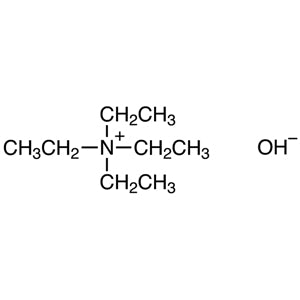
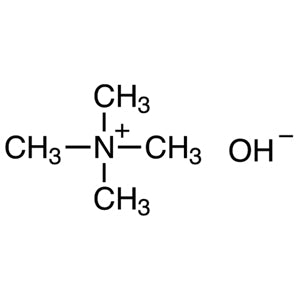
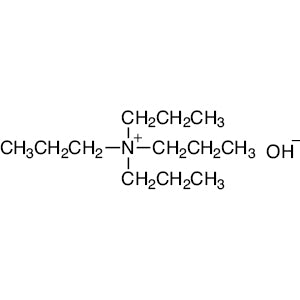
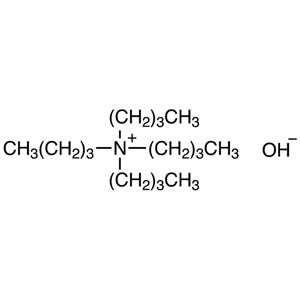
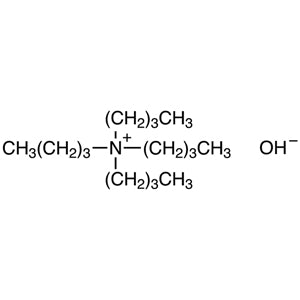
Tetrapropylammonium Hydroxide (TPA-H), with the CAS number 4499-86-9, is a liquid chemical compound widely used in synthetic chemistry applications. It serves as a strong base and is commonly employed in laboratory settings for various chemical reactions, including hydrolysis, deprotonation, and the formation of complex organic compounds. Its role in the laboratory is critical for facilitating reactions that require a basic environment, making it an essential reagent for chemists working on synthetic pathways. TPA-H is particularly useful in the synthesis of heterocyclic compounds, polymers, and other organic molecules where strong basic conditions are necessary.
One of the key properties that make TPA-H a preferred choice is its ability to act as a strong ionic base. This characteristic allows it to efficiently participate in a wide range of chemical reactions, especially those requiring high basicity. Additionally, TPA-H exhibits good stability under certain conditions, which enhances its usability in different experimental scales. Its high solubility and low volatility also contribute to its practicality in laboratory applications, as it can be easily handled and stored without significant degradation. These properties make it a reliable and versatile reagent for both research and industrial settings.
In Indonesian laboratories, TPA-H is commonly used in chemical, pharmaceutical, and industrial research. Its availability in various packaging options makes it suitable for both small-scale and large-scale experiments. Researchers in Indonesia rely on TPA-H for its effectiveness in creating complex organic structures and for its consistent performance in basic reaction conditions. Its widespread use underscores its importance in the chemical research landscape of the region.
TCI brochures (PDF)
- Quaternary Ammonium Salts 2025-11-10 · p. 2
- Colloidal Quantum Dot (QD) Research Reagents 2026-05-21 · p. 10
Related TCI products
- TCI T2589 77-98-5 Tetraethylammonium Hydroxide (35% in Water)
- TCI T1685 2052-49-5 Tetrabutylammonium Hydroxide (40% in Water)
- TCI T1565 4499-86-9 Tetrapropylammonium Hydroxide (ca. 40% in Water)
- TCI T1460 75-59-2 Tetramethylammonium Hydroxide (ca. 25% in Water)
- TCI T1020 4499-86-9 Tetrapropylammonium Hydroxide (20-25% in Water)
- TCI T0955 2052-49-5 Tetrabutylammonium Hydroxide (10% in Water)
- Used in the synthesis of heterocyclic compounds due to its strong basic properties, enabling efficient deprotonation and ring formation reactions.
- Applied in polymer synthesis where basic conditions are required to facilitate chain growth and cross-linking processes.
- Employed in organic chemistry research for the hydrolysis of esters and amides, providing a stable and reactive base environment.
- Utilized in pharmaceutical research for the modification of drug molecules, particularly in the formation of complex organic structures.
- Applied in analytical chemistry for the titration and pH adjustment of various chemical solutions, ensuring accurate experimental results.
| Brand | TCI |
|---|---|
| CAS number | 4499-86-9 |
| Molecular formula | — |
| Purity | — |
| Category | Chemistry > Synthetic Reagents > Acids, Bases [Synthetic Reagents] |
| Pack sizes | Available in various sizes to suit different experimental needs |
| Physical form | Liquid |
| Storage | — |
Tetrapropylammonium Hydroxide should be stored in a cool, dry place away from direct sunlight and sources of heat. It is recommended to keep the container tightly sealed to prevent evaporation and contamination. Suitable containers for storage include glass or high-density polyethylene bottles, which are resistant to chemical reactions. In laboratory settings, it is important to handle TPA-H with appropriate personal protective equipment, such as gloves and safety goggles, to ensure safety during use. Due to its strong basic nature, it should be handled carefully to avoid contact with skin or eyes. Proper ventilation should be maintained in the workspace to minimize exposure to vapors. These precautions help maintain the integrity and safety of the chemical during storage and use.
—
Produk Terkait
-
TetraethylammoniumHydroxide(35%inWater) TCI T2589
Regular price From Rp 822.150,00Regular priceRp 590.100,00Sale price From Rp 822.150,00 -
TetrabutylammoniumHydroxide(40%inWater) TCI T1685
Regular price From Rp 1.246.350,00Regular priceRp 887.250,00Sale price From Rp 1.246.350,00 -
TetrapropylammoniumHydroxide(ca.40%inWater) TCI T1565
Regular price From Rp 2.199.750,00Regular priceRp 1.554.000,00Sale price From Rp 2.199.750,00 -
TetramethylammoniumHydroxide(ca.25%inWater) TCI T1460
Regular price From Rp 557.550,00Regular priceRp 405.300,00Sale price From Rp 557.550,00 -
TetrapropylammoniumHydroxide(20-25%inWater) TCI T1020
Regular price From Rp 1.008.000,00Regular priceRp 720.300,00Sale price From Rp 1.008.000,00 -
TetrabutylammoniumHydroxide(10%inWater) TCI T0955
Regular price From Rp 637.350,00Regular priceRp 460.950,00Sale price From Rp 637.350,00 -
TetrabutylammoniumHydroxide(10%inWater) TCI T0216
Regular price Rp 1.087.800,00Regular priceRp 775.950,00Sale price Rp 1.087.800,00 -
TetrapropylammoniumHydroxide(10%inWater) TCI T0171
Regular price From Rp 955.500,00Regular priceRp 683.550,00Sale price From Rp 955.500,00