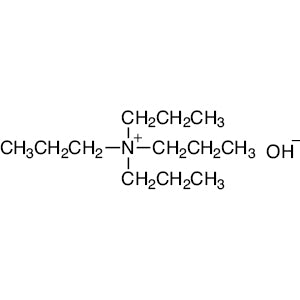
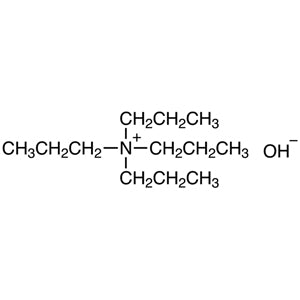
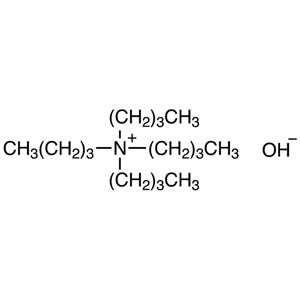
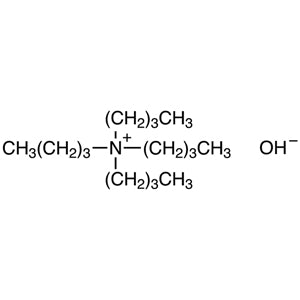
Tetrapropylammonium Hydroxide (10% in Water) from TCI is an aqueous solution of a quaternary ammonium base. It consists of the tetrapropylammonium cation paired with the hydroxide ion. It is a strong organic base that dissolves completely in water and contains no alkali metal ions. In the laboratory, it is best known as a structure-directing agent in zeolite synthesis. It is also used as a base in organic reactions and as an ion-pair reagent in analytical work, so it covers synthetic, materials, and analytical tasks.
Researchers mainly choose this reagent for the size and shape of the tetrapropylammonium cation. During hydrothermal crystallization, the cation fills the cavities and channels of the forming silicate framework and steers it toward specific topologies. The best-known are MFI-type structures such as ZSM-5, silicalite-1, and titanium silicalite TS-1. Because the solution is free of alkali metals, it gives cleaner synthesis gels without extra metal cations. The 10% aqueous form can also be measured by volume, which is easier than weighing a hygroscopic solid base.
In Indonesia, this solution is widely used in chemical engineering and inorganic chemistry laboratories that study catalysts for vegetable oil processing and biomass conversion. University research groups and institutional laboratories working on porous materials use it to prepare MFI-type zeolites and titanosilicates for catalytic testing. Synthetic and analytical chemistry laboratories also keep it on hand as an alkali-free organic base and as an ion-pair reagent, so one stock reagent can support several kinds of research.
TCI brochures (PDF)
- Quaternary Ammonium Salts 2025-11-10 · p. 2
- Colloidal Quantum Dot (QD) Research Reagents 2026-05-21 · p. 10
Related TCI products
- TCI T2589 77-98-5 Tetraethylammonium Hydroxide (35% in Water)
- TCI T1685 2052-49-5 Tetrabutylammonium Hydroxide (40% in Water)
- TCI T1565 4499-86-9 Tetrapropylammonium Hydroxide (ca. 40% in Water)
- TCI T1460 75-59-2 Tetramethylammonium Hydroxide (ca. 25% in Water)
- TCI T1020 4499-86-9 Tetrapropylammonium Hydroxide (20-25% in Water)
- TCI T0964 4499-86-9 Tetrapropylammonium Hydroxide (10% in Water)
- Zeolite synthesis as a structure-directing agent: the tetrapropylammonium cation fills the framework cavities and channels during hydrothermal crystallization, which directs the formation of MFI-type structures such as ZSM-5.
- Preparation of silicalite-1 and titanium silicalite TS-1: the alkali-free solution gives clean synthesis gels, which matters when making pure-silica or titanium-substituted frameworks for catalytic research.
- Catalyst research for vegetable oil processing and biomass conversion: Indonesian chemical engineering laboratories use it to make MFI-type porous catalysts that are then studied in these conversion processes.
- Strong organic base in synthetic reactions: it dissolves completely in water and contains no alkali metal ions, so it can deprotonate substrates without adding metal cations to the reaction mixture.
- Ion-pair reagent in chemical analysis: the quaternary ammonium cation can pair with anionic analytes, which makes the solution useful in analytical methods that rely on ion-pair formation.
| Brand | TCI (product code T0171) |
|---|---|
| CAS number | 4499-86-9 |
| Molecular formula | — |
| Purity | — |
| Category | Chemistry > Synthetic Reagents > Acids, Bases [Synthetic Reagents] |
| Pack sizes | as listed on the product page |
| Physical form | aqueous solution, 10% in water |
| Storage | keep tightly closed in a cool, well-ventilated place, away from acids |
Store Tetrapropylammonium Hydroxide (10% in Water) in its original, tightly closed container in a cool, dry, well-ventilated area. Keep it away from acids and incompatible materials. Because it is a strong base, keep the container sealed when not in use so it does not absorb atmospheric carbon dioxide, which can change the effective concentration over time. Use compatible chemical-resistant containers and avoid leaving the solution in open vessels. Handle it in a fume hood or well-ventilated area, and wear safety goggles, chemical-resistant gloves, and a lab coat. Avoid contact with skin and eyes. If contact occurs, rinse thoroughly with water. Always read the supplier's Safety Data Sheet before use and follow your institution's chemical hygiene and waste disposal procedures.
—
Produk Terkait
-
TetraethylammoniumHydroxide(35%inWater) TCI T2589
Regular price From Rp 822.150,00Regular priceRp 590.100,00Sale price From Rp 822.150,00 -
TetrabutylammoniumHydroxide(40%inWater) TCI T1685
Regular price From Rp 1.246.350,00Regular priceRp 887.250,00Sale price From Rp 1.246.350,00 -
TetrapropylammoniumHydroxide(ca.40%inWater) TCI T1565
Regular price From Rp 2.199.750,00Regular priceRp 1.554.000,00Sale price From Rp 2.199.750,00 -
TetramethylammoniumHydroxide(ca.25%inWater) TCI T1460
Regular price From Rp 557.550,00Regular priceRp 405.300,00Sale price From Rp 557.550,00 -
TetrapropylammoniumHydroxide(20-25%inWater) TCI T1020
Regular price From Rp 1.008.000,00Regular priceRp 720.300,00Sale price From Rp 1.008.000,00 -
TetrapropylammoniumHydroxide(10%inWater) TCI T0964
Regular price From Rp 769.650,00Regular priceRp 553.350,00Sale price From Rp 769.650,00 -
TetrabutylammoniumHydroxide(10%inWater) TCI T0955
Regular price From Rp 637.350,00Regular priceRp 460.950,00Sale price From Rp 637.350,00 -
TetrabutylammoniumHydroxide(10%inWater) TCI T0216
Regular price Rp 1.087.800,00Regular priceRp 775.950,00Sale price Rp 1.087.800,00