


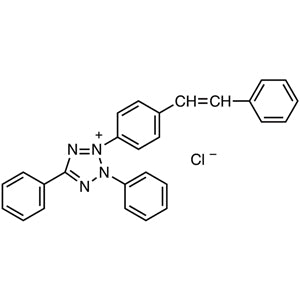
Tetrazolium Violet from TCI (product code T0174, CAS 1719-71-7) is a tetrazolium salt used as a redox indicator in biochemical, microbiological, and histochemical research. In its oxidised form the compound is almost colourless. When it accepts electrons from dehydrogenase enzyme systems or other reducing agents, its tetrazolium ring opens and it turns into an insoluble violet formazan. This colour change is why Tetrazolium Violet is used to show the metabolic activity of living cells, both visually and quantitatively.
Researchers choose Tetrazolium Violet because the reaction gives a clear colour signal that is easy to see, even without advanced instruments. The formazan settles at the site where the reaction happens, so the reagent is well suited to marking enzyme activity in tissue sections, microbial colonies, or electrophoresis gels. Its reduction depends on electron transport chain activity and on dehydrogenase enzymes, so the colour intensity reflects the level of metabolism. The compound is also used in some detection systems for superoxide radicals, which gives it value beyond simple viability staining.
In Indonesia, Tetrazolium Violet is useful for food microbiology, biotechnology, and medical laboratories. In these settings, staff often need a dependable way to tell metabolically active cells from inactive ones, or to find where an enzyme is active in a sample. Because the colour signal can be read by eye, the reagent works in both well-equipped research facilities and routine testing laboratories. It fits teaching, quality control, and research work where clear, reproducible results matter for daily decisions.
Related TCI products
- TCI B3581 1871-22-3 Blue Tetrazolium [for Biochemical Research]
- TCI B0325 38800-20-3 2,3-Diphenyl-5-(2-thienyl)tetrazolium Chloride
- TCI D0943 1871-22-3 Blue Tetrazolium
- TCI D0915 24387-36-8 2,5-Diphenyl-3-(4-styrylphenyl)tetrazolium Chloride
- TCI A5104 60662-33-1 Crystal Violet Nonahydrate [Ion association reagent for spectrophotometric analysis]
- TCI A5007 14936-97-1 Xylylazo Violet I [Spectrophotometric reagent for Mg]
- Microbial viability testing: live microorganisms reduce Tetrazolium Violet to violet formazan, so active colonies can be told apart from inactive ones by a visible colour change.
- Histochemical enzyme localisation: the insoluble formazan settles exactly where the reaction occurs, so it marks dehydrogenase activity accurately within tissue sections under the microscope.
- Electrophoresis gel zymography: after separation, enzyme bands can be stained in the gel, because the formazan stays in place and gives sharp, clearly visible bands.
- Cellular metabolic activity assessment: colour intensity follows electron transport chain and dehydrogenase activity, so the reagent supports visual or quantitative comparison of metabolic levels between samples.
- Superoxide radical detection systems: the compound's reduction by superoxide radicals lets it serve as the colour indicator in certain assay systems used to study oxidative processes.
| Brand | TCI (product code T0174) |
|---|---|
| CAS number | 1719-71-7 |
| Molecular formula | — |
| Purity | — |
| Category | Life Science > Biochemicals and Reagents > Enzymes, Enzyme Inhibitors, Enzyme Substrates |
| Pack sizes | Available in the TCI pack sizes shown on the product listing |
| Physical form | Solid; check the TCI certificate of analysis for specific details |
| Storage | Keep tightly closed, protected from light and moisture, as directed on the TCI label |
Store Tetrazolium Violet in its original, tightly sealed container in a cool, dry place away from direct light, because tetrazolium salts can be sensitive to light and moisture. Always follow the storage temperature on the TCI label and safety data sheet. Prepare working solutions fresh where possible, and keep them in amber or foil-wrapped containers. Wear gloves, a laboratory coat, and eye protection when handling the reagent. Avoid breathing in dust or letting it touch your skin, and weigh it in a well-ventilated area. Dispose of waste in line with local laboratory and environmental rules.
—
Produk Terkait
-
BlueTetrazolium[forBiochemicalResearch] TCI B3581
Regular price From Rp 1.246.350,00Regular price -
2,3-Diphenyl-5-(2-thienyl)tetrazoliumChloride TCI B0325
Regular price From Rp 1.696.800,00Regular price -
BlueTetrazolium TCI D0943
Regular price Rp 1.115.100,00Regular price -
2,5-Diphenyl-3-(4-styrylphenyl)tetrazoliumChloride TCI D0915
Regular price Rp 2.650.200,00Regular price -
CrystalVioletNonahydrate[Ionassociationreagentforspectrophotometricanalysis] TCI A5104
Regular price Rp 1.273.650,00Regular price -
XylylazoVioletI[SpectrophotometricreagentforMg] TCI A5007
Regular price From Rp 1.538.250,00Regular price -
XylylazoVioletII[SpectrophotometricreagentforMg] TCI A5006
Regular price From Rp 3.710.700,00Regular price -
PyrocatecholViolet TCI P0568
Regular price From Rp 664.650,00Regular price
![1871-22-3 Blue Tetrazolium [for Biochemical Research] - AMI Scientific](http://amiscientific.com/cdn/shop/files/TCI2510B3581_25792e25-dbc5-4e62-a711-c5f5176b1b02.jpg?v=1767433226&width=533)


![60662-33-1 Crystal Violet Nonahydrate [Ion association reagent for spectrophotometric analysis] - AMI Scientific](http://amiscientific.com/cdn/shop/files/TCI2510A5104.jpg?v=1767084855&width=533)
![14936-97-1 Xylylazo Violet I [Spectrophotometric reagent for Mg] - AMI Scientific](http://amiscientific.com/cdn/shop/files/TCI2510A5007.jpg?v=1769179450&width=533)
![523-67-1 Xylylazo Violet II [Spectrophotometric reagent for Mg] - AMI Scientific](http://amiscientific.com/cdn/shop/files/TCI2510A5006.jpg?v=1768358962&width=533)
