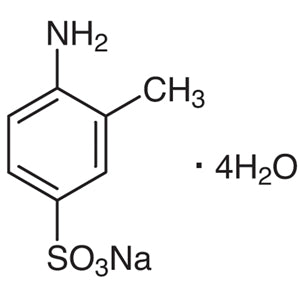
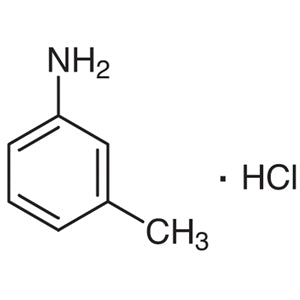
p-Toluidine Hydrochloride is the hydrochloride salt of p-toluidine, an aromatic amine with a methyl group at the para position of the benzene ring. Supplied by TCI under product code T0303, it is a non-heterocyclic building block and a convenient source of the 4-methylaniline unit in organic synthesis. Laboratories use it to prepare diazonium salts, azo dyes, amides, and a range of nitrogen-containing aromatic derivatives. These products serve as intermediates for the dye, pharmaceutical, and agrochemical industries.
The hydrochloride salt form has several advantages over the free amine. It is a solid that is generally more stable toward air oxidation, so it does not discolour as quickly as many free aromatic amines do. It is also easier to weigh accurately. Because the amine is already protonated, its solubility in water suits diazotisation reactions in aqueous acidic media. When a synthesis calls for the free amine, chemists can release it by adding a base and then extract it into an organic solvent for the next reaction step.
In Indonesia, p-Toluidine Hydrochloride is useful to organic chemistry laboratories at universities and to dye and textile research laboratories. Industrial development units working on aromatic intermediates also use it. University groups use it for teaching and research on diazotisation and azo coupling. Applied laboratories use it to explore colourants and nitrogen-containing aromatic compounds. Its solid salt form makes routine handling, accurate weighing, and stock management easier in teaching and research settings alike.
- Diazonium salt preparation: the protonated amine dissolves well in aqueous acid, which makes it a practical starting point for diazotisation of the 4-methylaniline unit under typical aqueous conditions.
- Azo dye synthesis: diazonium salts made from this compound couple with electron-rich aromatics to give azo colourants, which supports dye and textile research and teaching laboratories.
- Amide formation: once the free amine has been released with base, it reacts with acylating agents to give 4-methylanilide derivatives used as intermediates and model compounds.
- Synthesis of nitrogen-containing aromatic derivatives: as a non-heterocyclic building block, it introduces the 4-methylaniline group into larger molecules that serve as pharmaceutical and agrochemical intermediates.
- Teaching and demonstration of amine chemistry: the stable solid salt is easy to weigh and handle, so it suits student experiments on acid-base liberation of amines, extraction, and diazotisation.
| Brand | TCI (product code T0303) |
|---|---|
| CAS number | 540-23-8 |
| Molecular formula | — |
| Purity | — |
| Category | Chemistry > Building Blocks > Non-Heterocyclic Building Blocks |
| Pack sizes | see the available options listed on the product page |
| Physical form | solid (hydrochloride salt) |
| Storage | keep tightly closed in a cool, dry place, protected from light and air |
Store p-Toluidine Hydrochloride in its original, tightly sealed container in a cool, dry, well-ventilated area, away from direct light, moisture, and strong oxidising agents. Reseal the container promptly after each use to limit exposure to air and humidity. Handle the material in a fume hood or another well-ventilated area, and avoid creating or inhaling dust. Wear suitable gloves, safety glasses, and a laboratory coat, and avoid contact with skin and eyes. Keep it away from bases unless you intend to release the free amine. Always consult the supplier's Safety Data Sheet before use, and dispose of waste in line with local regulations and your institution's procedures.
—
Produk Terkait
-
N-(2-Aminoethyl)-N-ethyl-m-toluidine TCI A1284
Regular price Rp 4.001.550,00Regular priceRp 2.798.250,00Sale price Rp 4.001.550,00 -
o-Toluidine-4-sulfonicAcidSodiumSaltTetrahydrate TCI T0304
Regular price From Rp 505.050,00Regular priceRp 352.800,00Sale price From Rp 505.050,00 -
m-ToluidineHydrochloride TCI T0301
Regular price Rp 4.161.150,00Regular priceRp 2.909.550,00Sale price Rp 4.161.150,00 -
p-Toluidine TCI T0300
Regular price From Rp 769.650,00Regular priceRp 537.600,00Sale price From Rp 769.650,00 -
o-Toluidine TCI T0299
Regular price From Rp 505.050,00Regular priceRp 352.800,00Sale price From Rp 505.050,00 -
m-Toluidine TCI T0298
Regular price From Rp 505.050,00Regular priceRp 352.800,00Sale price From Rp 505.050,00 -
N-Methyl-p-toluidine TCI M1315
Regular price From Rp 2.174.550,00Regular priceRp 1.520.400,00Sale price From Rp 2.174.550,00 -
N-Methyl-m-toluidine TCI M0446
Regular price From Rp 1.353.450,00Regular priceRp 946.050,00Sale price From Rp 1.353.450,00