


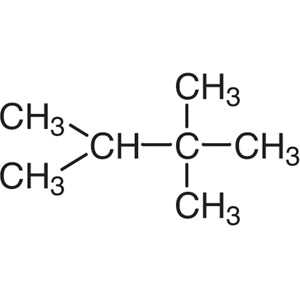
2,2,3-Trimethylbutane is a chemical compound widely used as a foundational building block in various laboratory reactions. It serves as a key intermediate in the synthesis of more complex organic molecules, offering a stable molecular structure that supports multiple chemical transformations. This compound is particularly valuable in organic chemistry research, where its simplicity and versatility make it an essential component for creating custom molecular structures. Its non-heterocyclic nature ensures compatibility with a wide range of synthetic methodologies, making it a reliable choice for both academic and industrial applications.
The properties of 2,2,3-Trimethylbutane make it a preferred choice in laboratory settings. As a non-polar hydrocarbon, it exhibits low reactivity under normal conditions, which enhances its stability during storage and use. Its ability to participate in substitution and addition reactions allows chemists to tailor its structure for specific applications. Additionally, its lack of functional groups simplifies its manipulation in chemical processes, enabling efficient modification into a variety of compounds. These characteristics make it a versatile and reliable reagent for organic synthesis and analytical chemistry.
In Indonesian laboratories, 2,2,3-Trimethylbutane is commonly used in research focused on organic chemistry and molecular synthesis. It is a staple in academic and industrial settings where the creation of complex carbon-based structures is required. Its non-toxic nature and ease of handling further contribute to its widespread use in both teaching and research environments. This compound supports a broad range of experimental procedures, making it an essential tool for chemists in Indonesia.
Related TCI products
- Organic synthesis applications benefit from 2,2,3-Trimethylbutane due to its stable structure and ability to undergo various chemical transformations.
- It is ideal for creating custom molecular structures in research settings where flexibility in chemical modification is required.
- In analytical chemistry, this compound serves as a reference standard for identifying and quantifying hydrocarbon compounds.
- Its non-polar nature makes it suitable for use in solvent systems where minimal reactivity is desired.
- It is frequently used in teaching laboratories to demonstrate basic principles of organic chemistry and molecular structure.
| Brand | TCI |
|---|---|
| CAS number | 464-06-2 |
| Molecular formula | — |
| Purity | — |
| Category | Chemistry > Building Blocks > Non-Heterocyclic Building Blocks |
| Pack sizes | Available in various quantities as per supplier specifications |
| Physical form | Liquid |
| Storage | Store in a cool, dry place away from direct sunlight |
2,2,3-Trimethylbutane should be stored in a cool, dry environment to maintain its stability and prevent degradation. It is recommended to keep it in a tightly sealed container to minimize exposure to air and moisture. Due to its non-polar nature, it is best stored in glass or polyethylene containers to avoid any chemical interactions. In laboratory settings, it should be handled with care to prevent spills and ensure proper ventilation. Regular monitoring of storage conditions is essential to maintain the compound’s integrity and ensure safe usage in all experimental procedures.
—
Produk Terkait
-
2,3-Dimethylbutane TCI D0690
Regular price From Rp 505.050,00Regular priceRp 352.800,00Sale price From Rp 505.050,00 -
2,2-Dimethylbutane TCI D0689
Regular price From Rp 2.254.350,00Regular priceRp 1.576.050,00Sale price From Rp 2.254.350,00 -
1-Bromo-2-ethylbutane(stabilizedwithCopperchip) TCI B1905
Regular price From Rp 1.035.300,00Regular priceRp 723.450,00Sale price From Rp 1.035.300,00 -
2-Bromo-2-methylbutane TCI B0612
Regular price Rp 3.180.450,00Regular priceRp 2.223.900,00Sale price Rp 3.180.450,00 -
1-Iodo-2-methylbutane(stabilizedwithCopperchip) TCI I0530
Regular price Rp 3.021.900,00Regular priceRp 2.112.600,00Sale price Rp 3.021.900,00 -
1-Bromo-3-methylbutane TCI I0504
Regular price From Rp 637.350,00Regular priceRp 445.200,00Sale price From Rp 637.350,00 -
1-Iodo-3-methylbutane(stabilizedwithNa2S2O3) TCI I0061
Regular price Rp 4.108.650,00Regular priceRp 2.872.800,00Sale price Rp 4.108.650,00 -
2,3-Dibromo-2,3-dimethylbutane TCI D1067
Regular price From Rp 1.565.550,00Regular priceRp 1.094.100,00Sale price From Rp 1.565.550,00


