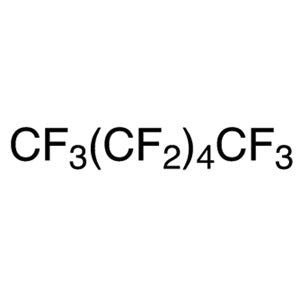
Tetradecafluoro-2-methylpentane (TCI T1012) is a fluorinated building block widely used in chemical laboratories for the synthesis of complex molecules. This compound plays a crucial role in organic chemistry by serving as a versatile intermediate in various reactions. Its unique molecular structure allows it to be incorporated into larger molecular frameworks, making it an essential tool for researchers aiming to develop new materials and compounds. Due to its stability and reactivity profile, it is particularly valuable in controlled synthesis environments where precision is key.
The compound's high chemical stability and non-polar nature make it a preferred choice for many synthetic applications. It exhibits minimal reactivity with other reagents, reducing the risk of unintended side reactions. This stability ensures that the compound maintains its integrity throughout the reaction process, contributing to the reliability of experimental outcomes. Additionally, its high boiling point allows it to remain in a liquid state under elevated temperatures, making it suitable for high-temperature applications without significant evaporation.
In Indonesian laboratories, Tetradecafluoro-2-methylpentane is commonly used in organic synthesis and material development. Its application is particularly relevant in academic and industrial research settings where the creation of new compounds with specific properties is required. Researchers in Indonesia rely on this compound to support their work in chemical innovation and scientific advancement.
TCI brochures (PDF)
- Fluorous Chemistry 2025-01-21 · p. 4
- Organic synthesis applications benefit from this compound's stability and reactivity control, enabling precise molecular construction.
- Material development projects utilize its non-polar properties to create compounds with desired chemical resistance and durability.
- Research in chemical innovation often incorporates this building block to explore new synthetic pathways and molecular structures.
- High-temperature processes leverage its high boiling point to maintain liquid state without excessive evaporation.
- Academic and industrial laboratories use it as a reliable reagent for consistent and reproducible experimental results.
| Brand | TCI |
|---|---|
| CAS number | 355-04-4 |
| Molecular formula | — |
| Purity | — |
| Category | Chemistry > Building Blocks > Fluorinated Building Blocks |
| Pack sizes | — |
| Physical form | Liquid |
| Storage | Store in a cool, dry place away from heat and direct sunlight. |
This compound should be stored in a cool, dry environment, away from heat and direct sunlight to maintain its stability. It is recommended to use sealed containers made of materials compatible with fluorinated compounds, such as glass or high-density polyethylene. Due to its chemical inertness, it does not react readily with most substances, but standard laboratory safety protocols should still be followed. Ensure proper ventilation when handling to avoid inhalation of vapors. Avoid contact with incompatible materials and follow standard chemical handling procedures to ensure safe usage in laboratory settings.
—
Produk Terkait
-
Tetradecafluorohexane TCI P0839
Regular price From Rp 3.367.350,00Regular priceRp 2.354.100,00Sale price From Rp 3.367.350,00 -
Heptadecafluoro-n-octylBromide TCI H0946
Regular price From Rp 980.700,00Regular priceRp 685.650,00Sale price From Rp 980.700,00 -
Octadecafluorooctane TCI O0268
Regular price Rp 1.326.150,00Regular priceRp 927.150,00Sale price Rp 1.326.150,00 -
Hexadecafluoroheptane(mixtureofisomers) TCI P0851
Regular price Rp 955.500,00Regular priceRp 667.800,00Sale price Rp 955.500,00 -
1H,1H-Undecafluoro-1-hexanol TCI U0074
Regular price Rp 3.207.750,00Regular priceRp 2.242.800,00Sale price Rp 3.207.750,00 -
Decafluorobenzophenone TCI D1631
Regular price From Rp 1.298.850,00Regular priceRp 924.000,00Sale price From Rp 1.298.850,00 -
1H,1H,7H-Dodecafluoro-1-heptanol TCI D1101
Regular price From Rp 1.167.600,00Regular priceRp 815.850,00Sale price From Rp 1.167.600,00 -
1H,1H,10H,10H-Hexadecafluoro-1,10-decanediol TCI H1233
Regular price From Rp 610.050,00Regular priceRp 426.300,00Sale price From Rp 610.050,00