Trifluoromethanesulfonyl Chloride from TCI, catalog code T1027, is commonly known as triflyl chloride (CF₃SO₂Cl). It is a highly reactive sulfonyl halide reagent that carries the trifluoromethanesulfonyl group. In the synthesis laboratory it serves two roles. First, it is used to install the triflyl group onto amines and other nucleophiles. Second, it acts as a source of the trifluoromethyl radical (CF₃•) in photoredox and radical reactions. It is also used in certain chlorination reactions, which makes it a versatile building block for fluorine chemistry.
The triflyl group is strongly electron-withdrawing, and this is the main reason chemists choose the reagent. That property makes triflamides acidic and stable, while triflate derivatives become excellent leaving groups. In modern radical chemistry, triflyl chloride readily releases SO₂ and generates the CF₃ radical. This gives chemists a practical way to introduce the trifluoromethyl group into aromatic compounds and alkenes. The trifluoromethyl group is very important in drug design and agrochemistry, so a dependable source of it has clear value in research programs.
In Indonesian laboratories, medicinal chemistry, organic synthesis and photoredox catalysis research groups can use this reagent to develop fluorinated compounds. The 5 g pack suits method testing and small-scale route scouting, while the 25 g pack suits groups that run reactions more regularly. Because the reagent is reactive, it is best used by trained staff who work with air- and moisture-sensitive materials and have suitable fume hood facilities.
TCI brochures (PDF)
- Sulfonylation Reagents 2023-01-20 · p. 2
- Halogenation Reagents 2026-04-03 · p. 5
- Condensing Agents 2025-11-18 · p. 8
- Protecting Agents 2025-03-25 · p. 11
Related TCI products
- TCI T3177 29540-81-6 1-(Trifluoromethanesulfonyl)imidazole
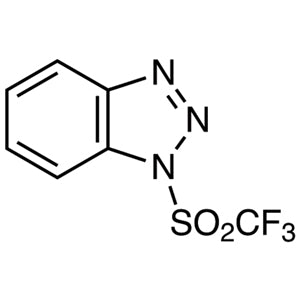
- TCI T3167 117632-84-5 1-(Trifluoromethanesulfonyl)-1H-benzotriazole
- TCI T3592 15458-53-4 Trifluoromethanesulfonyl Bromide
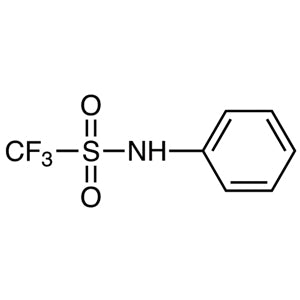
- TCI T2985 456-64-4 Trifluoromethanesulfonanilide
- TCI B1871 145100-50-1 N-(2-Pyridyl)bis(trifluoromethanesulfonimide) [Triflating Reagent]
- TCI T1100 358-23-6 Trifluoromethanesulfonic Anhydride
- Triflylation of amines: the reagent attaches the trifluoromethanesulfonyl group to amines, giving triflamides that are acidic and stable thanks to the strongly electron-withdrawing triflyl group.
- Trifluoromethylation of aromatic compounds: under radical conditions the reagent releases SO₂ and forms CF₃ radicals, offering a practical way to introduce a trifluoromethyl group onto aromatic rings.
- Photoredox catalysis research: as a source of CF₃• in photoredox reactions, it lets research groups study radical trifluoromethylation of alkenes and other substrates under light-driven conditions.
- Medicinal chemistry programs: the trifluoromethyl group is important in drug design, so this reagent helps chemists prepare fluorinated analogues of lead compounds for structure-activity studies.
- Selected chlorination reactions: its reactivity as a sulfonyl chloride allows it to be used in certain chlorination steps, giving synthetic chemists another option when planning a route.
| Brand | TCI |
|---|---|
| CAS number | 421-83-0 |
| Molecular formula | — |
| Purity | — |
| Category | Chemistry > Synthetic Reagents > Coupling [Synthetic Reagents] |
| Pack sizes | 5 g and 25 g |
| Physical form | — |
| Storage | keep tightly closed and protected from moisture; follow the storage guidance on the supplier label and safety data sheet |
- Catalog code: T1027
Store the reagent in its original tightly closed container, in a cool, dry and well-ventilated place away from moisture, since sulfonyl halides are generally sensitive to water. Follow the storage conditions printed on the label and in the safety data sheet. Keep it away from incompatible materials such as strong bases and nucleophiles. Handle it only inside a fume hood, wearing chemical-resistant gloves, safety goggles and a laboratory coat. Use dry glassware and, where the procedure requires, an inert atmosphere. Avoid inhaling vapors and avoid contact with skin and eyes. Dispose of waste according to institutional and local regulations, and read the safety data sheet before first use.
—
Product Categories
Produk Terkait
-
1-(Trifluoromethanesulfonyl)imidazole TCI T3177
Regular price From Rp 3.127.950,00Regular priceRp 2.202.900,00Sale price From Rp 3.127.950,00 -
1-(Trifluoromethanesulfonyl)-1H-benzotriazole TCI T3167
Regular price From Rp 1.670.550,00Regular priceRp 1.183.350,00Sale price From Rp 1.670.550,00 -
TrifluoromethanesulfonylBromide TCI T3592
Regular price From Rp 1.565.550,00Regular priceRp 1.094.100,00Sale price From Rp 1.565.550,00 -
Trifluoromethanesulfonanilide TCI T2985
Regular price From Rp 2.093.700,00Regular priceRp 1.479.450,00Sale price From Rp 2.093.700,00 -
N-(2-Pyridyl)bis(trifluoromethanesulfonimide)[TriflatingReagent] TCI B1871
Regular price Rp 5.141.850,00Regular priceRp 3.610.950,00Sale price Rp 5.141.850,00 -
TrifluoromethanesulfonicAnhydride TCI T1100
Regular price From Rp 1.670.550,00Regular priceRp 1.167.600,00Sale price From Rp 1.670.550,00 -
N-Phenylbis(trifluoromethanesulfonimide)[TriflatingReagent] TCI P1257
Regular price From Rp 1.908.900,00Regular priceRp 1.350.300,00Sale price From Rp 1.908.900,00 -
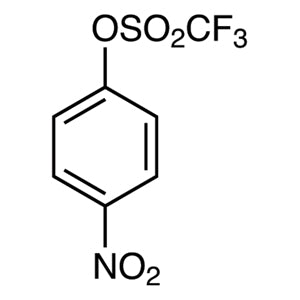
4-NitrophenylTrifluoromethanesulfonate TCI N0993
Regular price From Rp 557.550,00Regular priceRp 389.550,00Sale price From Rp 557.550,00