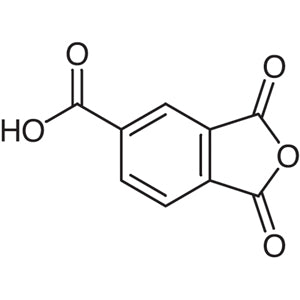
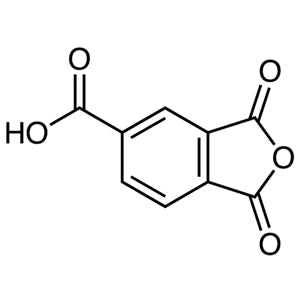
Trimellitic Anhydride Chloride (TCI T1079), with CAS number 1204-28-0, is a chemical compound widely used in scientific experiments, particularly in the fields of material science and polymer chemistry. It serves as a key raw material in the synthesis of polyimide compounds, which are known for their exceptional thermal and chemical resistance. In laboratory settings, this compound plays a crucial role in polymerization reactions and polymer modification processes, contributing to the development of advanced materials with superior performance characteristics.
One of the main reasons Trimellitic Anhydride Chloride is preferred is its complex chemical structure, which allows for highly specific chemical reactions. Its ability to react with various molecules makes it a versatile reagent in the creation of polymers with tailored properties. This flexibility is especially valuable in research that requires materials with high stability and mechanical strength. The compound’s chemical reactivity and compatibility with multiple substances further enhance its utility in diverse experimental applications.
In Indonesian laboratories, Trimellitic Anhydride Chloride is commonly used by researchers and educational institutions for material research and development. Its relevance spans across industrial chemistry, material technology, and applied research, where high-quality polymer raw materials are essential. The compound’s role in producing materials with enhanced durability and performance makes it an important component in the advancement of scientific and industrial applications in Indonesia.
TCI brochures (PDF)
- Raw Materials for Polyimide Synthesis 2026-05-11 · p. 3
Related TCI products
- TCI C0046 552-30-7 Trimellitic Anhydride
- TCI C0959 552-30-7 Trimellitic Anhydride
- TCI I0856 38103-06-9 4,4'-(4,4'-Isopropylidenediphenoxy)diphthalic Anhydride
- TCI T3871 632-79-1 Tetrabromophthalic Anhydride (purified by sublimation)
- TCI T2381 652-12-0 Tetrafluorophthalic Anhydride
- TCI B4629 36978-41-3 3,4'-Biphthalic Anhydride
- Polymer synthesis for high-performance materials due to its reactivity and compatibility with various monomers.
- Development of polyimide-based composites for applications requiring thermal and chemical resistance.
- Modification of existing polymer structures to enhance mechanical and thermal properties.
- Research in material science for creating advanced materials with tailored properties.
- Industrial applications in chemical manufacturing requiring stable and durable polymer compounds.
| Brand | TCI |
|---|---|
| CAS number | 1204-28-0 |
| Molecular formula | — |
| Purity | — |
| Category | Materials Science > Polymer/Macromolecule Reagents > Polyimide Raw Materials |
| Pack sizes | Available in standard laboratory quantities |
| Physical form | Solid powder |
| Storage | Store in a cool, dry place away from moisture and direct sunlight |
Trimellitic Anhydride Chloride should be stored in a cool, dry environment to maintain its chemical integrity. It is recommended to keep the compound in airtight containers to prevent exposure to moisture, which can affect its stability. Due to its chemical reactivity, it should be handled with appropriate personal protective equipment, including gloves and safety goggles. Proper ventilation is essential when working with this material to minimize inhalation risks. The compound should be stored away from incompatible substances such as strong bases or reducing agents. Regular inspection of storage conditions ensures the material remains suitable for use in laboratory applications.
—
Produk Terkait
-
TrimelliticAnhydride TCI C0046
Regular price From Rp 505.050,00Regular priceRp 352.800,00Sale price From Rp 505.050,00 -
TrimelliticAnhydride TCI C0959
Regular price From Rp 505.050,00Regular priceRp 352.800,00Sale price From Rp 505.050,00 -
4,4'-(4,4'-Isopropylidenediphenoxy)diphthalicAnhydride TCI I0856
Regular price From Rp 1.431.150,00Regular priceRp 1.016.400,00Sale price From Rp 1.431.150,00 -
TetrabromophthalicAnhydride(purifiedbysublimation) TCI T3871
Regular price Rp 2.625.000,00Regular priceRp 1.835.400,00Sale price Rp 2.625.000,00 -
TetrafluorophthalicAnhydride TCI T2381
Regular price From Rp 1.458.450,00Regular priceRp 1.019.550,00Sale price From Rp 1.458.450,00 -
3,4'-BiphthalicAnhydride TCI B4629
Regular price From Rp 2.411.850,00Regular priceRp 1.686.300,00Sale price From Rp 2.411.850,00 -
4,4'-BiphthalicAnhydride(purifiedbysublimation) TCI B4262
Regular price Rp 4.347.000,00Regular priceRp 3.039.750,00Sale price Rp 4.347.000,00 -
3-BromophthalicAnhydride TCI B4061
Regular price From Rp 1.246.350,00Regular priceRp 871.500,00Sale price From Rp 1.246.350,00